Companion Animal Care Articles used with permission from All-Creatures.org
Ed Boks investigates the question of whether the demand for dogs is truly greater than the number of dogs entering shelters in some parts of the U.S.
Are We Really “Running Out” of Shelter Dogs?
From Ed Boks, Animal Politics with Ed Boks, AnimalPolitics.substack.com
March 2026
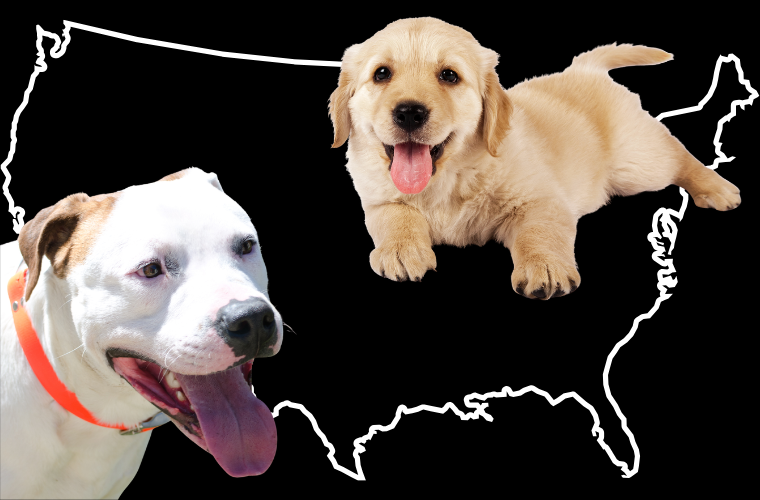
Images from Canva
History
For years, a familiar story has circulated in animal welfare circles: the South and parts of the West are awash in surplus dogs, while shelters in the Pacific Northwest, Northeast, and some Midwestern states “can’t get enough” companion animals to meet adopter demand.
Van-loads of puppies and small dogs, and increasingly, larger dogs with unknown or poorly documented histories, roll north on the interstate, accompanied by feel-good social media posts and fundraising appeals that frame these transports as the natural balancing of a supply-and-demand equation.
There is some truth in the underlying geography. Decades of aggressive spay/neuter, licensing, and leash law enforcement have dramatically reduced shelter intake and free-roaming dog populations in many northern tier states. At the same time, large swaths of the South still struggle with higher intake, lower sterilization rates, and more stray and abandoned animals.
What the Numbers Actually Show
Meanwhile, national data tell a more complicated story than the simple “shortage up north, surplus down south” slogan. Shelter Animals Count’s recent reports1 show that, overall, U.S. shelters remain under pressure from high intake and lagging outcomes, with most regions still struggling to keep live outcomes in step with the number of animals coming through the door.
In some Northern and upper Midwestern shelters, “local” intake really is low enough that kennels would sit empty or be filled largely with a narrow slice of harder-to-place dogs (for example, adolescent bully-breed mixes) without imported animals.
Over the past four decades, U.S. shelter intake has fallen dramatically, from an estimated 12–17 million animals annually in the 1970s to roughly 6–7 million today. That historic decline was driven largely by widespread investment in spay/neuter programs, public education, and changing norms around responsible pet ownership.
In other words, the system reduced intake by focusing on the source of overpopulation long before the shift to the modern transport economy.
From Prevention to Transport
Transports were meant to be a secondary tool on top of that foundation, not a substitute for it. Transfers can relieve local pressure points, but they have declined since the pandemic, in part because many destination shelters now face crowding of their own because spay/neuter and other prevention tools lost ground during the crisis and its aftermath.
Against that backdrop, the narrative of a broad, persistent “shortage” of adoptable animals in large parts of the northern states deserves scrutiny. Is there truly a lack of available companion animals for adoption in those regions, or has a more nuanced, data-limited reality been curated into a convenient justification for a national transport market?
This Week’s Question
“Is it true and verifiable that states, mostly in the Midwest and Northeast, are lacking a sufficient number of available companion animals for adoption?
“Many shelters and rescues in the southern states are sending animals up north, claiming there is a shortage. A check on the web comes up with various responses from AI, Google and Reddit, not all confirming the same info. I’d be curious to have factual information.” – A.W.
Animal Politics Response
The short answer is that there are pockets of relative scarcity for certain types of dogs in parts of the Northeast, the Pacific Northwest, and the upper Midwest, but there is no credible evidence of a broad, sustained ‘shortage’ of companion animals in those regions, and certainly not a national shortage. What we see instead is a regional mismatch, layered with marketing and policy choices that amplify transports while obscuring the lack of investment in prevention.
A few key points help untangle this:
1. Regional mismatch is real, but specific.
In many Southern and some Western communities, shelter intake per capita is still significantly higher than in much of New England, the Pacific Northwest, and parts of the upper Midwest, driven by lower sterilization rates, more free-roaming animals, and economic barriers to veterinary care.
In contrast, some Northeastern and Pacific Northwest shelters report that most local intake consists of a narrow set of profiles, often adult bully-type dogs, while there is strong adopter demand for puppies, small dogs, and “family-friendly” mixes. That mismatch creates a real incentive to import animals that better “fit the market,” even if local animals still sit in kennels.
2. National data show pressure everywhere, not empty kennels.
Shelter Animals Count’s recent mid-year and annual reports point to crowded conditions across much of the country: adoptions have softened slightly, non-live outcomes remain a concern in many regions, and the system is still absorbing post-pandemic surrenders and strays.
If there were a true, widespread shortage of animals in the northern tier states, we would expect to see consistently low intake and very high adoption-to-intake ratios across those regions; instead, the data show a patchwork of communities, some doing relatively well and others facing the same overcrowding headlines as the rest of the country.
To be clear, Shelter Animals Count’s database is voluntary and incomplete, and its national trends are modeled estimates rather than a full census of U.S. shelters, but even with those caveats, the direction of the data points to pressure, not empty kennels.
3. Transfers and transports are a tool, but their decline undercuts the “chronic shortage” story.
In a “healthy” system, modest numbers of animals move from high-intake to higher-demand areas to smooth local imbalances. However, Shelter Animals Count has documented a drop in dog transfers between organizations since 2019, with many shelters that once received transports now citing their own local crowding and resource constraints.
If Northern, Midwestern, and Pacific Northwest shelters truly suffered from a persistent shortage, we would expect them to be begging for more transports, not stepping back from them because they are too full of local animals.
4. The shortage narrative is highly curated, and market-driven.
Destination organizations are not usually importing “any dog”; they are selecting animals they know will move quickly: small breeds, puppies, and highly adoptable mixes. This curation makes transports look extraordinarily successful, dogs “fly off the shelves”. This feeds the claim that there is a desperate shortage locally, when in reality there may be plenty of large, black, senior, or behaviorally challenging dogs still waiting in nearby shelters.
It is entirely possible, and increasingly common, for a shelter to claim “we have more adopters than dogs” while simultaneously transferring in vanloads of marketable animals and euthanizing or warehousing harder-to-place local pets.
5. Data gaps and incentives make “verifiable shortage” a high bar.
To truly verify a regional shortage, we would need transparent, standardized reporting on local intake, outcomes, and transport flows by species, age, and type, across both sending and receiving organizations.
Instead, much of the transport system operates with fragmented data and limited oversight, making it difficult to track how many animals move where, what happens to them, and whether transports are addressing genuine gaps or simply feeding a curated retail pipeline.
Complicating matters further, most national data dashboards are now run by ASPCA- and Best Friends–affiliated projects, creating an inherent conflict of interest: the same organizations promoting transport-driven ‘life-saving’ also control which numbers are collected, how they are modeled, and what stories they tell.
Fundraising narratives, “no-kill” targets, and branding incentives all push toward describing a shortage, even when the actual numbers are more ambiguous.
So where does that leave your question?
- Yes, there are communities in the Northeast, Pacific Northwest, and upper Midwest where shelter intake is low enough, and adopter demand for certain types of dogs high enough, that transports from higher-intake regions can be justified as a rational way to match animals with homes.
- No, there is not strong, comprehensive evidence of a broad, persistent shortage of companion animals across those regions; in many states, shelters still see more animals entering than leaving alive, and crowding remains a concern.
- And importantly, the current transport model often functions less as a neutral balancing of supply and demand and more as a curated, market-driven system that allows national players to chase “no-kill” benchmarks and fundraising goals while leaving prevention, especially high-volume, accessible spay/neuter, chronically underfunded in the very communities producing the surplus.
Your instinct to ask whether the claimed shortages are “true and verifiable” is exactly right. Until shelters report intake, outcomes, and transport flows with real transparency, it is impossible to confirm whether these regional shortages are genuine or simply the result of selective narratives and incomplete data.
For now, the idea that large parts of the country are “running out of shelter dogs” should be treated less as an established fact than as a claim that must be tested against the numbers.
If you volunteer or work in a shelter in the Northeast, Pacific Northwest, or upper Midwest, I’d be especially interested in your on-the-ground experience: are you truly “short on dogs” overall, or short on certain types of dogs while others sit? Please feel free to share specifics in the comments: include your state, whether you’re urban or rural, and whether your shelter imports or exports animals.
[To leave a comment, please go to the original article.]
1 Note: Shelter Animals Count aggregates data from participating shelters and then uses an estimation model to describe national trends; coverage is uneven by state and tends to oversample higher-intake organizations, which means state-level “shortage” or “surplus” claims should always be interpreted with caution. Since 2025 SAC has operated as a program of the ASPCA rather than as an independent clearinghouse. Other national shelter data work is channeled through Shelter Pet Data Alliance, a Best Friends Animal Society initiative tied closely to its transport-driven life-saving agenda.
Posted on All-Creatures.org: March 12, 2026
Return to Companion Animal Care
Follow us on:


- Home Page
- What's New
- Contact Us
- Action Alerts
- Animal Exploitation
- Animal Issues
- Animal Rights Activism
- Archives
- Art & Photography
- Articles Directory
- Bible
- Bible Commentary Blog
- Books
- Campaigns
- Church & Religion
- Discussions
- Events / Podcasts / Media
- Health
- Hosted Web Sites
- Humor
- Kids' Korner
- Letters
- Links
- Nature Studies
- Newsletter
- Poetry & Stories
- Prayers
- Quotations
- Recipes with Photos
- Recipes Without Photos
- Sermons
- Stop Cruelty in Churches
- Video Library
- The Mary T. and Frank L. Hoffman Family Foundation
- Email: [email protected]
A web site sponsored by The Mary T. and Frank L. Hoffman Family Foundation and all-creatures.org
Copyright © 1998-2026 The Mary T. and Frank L. Hoffman Family Foundation. All rights reserved. May be copied only for personal use or by not-for-profit organizations to promote compassionate and responsible living. All copied and reprinted material must contain proper credits and web site link www.all-creatures.org.
Fair Use Notice: This document, and others on our web site, may contain copyrighted material whose use has not been specifically authorized by the copyright owners. We believe that this not-for-profit, educational use on the Web constitutes a fair use of the copyrighted material (as provided for in section 107 of the US Copyright Law). If you wish to use this copyrighted material for purposes of your own that go beyond fair use, you must obtain permission from the copyright owner.

Thank you for visiting all-creatures.org.