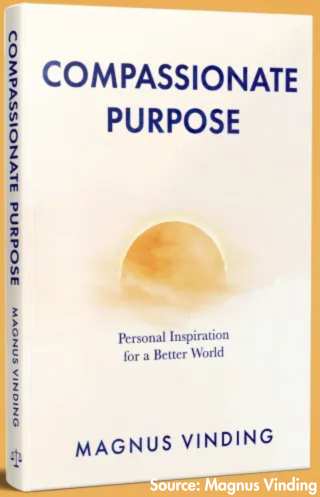
Compassionate Purpose: Personal Inspiration for a Better World
Available at
MagnusVinding.com and many online bookstores
Book Recommendations, Reviews and Author Interviews from All-Creatures.org
Compassionate Purpose: Personal Inspiration for a Better World By Magnus Vinding
Publisher: Independently Published by Magnus Vinding
Author interviewed by Marc Bekoff, Psychology Today
Marc Bekoff's Interview: The Importance of Compassionate Ethics
Magnus Vinding's book, Compassionate Purpose, offers inspirational solutions.
Key points
- Vinding's book explains how we can improve our personal lives to help others.
- His focus on impartial ethics offers a way to help build a more compassionate future for all sentient beings.
One would have to live in a cave not to know that the world we live in is deeply troubled, and that many humans and nonhumans are suffering in myriad ways. In The Animal Manifesto, I suggested six ways to expand our compassion footprint for nonhuman animals and ourselves. I revisited these ideas when I first learned of the co-founder of the Center for Reducing Suffering, Magnus Vinding's recent book Compassionate Purpose: Personal Inspiration for a Better World. In an email he sent me, he wrote, "The broad theme of the book is 'self-help meets impartial ethics'. In particular, the book seeks to provide evidence-based suggestions on how we might improve various aspects of our lives and outlooks to reduce suffering on behalf of sentient beings."
Of course, his note whetted my appetite for more, and now that I've read his work, I can see why it has received many accolades, including one from renowned philosopher Peter Singer that reads: "How are we to live in a world in which there is so much unnecessary suffering? Magnus Vinding looks unflinchingly at that question and gives an answer that is realistic and yet inspiring. Read this book. It may change your life."
As I read Vinding's book, I also thought of a recent book by Lybi Ma titled How to Be Less Miserable: End the Negative Mind Loops and Find Joy, and how her ideas about overcoming what she calls "negativity bias" also could have positive effects that expand beyond the person who is enduring deep misery and suffering. In an interview with Ma, she writes, "Emotions are contagious. We can all be more at peace with ourselves and rid the gloom inside our heads. If our emotions spread, they might as well be the emotions that give us peace."
Marc Bekoff: Why did you write Compassionate Purpose, and how did you pick the title?
Magnus Vinding: I wrote the book because I saw a gap in the existing literature: books on self-help rarely cover ethics, and books on ethics rarely say much about how to handle the personal challenges of helping others. That intersection of the ethical and the intimately personal seems neglected; this is especially true when it comes to the ethical purpose of reducing suffering.
Picking the title was a matter of capturing two key elements. Compassion is sympathy for suffering combined with a desire to alleviate it, and the book explores how we can live out compassion as a lasting commitment and purpose in life. “Compassionate purpose” very much captures the heart of the book.
MB: How does your book relate to your background and general areas of interest?
MV: I have been thinking and writing about how we can reduce suffering for a long time, such as in my earlier books Suffering-Focused Ethics and Reasoned Politics. I also co-founded the Center for Reducing Suffering in 2020. Given this background, I am very interested in how we can address the personal challenges of reducing suffering and to become more capable agents for compassionate change. We need to make compassion realistically livable, not just a fancy theory.
I have been wrestling with these questions in my personal life; the book also grew out of my own struggles in trying to ease and prevent suffering for sentient beings.
MB: Who do you hope to reach?
MV: I hope to reach people who care about reducing suffering and who want to contribute to this aim. I also want to reach people who struggle with the reality of suffering— people who may feel overwhelmed, discouraged, or unsure how to help—and who want to find healthier, more constructive ways to respond.
MB: What are some of the topics you consider, and what are some of your major messages?
MV: The book covers topics such as self-compassion, motivation, healthy habits, emotional resilience, relationships, hidden motives, and concrete actions we can take to reduce suffering. One major message is that compassion is not just a feeling, but something we can cultivate as a stable orientation in life. Another key point is that we can take suffering seriously without becoming overwhelmed by it. I try to show ways to do that, such as cultivating greater self-compassion and developing a realistic hope for compassionate impact.
I also make the case for a thoughtful and reflective approach combining compassion with reason and evidence to guide our actions. Relatedly, I argue that we often do better by focusing on learning and reflection rather than rushing into ill-considered action.
The book is ultimately about becoming wiser and more effective in our efforts to help.
MB: How does your work differ from other work on the same general topics?
MV: One thing that’s different in this book is the distinctly personal angle on reducing suffering: How can we address concrete everyday challenges such as guilt, empathic distress, and low motivation?
I also think the book contributes something new with its case for an inspiring and hopeful approach to reducing suffering. Adopting a compassionate purpose does not imply a grey and suffocating outlook. On the contrary, it has room for color, art, vitality, and warmth: all the uplifting parts of life that inspire us and keep us going.
MB: Are you hopeful that, as people learn more about the importance of being compassionate, they will incorporate it into their daily routines?
MV: I am hopeful that many will, and not just at the level of daily routines. I hope that more and more of us will strive to embody an effective compassion that helps bring relief to sentient beings. We have so many tools and opportunities available to us. Why not put them to good use?
References
In conversation with Magnus Vinding, co-founder of the Center for Reducing Suffering.
Interview originally published on PsychologyToday.com:
https://www.psychologytoday.com/us/blog/animal-emotions/202605/the-importance-of-compassionate-ethics
Posted to All-Creatures: June 2, 2026
Return to Book Recommendations
Read more at Book Directory
Follow us on:


- Home Page
- What's New
- Contact Us
- Action Alerts
- Animal Exploitation
- Animal Issues
- Animal Rights Activism
- Archives
- Art & Photography
- Articles Directory
- Bible
- Bible Commentary Blog
- Books
- Campaigns
- Church & Religion
- Discussions
- Events / Podcasts / Media
- Health
- Hosted Web Sites
- Humor
- Kids' Korner
- Letters
- Links
- Nature Studies
- Newsletter
- Poetry & Stories
- Prayers
- Quotations
- Recipes with Photos
- Recipes Without Photos
- Sermons
- Stop Cruelty in Churches
- Video Library
- The Mary T. and Frank L. Hoffman Family Foundation
- Email: [email protected]
A web site sponsored by The Mary T. and Frank L. Hoffman Family Foundation and all-creatures.org
Copyright © 1998-2026 The Mary T. and Frank L. Hoffman Family Foundation. All rights reserved. May be copied only for personal use or by not-for-profit organizations to promote compassionate and responsible living. All copied and reprinted material must contain proper credits and web site link www.all-creatures.org.
Fair Use Notice: This document, and others on our web site, may contain copyrighted material whose use has not been specifically authorized by the copyright owners. We believe that this not-for-profit, educational use on the Web constitutes a fair use of the copyrighted material (as provided for in section 107 of the US Copyright Law). If you wish to use this copyrighted material for purposes of your own that go beyond fair use, you must obtain permission from the copyright owner.
Thank you for visiting all-creatures.org.
Since 