Companion Animal Care Articles used with permission from All-Creatures.org
Marc Bekoff and Marlon H. Reis discuss animal friendships both within and between species, providing many remarkable and heartwarming examples. They suggest that the question is not if non-human animals make friends, but why they do.
Do Dogs and Other Animals Really Make Friends? They Do!
From Marc Bekoff, Ph.D., PsychologyToday.com
January 2026
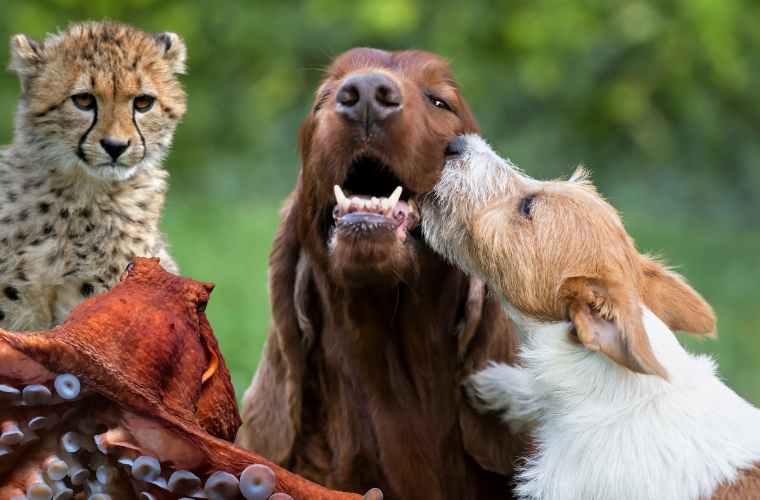
Images from Canva
Key points
- Research shows animals form enduring friendships with individuals of their own and other species.
- They clearly have the cognitive and emotional capacities to do so.
- The important question is why animals make friends, not if they do.
- While they don't write love letters, animals use pee-mail and other signals to form and sustain friendships.
While an increasingly small number of people, especially academic researchers, try to argue that nonhuman animals (animals) don’t really make friends, most people, including both researchers and non-researchers, know from simple observation and experience that a wide variety of animals do, indeed, make friends and form long-term friendships within and between species. Consider dog-human relationships and those with other companion animals. Dogs and cats also can become close friends and engage in rough-and-tumble play-fighting. Marc's friend Neal Henderson told him that one of his dogs, Skye, taught a visiting puppy, Simon, to respect his family's kitty.
No matter how one defines the words “friend” and “friendship,” ample research combined with common sense clearly shows that humans aren’t the only species capable and even desirous of making and keeping friends.1
While they may not write love letters or send texts or make phone calls, many animals use pee-mail—different odors or combinations thereof—and other subtle signals that are beyond our own capacity to see, hear, or smell, and these communiques serve to make friends and sustain relationships over long periods of time. When you consider their lifestyles and how they communicate with one another, they clearly express friendship and love in ways different from but no less valid than how we do.
A drive for close connection seems to underlie the development of friendships across many different species. It's safe to say it feels good to have close relationships based on feelings of trust and safety, and the knowledge that you can count on one another. Let’s see what science, stories, and common sense tell us about nonhuman friendships.2
When studying other animals, it's essential to focus on their cognitive, sensory, and emotional capacities—their cosmos. They may be different from those that form human-to-human or even between members of the same species, but our own experience teaches us that friendships form between individuals, so questions that apply to friendships among members of the same species are applicable to friendships that form among members of different species, often called “odd couples.” Let's focus on some of these surprising and unexpected relationships because same-species friendships abound and aren't all that surprising.
Odd couples: Friendships crisscross species lines
Deep friendships form among members of different species. These so-called unlikely relationships are often called “odd couples.” Researchers believe wholeheartedly in such bonds, with one such example being the friendships that form between dogs and dolphins. The choices animals make in cross-species relationships are the same as those they make in same-species relationships. Not unlike humans, animals are selective about the individuals they let into their lives. Even predators and prey can form relationships—the ultimate demonstration of trust. My dog Jethro rescued and then bonded with a bunny, an up-close-and-personal experience I'll never forget.
What’s love got to do with it? Consider a PBS documentary called Animal Odd Couples. In this documentary, we learn: "Love apparently knows no boundaries in the animal kingdom. A lion befriends a coyote. A goat guides a blind horse. A goose romances a tortoise, and so on."
At Florida’s Busch Gardens, Kasi, an orphaned cheetah cub, was paired with Mtani, a Labrador retriever puppy, to see if they would support one another. In an account of their behavior, we read, “Their initial comfort with one another was shaped by shared means of communicating, their use of similar signals and sounds.” They created their own language—not dog or cheetah, but a combination—Kasi-Mtani language. They seemed more than happy to become inseparable companions.
There are other compelling examples. Consider Anthony, a lion, and Riley, a coyote, living at Arizona’s Keepers of the Wild sanctuary. They were brought together when they were both a little more than a month old. Despite the difference in their relative sizes and that they would never be friends in the wild, these unlikely friends formed a close and gentle bond and have learned to greatly enjoy one another’s company.
There’s also a heartwarming story from Oklahoma’s Wild Heart Ranch, in which we see selfless caring and compassion. When elderly Charlie lost his eyesight, his friend, Jack, a goat, became Charlie’s eyes, guiding him and protecting him from harm until Charlie died. Jack got nothing out of helping Charlie except knowing he was helping Charlie along, and there were no reasons to claim that it didn’t make him feel good.
Making friends with an alien: Sy Mongomery meets an octopus named Octavia
Octavia wanted nothing to do with the humans gawking at her. A giant Pacific octopus, Octavia was like some sci-fi alien, an intelligent visitor from another planet. Like the fictional ET, she probably wished to return home to the rocky Pacific Ocean floor off British Columbia rather than be stuck in a temporary container at the New England Aquarium.
One of the people crowded around was naturalist and award-winning author Sy Montgomery. Sy hoped to reach across a vast evolutionary divide—the modern octopus had barely changed in 200 million years, while modern humans had been around a measly 300,000 years. And she did.
Sy very much wanted to befriend Octavia, but there was a bust. Octavia refused to interact, choosing instead to remain at the bottom of her container, as far from people as she could get. But Sy was undeterred. The third time Sy visited Octavia, the octopus changed her mind. After the container opened, Octavia rose to the top, and Sy recounts, “Her red skin signaled her excitement. I was excited too. She had my left arm up to the elbow encased in three of hers, and my right arm held firmly in another.” Despite Octavia’s tremendous strength, her beak, her venom, Sy says, “I felt no threat from Octavia. I felt only that she was curious.”
Minding animals: Feeling their feelings and they ours
Science shows the important question is why animals make friends, not if they do. Research also confirms that other animals have these cognitive and emotional capacities to do so as well. Acknowledging that they are minded beings and that we will learn a lot more about them (and us) than if we decide they can't or don't have very active and highly evolved minds.
By watching animals closely and allowing ourselves to feel the joy of greeting a friend or the thrill of making a new one, by acknowledging that, like us—they suffer the grief of losing loved ones—and by letting ourselves feel what other animals are likely feeling, only then might we realize the true folly of questioning whether animals make friends. Their feelings are contagious and often very much like our own.
Seeing our feelings reflected in other animals is an affirmation that we are not alone in the world, and that the self-same feelings that underlie human friendships crisscross species. Trying to divorce emotions and feelings from how we see animals ignores a wealth of scientific research. For far too long, we have assumed that humans are unique and animals don’t feel pain or emotions or make friends. It's high time to change our narrow speciesist ways.
References
This essay was written with Colorado's First Gentleman, Marlon H. Reis.
1) Marc asked 50 people to define “friend” and some common elements included: someone you like to spend time with, someone you trust, someone with whom you feel safe, someone you care about, someone you miss, someone you seek out, someone you’re more than happy to help, and someone you feel will help you when needed. When he asked if animals make friends, all but one of these people thought the question was “asinine,” and a few even commented, “You academics beat the hell out of everything and some try to make the word ‘friend’ only refer to humans to place us above or make us better and separate from other animals, which is absurd.” Many people on Facebook call people they’ve never met “friends.”
2) In addition to questions about supposed human exceptionalism, there also are close ties to classical ethology, namely, the importance of observation and careful analysis of topics including evolution, adaptation, causation, and the development of behavior. They also lend themselves to questions sentience—the ability to feel—that arise in the ever-growing field called cognitive ethology—the study of animal minds and how they work. Cognitive ethologists basically study what are called “subjective experiences”—what animals are thinking about and feeling—their cognitive and emotional lives and sentience.
So, for example, concerning friendships, we can ask, why did they evolve? What are they good for? How do they help individuals adapt to the wide variety of social situations in which they find themselves? And what causes them to form and develop? We can also ask why do individual differences emerge even among members of the same species (conspecifics), what do they think about these differences, and how do they make them feel?
About the Author
Marc Bekoff, Ph.D., is professor emeritus of ecology and evolutionary biology at the University of Colorado, Boulder.
Online: marcbekoff.com, X
Article originally published on PsychologyToday.com:
https://www.psychologytoday.com/us/blog/animal-emotions/202601/do-dogs-and-other-animals-really-make-friends-they-do
Posted on All-Creatures.org: January 22, 2026
Return to Companion Animal Care
Read more at Wildlife Articles
Follow us on:


- Home Page
- What's New
- Contact Us
- Action Alerts
- Animal Exploitation
- Animal Issues
- Animal Rights Activism
- Archives
- Art & Photography
- Articles Directory
- Bible
- Bible Commentary Blog
- Books
- Campaigns
- Church & Religion
- Discussions
- Events / Podcasts / Media
- Health
- Hosted Web Sites
- Humor
- Kids' Korner
- Letters
- Links
- Nature Studies
- Newsletter
- Poetry & Stories
- Prayers
- Quotations
- Recipes with Photos
- Recipes Without Photos
- Sermons
- Stop Cruelty in Churches
- Video Library
- The Mary T. and Frank L. Hoffman Family Foundation
- Email: [email protected]
A web site sponsored by The Mary T. and Frank L. Hoffman Family Foundation and all-creatures.org
Copyright © 1998-2026 The Mary T. and Frank L. Hoffman Family Foundation. All rights reserved. May be copied only for personal use or by not-for-profit organizations to promote compassionate and responsible living. All copied and reprinted material must contain proper credits and web site link www.all-creatures.org.
Fair Use Notice: This document, and others on our web site, may contain copyrighted material whose use has not been specifically authorized by the copyright owners. We believe that this not-for-profit, educational use on the Web constitutes a fair use of the copyrighted material (as provided for in section 107 of the US Copyright Law). If you wish to use this copyrighted material for purposes of your own that go beyond fair use, you must obtain permission from the copyright owner.

Thank you for visiting all-creatures.org.