Companion Animal Care Articles used with permission from All-Creatures.org
The National Link Coalition discusses workers who skirt the rules of human-only domestic violence shelters in order to protect companion animals and their families.
“Sneaky” Sheltering by “Moral Entrepreneurs” Sometimes Co-Houses Pets
From October 2026 LINK-Letter, The National Link Coalition
October 2026
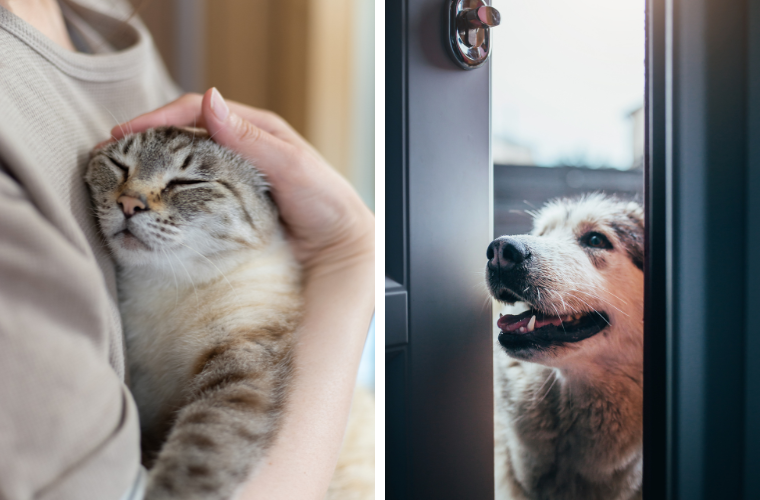
Images from Canva
While it is now widely recognized that fear for the welfare of their pets deters many survivors from leaving their abusers, co-sheltering of pets with their families is often hampered by such barriers as a lack of funds, space, or labor, and concerns related to the health and well-being of residents and staff. Meanwhile, recent research from Ontario, Canada, has reported that laws which allow survivors to include pets in protection orders may inadvertently result in survivors in those jurisdictions having less access to co-sheltering (See the July 2026 LINK-Letter) and that shelter staff may resist also accepting victims pets (See the August 2025 LINK-Letter).
A new study of shelter workers is revealing what Sarah May Lindsay and Abe Oudshoorn care calling “sneaky sheltering” – covert and overt co-sheltering. Despite the traditional human-centric model of shelters presenting a significant barrier for women who are unwilling to abandon their pets to flee abuse, “our findings demonstrate how a sample of Ontario shelter workers act as moral entrepreneurs, challenging and expanding the norms of their profession to accommodate multi-species families,” they write.
By identifying the exclusion of companion animals as a critical gap in service, these women, through both overt advocacy and covert actions, actively work to transform their facilities to include clients’ animals. “In doing so, they are not only upholding the original, woman-centered mission of IPV shelters but are also pioneering a new, more inclusive model of care that recognizes the profound bonds between humans and their nonhuman family members,” they add.
The differing legal statuses of companion, service and emotional support animals confound shelters’ ability to treat these animals on equal status. Despite the majority of shelters remaining human-only, the researchers identified “moral entrepreneurs” who conduct strategies ranging from secretive care of companion species to fully integrated shared-living scenarios. The study emphasizes that women are helping other women in shelters generally, and specifically, with pet co-sheltering.
The study also identifies an issue commonly described: survivors falsely claiming their pets are “emotional support animals” in an effort to obtain services for them, despite lacking medical documentation indicating a need for them.
The authors present several recommendations to address the lack of uniform co-sheltering in shelters to remove “gendered inequities as interwoven points of oppression that are life-threatening and life-altering, but not insurmountable.” These include:
- Establishing a collaborative co-sheltering collaborative advisory board whereby shelters that already accept pets can offer guidance to those that have not yet crossed this threshold;
- Creating co-care plans with pet foster and rescue organizations, developing protocols for how to assist, protect, care for, and rehome or reunite animals when survivors seek emergency shelter and relocation;
- Replacing “companion animal” and “emotional support animal” with the term “non-human family member”;
- Modifying the Canadian definition of homelessness to identify and include multispecies families;
- Establishing multispecies-specific sanctuaries for co-sheltering and a safe place of respite and recovery.
Lindsay, S. M., & Oudshoorn, A. (2026). Sneaky sheltering: Covert and overt co-sheltering of companion and emotional support animals in Ontario, Canada’s IPV shelters. Human-Animal Interactions, 0021. https://doi.org/10.1079 hai.2026.0021
Posted on All-Creatures.org: October 13, 2026
Return to Companion Animal Care
Follow us on:


- Home Page
- What's New
- Contact Us
- Action Alerts
- Animal Exploitation
- Animal Issues
- Animal Rights Activism
- Archives
- Art & Photography
- Articles Directory
- Bible
- Bible Commentary Blog
- Books
- Campaigns
- Church & Religion
- Discussions
- Events / Podcasts / Media
- Health
- Hosted Web Sites
- Humor
- Kids' Korner
- Letters
- Links
- Nature Studies
- Newsletter
- Poetry & Stories
- Prayers
- Quotations
- Recipes with Photos
- Recipes Without Photos
- Sermons
- Stop Cruelty in Churches
- Video Library
- The Mary T. and Frank L. Hoffman Family Foundation
- Email: [email protected]
A web site sponsored by The Mary T. and Frank L. Hoffman Family Foundation and all-creatures.org
Copyright © 1998-2026 The Mary T. and Frank L. Hoffman Family Foundation. All rights reserved. May be copied only for personal use or by not-for-profit organizations to promote compassionate and responsible living. All copied and reprinted material must contain proper credits and web site link www.all-creatures.org.
Fair Use Notice: This document, and others on our web site, may contain copyrighted material whose use has not been specifically authorized by the copyright owners. We believe that this not-for-profit, educational use on the Web constitutes a fair use of the copyrighted material (as provided for in section 107 of the US Copyright Law). If you wish to use this copyrighted material for purposes of your own that go beyond fair use, you must obtain permission from the copyright owner.

Thank you for visiting all-creatures.org.