Clothing/Cosmetics and Animal Abuse Article from All-Creatures.org
Fashion Ethics Must Respect Humans, Nonhumans, and the Planet
From
Marc Bekoff
May 2024
Emma Håkansson shows why a holistic view of who and what we wear raises serious ethical questions about social justice, freedom, human and nonhuman well-being, and sustainability. Collective Fashion Justice was formed because the fashion industry is far from operating within a framework that respects and prioritises life over profit—despite both the environmental and long-term economic sustainability of the industry demanding it (there’s no other planet for us to make money on should we destroy this one). .
KEY POINTS
Collective Fashion Justice prioritizes life and
wellbeing for all—humans, nonhumans, and the planet.
It differs from other organizations by taking a holistic approach
and by being pragmatically utopian.
Terms like "ethical fashion", "fair fashion", "vegan fashion", and
"sustainable fashion" are widely misused.
The current definition of ‘sustainability’ in fashion is sterile and
lifeless.
I've long been interested in the clothes we choose to wear—who and
what we don—to express our individuality or to look fashionable.(1)
I thought I had a pretty good view of the totality of the
all-encompassing fashion industry until I discovered Collective
Fashion Justice, when I came to realize that my and others' views
only reflected the tip of the "fashion iceberg." I immediately
reached out to Emma Håkansson, founder director of Collective
Fashion Justice, and I'm thrilled she agreed to answer a few
questions about her organization—a total ethics and comprehensive
fashion system "which prioritises life and wellbeing for all."(2)
Marc Bekoff: Why did you found Collective Fashion Justice?
Emma Håkansson: Collective Fashion Justice was formed because the
fashion industry is far from operating within a framework that
respects and prioritises life over profit—despite both the
environmental and long-term economic sustainability of the industry
demanding it (there’s no other planet for us to make money on should
we destroy this one).
Specifically, the charity exists because the current definition of ‘sustainability’ in fashion is sterile and lifeless. It considers greenhouse gas emissions, chemistry, water use and other important factors, but fails to acknowledge that the environment we work to protect is made up of biodiverse and sentient life—both human and other than human. The fashion industry remains unable to truly grapple with the idea that for it to be sustainable it must not only operate within planetary boundaries, but moral boundaries, where sentient life is not exploited and taken for profit.
As humans, we are one of many phenomenal animal species, and all of us animals don’t just live in nature, we are a part of it. Our work exists to look at sustainability through this more holistic and accurate lens, towards policy change that respects and protects life.
EH: I began my relationship with fashion as a model, and as I learned more about the harm the industry causes, I became increasingly uncomfortable using my face and body to sell it. Fur, leather, clothing made through modern slavery, through environmental destruction.
As I moved into consulting to transform the industry and into the NGO space, I found that social justice movements working to change the industry often operated singularly. I worked for an animal protection organisation that wanted only to address the ethical crisis of wool but not its methane emissions, and equally in an environmental space that did not care to acknowledge the moral bankruptcy of a wool industry profiting from a cycle of breeding, exploitation and ultimate slaughter.
My dedication to ensure autonomy for all comes from being a survivor of child sexual abuse. That lived experience allowed me to see how autonomy is stripped from so many of us—animals viewed as mere commodities, humans treated like machines made to work in poverty for a business with a billionaire CEO. I feel strongly that if we all considered what it means to value autonomy, freedom and life over profit and greed consistently, this would be revolutionary.
MB: Who do you hope to reach in your interesting and important work?
EH: Our work is split across a few key audiences. The general public, who we hope to see recognise themselves as active citizens capable of change-making, not only as consumers. Fashion industry members, who we work with to transform the industry, its policies and sourcing strategies. Academics, as we contribute to a world of thought and knowledge on how ethics and the environment relate to fashion. And finally, policy-makers at a government level, who can influence the industry when it does not act fast enough alone.
MB: What are some of the major topics you consider?
EH: Because we are clear on the need to consistently consider people, our fellow animals and the planet alike, our key campaigns focus on shifting the fashion industry beyond the use of animal-derived materials. It is in these supply chains where all three are harmed, and so all three can benefit from this progress.
We have reports on how the leather supply chain impacts all three groups (though they are interconnected and one), as well as how we can justly transition towards more responsible materials. We campaign to move fashion beyond the false notion that killing wild animals for their fur, skins and feathers could be a form of ‘conservation’—given commodifying and killing these animals inherently devalues their lives, and the goal of conservation demands the opposite. We look at how fashion is taught to students, transforming this so that sustainability and ethics are at the core of this learning, so the next generation can design more justly.
MB: How does your organization and work differ from others that are concerned with some of the same general topics and how has it been received?
EH: We differ from other organisations in the space by taking a holistic approach and by being pragmatically utopian—two things I think are essential to change making.
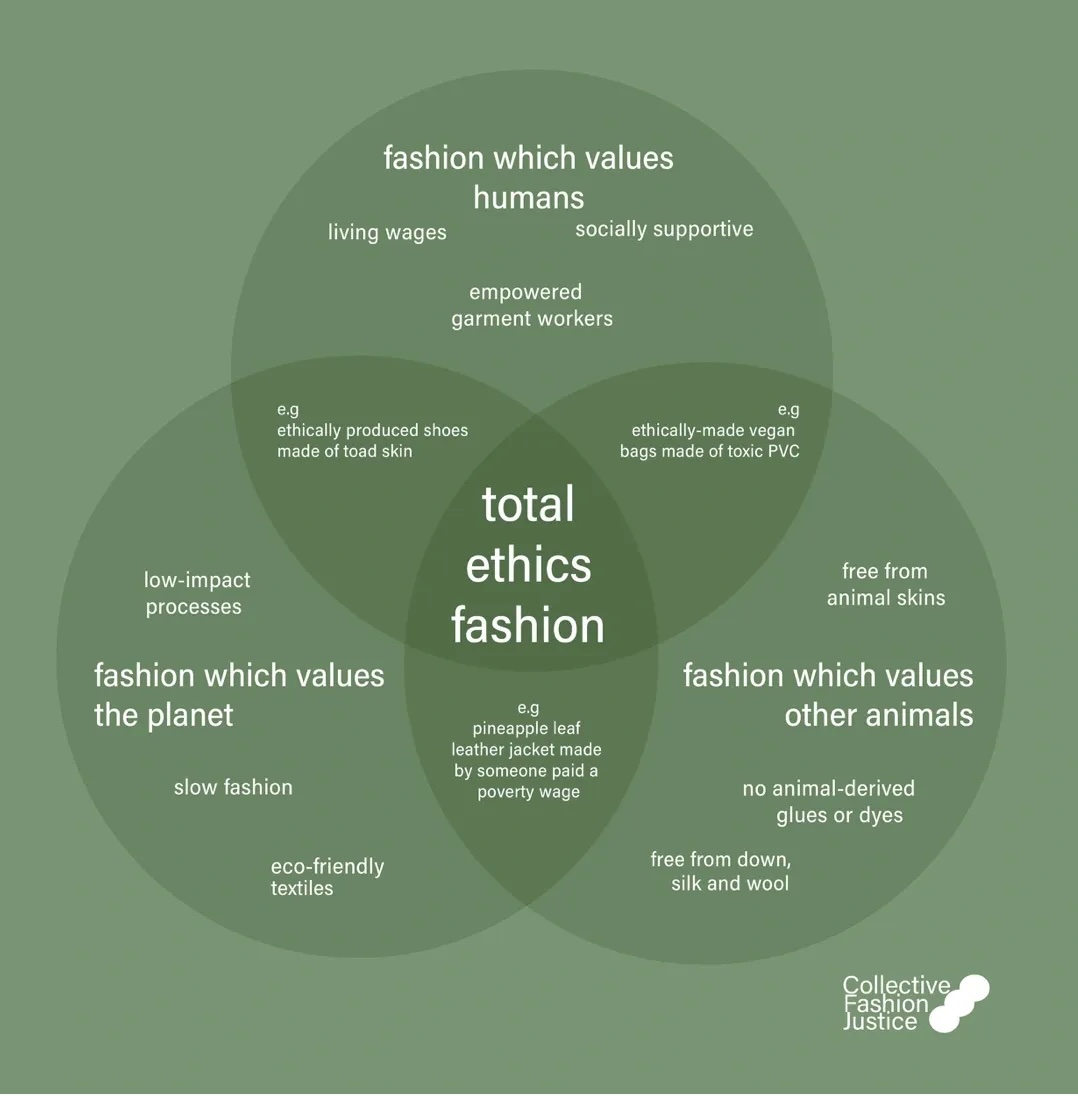
I coined the term ‘total ethics fashion’ to highlight the need for fashion to consider people, our fellow animals and the planet ahead of profit at all times. This was required because ‘sustainable fashion’ is so often viewed only as relating to fashion’s emissions, deforestation, waste and other environmental factors, ‘ethical fashion’ often considered only about human rights, and ‘vegan fashion’ viewed as a fringe notion to protect animals.
Realistically, we can protect some but not all of us. We can’t expect a leather supply chain to shift beyond its modern slavery practices or deforestation when both of these are rooted in a lack of care for life, and the animal-derived leather supply chain necessitates killing and skinning of sentient beings — an undeniable lack of care for life. We cannot focus on symptoms without addressing the source of fashion’s oppressive destruction.
Many organisations work through a welfarist view, seeking to minimise suffering without being willing to imagine, work towards and name the need for a fashion system which moves totally beyond inflicting it. They aim for improvements to systems that are fundamentally inefficient and harmful.
We work with the industry to take pragmatic steps towards our ultimate goal of total ethics fashion. For us, that means a gradual phase out of animal-derived, fossil fuel-based and native deforestation-driven materials, payment of living wages to all, and an industry slowed to align with planetary boundaries.
MB: Are you hopeful that as people learn more about total ethics fashion they will change how they dress?
EH: Absolutely. Over the last couple centuries we have seen whale skins no longer used for Hermes bags, Amazonian hummingbirds no longer deemed acceptable to stuff as earrings, dog skin gloves outright banned and the European fur industry massively shrink in size. We have a long way to go, but this historical context gives me hope for where we will be in coming decades. But we need to act far faster than we are now.
References
In conversation with Emma Håkansson, founding director of Collective Fashion Justice and author of Total Ethics fashion.
1) Hats: The Deadly History of Who We Put on Our Heads; The Brave Women Who Saved Birds from "Murderous Millinery".
2) "The term ‘total ethics fashion’ exists to express intersections and collectivity where other concepts and terms related to responsible production, consumption and relationships with fashion have not. It exists to demand an all-encompassing and holistic view of this responsibility, and of care. To counter the increasing narrowness of terms like ‘ethical fashion’, ‘fair fashion’, ‘vegan fashion’, ‘sustainable fashion’, ‘cruelty-free fashion’ and ‘eco-friendly fashion’, which have been overused and misused to such a degree the meaning is twisted, contorted and eventually lost."
Under their skin: A report series on the injustices of leather production; Cruelty is Out of Fashion: An overview of the fashion industry’s policies on wild animal products, from Collective Fashion Justice and World Animal Protection; Shear Destruction: Wool, Fashion and the Biodiversity Crisis.
Posted on All-Creatures.org: May 29, 2024
Return to Clothing/Cosmetics Abuses Articles
Follow us on:


- Home Page
- What's New
- Contact Us
- Action Alerts
- Animal Exploitation
- Animal Issues
- Animal Rights Activism
- Archives
- Art & Photography
- Articles Directory
- Bible
- Bible Commentary Blog
- Books
- Campaigns
- Church & Religion
- Discussions
- Events / Podcasts / Media
- Health
- Hosted Web Sites
- Humor
- Kids' Korner
- Letters
- Links
- Nature Studies
- Newsletter
- Poetry & Stories
- Prayers
- Quotations
- Recipes with Photos
- Recipes Without Photos
- Sermons
- Stop Cruelty in Churches
- Video Library
- The Mary T. and Frank L. Hoffman Family Foundation
- Email: [email protected]
A web site sponsored by The Mary T. and Frank L. Hoffman Family Foundation and all-creatures.org
Copyright © 1998-2026 The Mary T. and Frank L. Hoffman Family Foundation. All rights reserved. May be copied only for personal use or by not-for-profit organizations to promote compassionate and responsible living. All copied and reprinted material must contain proper credits and web site link www.all-creatures.org.
Fair Use Notice: This document, and others on our web site, may contain copyrighted material whose use has not been specifically authorized by the copyright owners. We believe that this not-for-profit, educational use on the Web constitutes a fair use of the copyrighted material (as provided for in section 107 of the US Copyright Law). If you wish to use this copyrighted material for purposes of your own that go beyond fair use, you must obtain permission from the copyright owner.
Thank you for visiting all-creatures.org.
