An Egg Production Article used with permission from All-Creatures.org
Ed Boks discusses the problems with sending newborn chicks through the U.S. Postal Service, which time and time again has led to tragedy and extreme suffering for these creatures.
Mail-Order Massacre: Thousands of Chicks Die in U.S. Postal Truck
From Ed Boks, Animal Politics with Ed Boks, AnimalPolitics.substack.com
June 2025
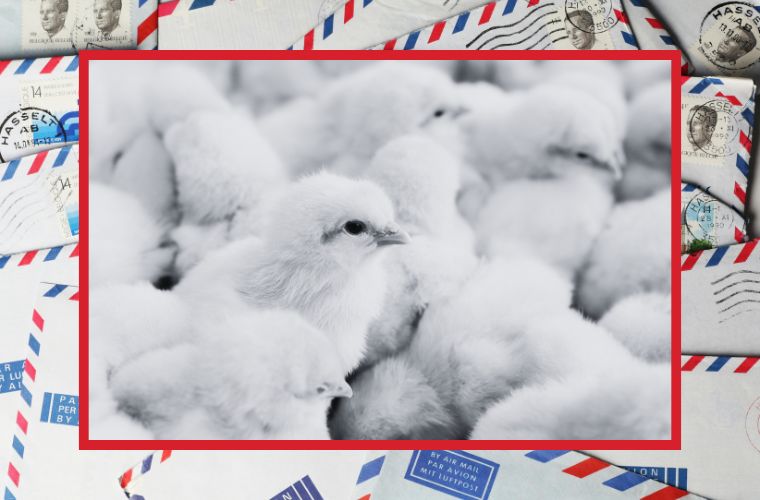
Images from Canva
On a warm morning in late May, postal workers at a Delaware distribution center opened the doors of a parked U.S. Postal Service truck—and uncovered a scene of mass death. Nearly 12,000 day-old chicks, shipped from a Pennsylvania hatchery and destined for farms across the country, had been abandoned in the sweltering vehicle for three days. By the time state officials arrived, 4,000 chicks were already dead. The rest, barely clinging to life, were dehydrated, trampled, and gasping.
The sight was grotesque. But it was not unprecedented.
The Hidden Cruelty of Mail-Order Poultry
For over a century, the U.S. Postal Service has quietly shipped millions of live chicks each year. The industry justifies this on a biological technicality: newly hatched chicks can survive for up to 72 hours without food or water. That window—nature’s brief allowance for post-hatch survival—has been turned into a shipping loophole. It’s a system that prioritizes efficiency and profit over life, treating animals as if they were dry goods.
This latest tragedy is not an anomaly. In 2020, nearly 5,000 chicks perished in Maine due to postal delays. Two years later, 4,000 more died on a sunbaked Miami runway. These incidents are not isolated—they’re systemic.
Every year, untold thousands of chicks die silently in transit. Their suffering is invisible, their deaths unrecorded, their value calculated only in economic terms.
System Failure—By Design
The Delaware shipment originated at Freedom Ranger Hatchery in Pennsylvania. The chicks were headed to farms as far as Texas and Washington. Somewhere en route, the system broke down—again. The truck was never unloaded. The hatchery received no updates. No emergency protocol was triggered. The birds were left to die.
By the time shelter workers from the First State Animal Center and SPCA were alerted, the damage was done. Thousands of survivors poured into the shelter, which lacked the infrastructure or staff to handle a crisis of this magnitude.
Workers scrambled to save what they could, providing heat, water, and food around the clock. Yet days later, most of the chicks remained unadopted. Many would eventually be euthanized—first abandoned by a system built for failure, then by a society ill-equipped to respond.
No Rules, No Rescue
According to the USPS, chicks can be shipped safely if properly packaged and delivered within 72 hours. But that claim rests on faith, not oversight. Federal regulations are toothless. There are no climate-control standards, no required contingency plans, no real-time tracking mandates, and no accountability when animals die.
The commodification of chicks extends beyond logistics. Hatcheries routinely use male chicks—deemed economically useless for egg production—as “warmers,” packing them around female chicks to buffer against cold. These males are considered disposable. Many are dead on arrival. Others are euthanized or discarded at their destination.
The entire pipeline—from hatchery to mailbox—is cloaked in normalization. We treat this cruelty as the cost of doing business.
The Human Cost
Lost shipments don’t just kill animals—they also threaten the livelihoods of small farmers who depend on timely deliveries. A delayed shipment of 200 chicks can mean the collapse of a season’s production cycle. For homesteaders and rural families living on tight margins, the loss is both economic and emotional.
They, too, are casualties of an indifferent system.
Time for a Reckoning
Enough is enough. This tragedy must not be buried in the next news cycle.
The United States needs immediate reform. Federal regulators must mandate climate control in all live-animal shipments, require real-time tracking with emergency alerts, and hold USPS and hatcheries financially and legally accountable when animals suffer or die.
But deeper change is needed. We must ask a more uncomfortable question: Should we be shipping live animals through the mail at all?
The answer reveals itself in the silence of that truck, in the panicked peeping that faded to nothing, in the piles of feathered bodies that greeted rescuers far too late.
A Moral Imperative
A locked truck filled with dying animals is not an accident—it is the inevitable byproduct of a system designed to cut costs, not preserve life. That is a stain on our national conscience.
It is time for lawmakers, regulators, and the agricultural industry to face this truth. Transparency is not enough. Accountability is not enough. The only acceptable response is meaningful reform—and, ultimately, the end of live-animal mail shipping as we know it.
Until then, the chicks will keep dying, and we’ll keep pretending we don’t hear them.
What You Can Do
If this story moves you, take action. Contact your members of Congress and demand oversight of live animal shipping. Urge the USPS to adopt humane protocols—or end the practice altogether. Support legislation that strengthens protections for animals in transit. Donate to shelters that shoulder the fallout of these systemic failures. And reconsider supporting hatcheries that profit from this cruel supply chain. Change begins when outrage becomes action.
Posted on All-Creatures.org: June 3, 2025
Return to Egg Production Articles
Read more at Meat and Dairy Industries
Follow us on:


- Home Page
- What's New
- Contact Us
- Action Alerts
- Animal Exploitation
- Animal Issues
- Animal Rights Activism
- Archives
- Art & Photography
- Articles Directory
- Bible
- Bible Commentary Blog
- Books
- Campaigns
- Church & Religion
- Discussions
- Events / Podcasts / Media
- Health
- Hosted Web Sites
- Humor
- Kids' Korner
- Letters
- Links
- Nature Studies
- Newsletter
- Poetry & Stories
- Prayers
- Quotations
- Recipes with Photos
- Recipes Without Photos
- Sermons
- Stop Cruelty in Churches
- Video Library
- The Mary T. and Frank L. Hoffman Family Foundation
- Email: [email protected]
A web site sponsored by The Mary T. and Frank L. Hoffman Family Foundation and all-creatures.org
Copyright © 1998-2026 The Mary T. and Frank L. Hoffman Family Foundation. All rights reserved. May be copied only for personal use or by not-for-profit organizations to promote compassionate and responsible living. All copied and reprinted material must contain proper credits and web site link www.all-creatures.org.
Fair Use Notice: This document, and others on our web site, may contain copyrighted material whose use has not been specifically authorized by the copyright owners. We believe that this not-for-profit, educational use on the Web constitutes a fair use of the copyrighted material (as provided for in section 107 of the US Copyright Law). If you wish to use this copyrighted material for purposes of your own that go beyond fair use, you must obtain permission from the copyright owner.
Thank you for visiting all-creatures.org.
