An Environmental Article used with permission from All-Creatures.org
Virginia Bell discusses Michael Grunwald's new book, We Are Eating the Earth, which explores the profound environmental impact of animal farming as well as a path forward to a more sustainable future.
“We Are Eating the Earth” By Michael Grunwald
From Virginia Bell
September 2025
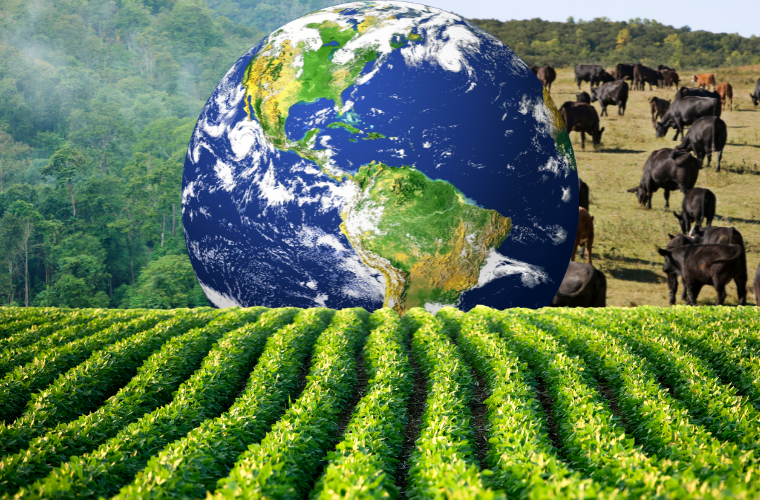
Images from Canva
Michael Grunwald is a distinguished American journalist and author. He writes for Politico Magazine, and has in the past written for The Boston Globe, The Washington Post and Time.
His 2 previous books - The Swamp: The Everglades, Florida and the Politics of Paradise (published 2006), and The New New Deal: The Hidden Story of Change in the Obama Era (published 2012) - were widely acclaimed.
His latest book, We Are Eating the Earth, published 2025, is timely and relevant. It has been five years in the making, so he has researched his topic thoroughly.
In an interview about his book, Grunwald explains how he had been a green campaigner who ate meat. One day he thought he’d check if meat really was so bad for the planet. The answer made him realise that he had been spectacularly ignorant about the matter, and if he had been, others must be too, so he decided to write a book informing people about how agriculture, and especially animal agriculture, was killing the planet.
He found that meat turned out to be the leading driver of deforestation, of water pollution, of water shortages and of biodiversity loss.
You will have some idea of why agriculture has such an influence on planetary health when you realise that cities and suburbs take up 1% of our land, whereas farming takes up almost 40%. We humans have taken over the planet to the extent that of all the mammals on Earth, 60% are livestock, 36% are humans, and only 4% are wild mammals (Our World in Data).
Environmentalists and religious and political leaders have tended to stay clear of the thorny issue of agriculture, and especially animal agriculture, preferring to concentrate on fossil fuels and energy. Michael Grunwald makes it clear in the interview that the real climate and environmental problem is the loss of forests to agriculture. This goes a long way to back up the research by Gerard Wedderburn-Bisshop earlier in 2025, who described how the loss of land and trees to animal agriculture was a greater threat to the environment and a greater cause of climate change than even fossil fuels and energy use.
Grunwald puts it like this: “And from a climate perspective, trying to decarbonise the planet while you’re tearing down forests for agriculture, it’s like trying to clean up your house while you’re smashing the vacuum cleaner to bits in the living room. You’re making this huge mess, because you’re losing all the carbon in the forest. But you’re also crippling your ability to clean up the mess, because that’s what forests do.”
Some people believe Big Meat’s claim that grass fed beef is sustainable. But the opposite is true. Grunwald points out that extensive animal farming is not the answer. It uses less chemicals and treats animals better, he says, but it is even less efficient than factory farms.
“What really matters from a climate and environmental perspective, is what you’re eating and how efficiently it’s grown.” He continues “And grass-fed beef - for one thing, it’s beef. So it’s already a huge climate and land problem. But it’s actually worse than factory farmed beef”. However polluting and inefficient factory farming is, it is more efficient and less polluting than extensive grass-fed farming, because grass-fed takes more land, and because the cows take longer to reach slaughter weight and so produce more emissions, more pollution and more waste of resources.
Although not yet a vegan, Grunwald admits that “Veganism is the best diet”.
Grunwald points out that cattle are “spectacularly inefficient converters of their feed into our food.” This is true of chickens, pigs and all meat and dairy products.
Grunwald says that the real environmental disaster is not the intensification of farming; it is the transformation of nature into animal farms. It is land change. “That’s when we lost biodiversity. That’s when we lost the carbon.” (He’s referring to carbon being released when we cut down trees.)
Much of his book is about exploring potential solutions to this problem and talking to those working on them.
I think the answer is simple, if not easy. The answer is organic arable farming. Grunwald is aware that farmers need help to end the unsustainable, messy and polluting farming that is common practice, and he is optimistic that governments can help farmers change.
Governments can help end animal agriculture by ending all grants, subsidies etc which are now being given to meat, dairy, fish and eggs, and transferring them to plant-based agriculture. Consumers can help end animal agriculture by not eating animal products. We will then be able to feed the world, drastically reduce emissions, pollution and waste of resources, and have enough land left over to give back to nature, through rewilding and planting trees, to ensure a planet fit to live in.
Michael Grunwald - "We Are Eating the Earth”
published July 2025
https://www.youtube.com/watch?v=4a_2bmJOQ2g
Posted on All-Creatures.org: October 8, 2025
Return to Environment Articles
Read more at Meat and Dairy Articles
Follow us on:


- Home Page
- What's New
- Contact Us
- Action Alerts
- Animal Exploitation
- Animal Issues
- Animal Rights Activism
- Archives
- Art & Photography
- Articles Directory
- Bible
- Bible Commentary Blog
- Books
- Campaigns
- Church & Religion
- Discussions
- Events / Podcasts / Media
- Health
- Hosted Web Sites
- Humor
- Kids' Korner
- Letters
- Links
- Nature Studies
- Newsletter
- Poetry & Stories
- Prayers
- Quotations
- Recipes with Photos
- Recipes Without Photos
- Sermons
- Stop Cruelty in Churches
- Video Library
- The Mary T. and Frank L. Hoffman Family Foundation
- Email: [email protected]
A web site sponsored by The Mary T. and Frank L. Hoffman Family Foundation and all-creatures.org
Copyright © 1998-2026 The Mary T. and Frank L. Hoffman Family Foundation. All rights reserved. May be copied only for personal use or by not-for-profit organizations to promote compassionate and responsible living. All copied and reprinted material must contain proper credits and web site link www.all-creatures.org.
Fair Use Notice: This document, and others on our web site, may contain copyrighted material whose use has not been specifically authorized by the copyright owners. We believe that this not-for-profit, educational use on the Web constitutes a fair use of the copyrighted material (as provided for in section 107 of the US Copyright Law). If you wish to use this copyrighted material for purposes of your own that go beyond fair use, you must obtain permission from the copyright owner.
Thank you for visiting all-creatures.org.
