Fishes and other Sea Animals Articles used with permission from All-Creatures.org
Deepen your appreciation of humpback whales in this installment of John R. Platt’s monthly cetacean spotlight! Learn about what makes these whales special, conservation victories, threats they currently face, and what we can do to help these wonderful creatures thrive.
Click here to listen to whalesong while you read!
Whale of the Month: Humpback Whales
By John R. Platt, The Revelator
October 2026
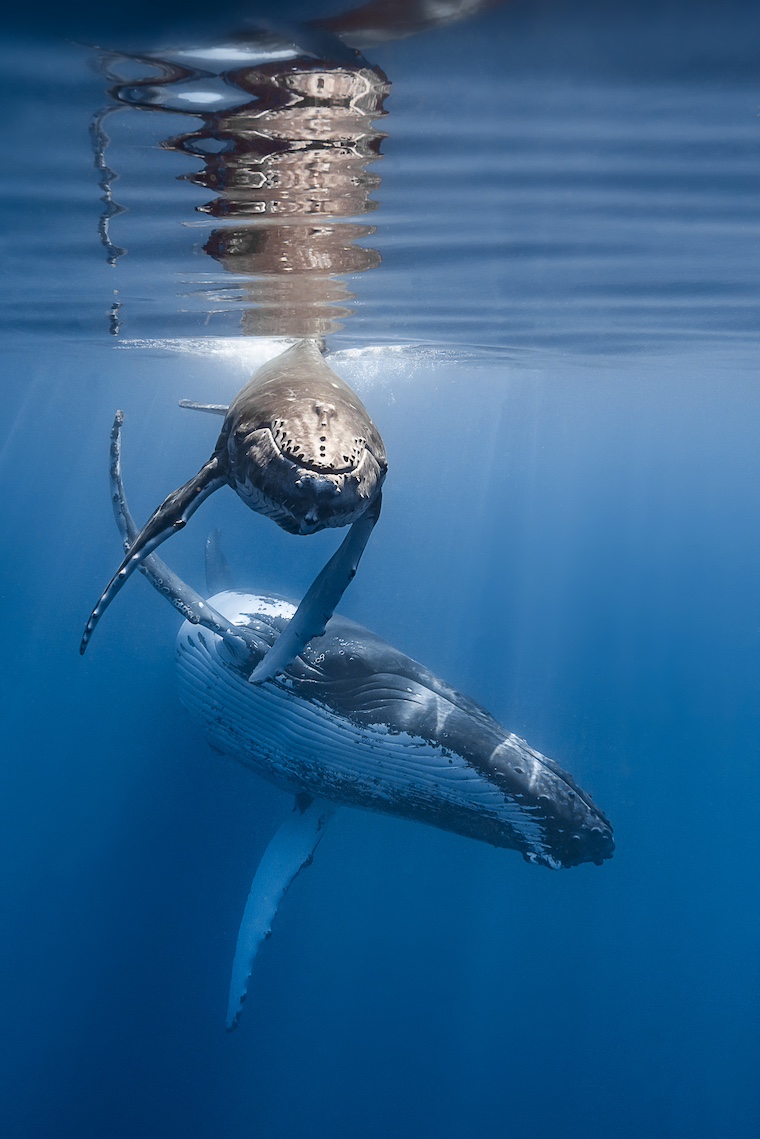
Humpback whales, Reunion Island. Photo Credit: François Baelen / Ocean Image Bank
This story was originally published by The Revelator.
I enjoyed talking about narwhals last month. What whale are we talking about this time?
This time we’re diving into one of my personal favorites: the humpback.
Wait, we usually talk about more obscure whales. Aren’t humpbacks kind of mainstream?
That’s true, but mainstream doesn’t mean boring. Humpbacks embody cetacean charisma. In addition to their good looks, they’re champion swimmers — they’re constantly observed leaping almost entirely out of the water in giant, thunderous breaches.
They’re also icons of conservation efforts; pop-culture superstars; and the subjects of amazing new science. Humpbacks are constantly in the news, too. One was recently spotted in a California river miles away from the ocean. Another made worldwide headlines for a very emotional display of grief after the loss of her calf.
Oh, that’s sad.
Yeah, but seeing that grief helps humans understand humpbacks even better — and maybe love them even more.
So where do they get the name “humpback”? I’ve seen photos — their backs don’t look all that humpy.
That’s true. But the name comes from those famous breaches and a distinct hump that forms on their backs when they arch to dive deep into the water.
That dive is a great opportunity to see one of humpbacks’ most beloved features: their tail flukes, which display unique black-and-white patterns on the underside. Photo-identification databases of these tail patterns allow scientists to track individual humpbacks across thousands of miles and throughout their decades-long lifespans. (Writer and whale fan Christopher Moore based an entire novel on those patterns.)
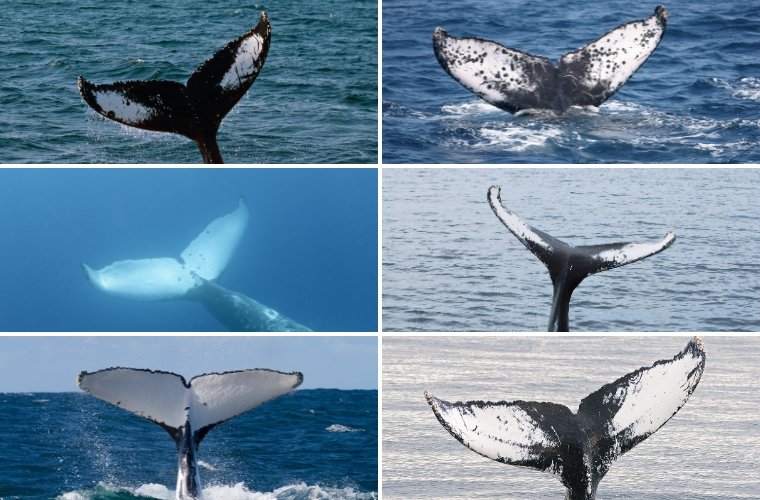
Examples of the unique tail fluke patterns of humpback whales. Photos from Canva
Getting back to their nomenclature, their scientific name, Megaptera novaeangliae, means “big-winged New Englander” and refers to their gigantic, wing-like pectoral flippers, which can grow up to 16 feet long — about a third of their total body length.
That must help them swim. Don’t they hold some kind of record for migrating?
You’ve been doing some reading in between these discussions! Good for you. Yes, humpback whales complete some of the longest migrations of any mammal on Earth. Each population has a different migratory path, but generally speaking they spend their summers in chilly, nutrient-rich polar waters where they gorge on krill and tiny fish — often using air bubbles to condense their prey into one location for easy pickings. Once suitably fattened up, they head north — a journey of several thousand miles to warm tropical waters near the equator, where they mate and give birth. They barely eat anything during the migration or their winter breeding season and live off their thick blubber stores.
That sounds like an intense diet plan. What else makes them famous?
Their music. Male humpbacks are known for their complex underwater “songs” — elaborate arrangements of moans, howls, and cries arranged in patterns that can last for hours. The songs evolve over time, with new “remixes” spreading across entire whale populations.
[Click here to listen to whalesong.]
Those vocalizations are arguably one of the reasons we still have humpbacks. The 1970 album Songs of the Humpback Whale, recorded by bio-acoustician Roger Payne, sold more than 100,000 copies (about the same as David Bowie’s The Man Who Saved the World the same year) and helped kick off the global “Save the Whales” movement — not to mention my own fascination with whales. I heard part of the album for the first time in 1979 when an issue of National Geographic magazine included an excerpt on flexi-disc — a record printed on flexible plastic instead of pressed on vinyl. I must have listened to it a thousand times over the next couple of years.
Cool. I’ll have to look for a copy of that issue on eBay. How are humpbacks doing these days? They were heavily hunted, right?
Extremely heavily. Commercial whaling reduced global humpback populations by an estimated 90% before the international whaling moratorium took effect in 1986.
But 40 years later, humpbacks are often celebrated as one of conservation’s greatest success stories and the species overall is classified as “least concern” by the IUCN, with an estimated adult population of 84,000 and rising.
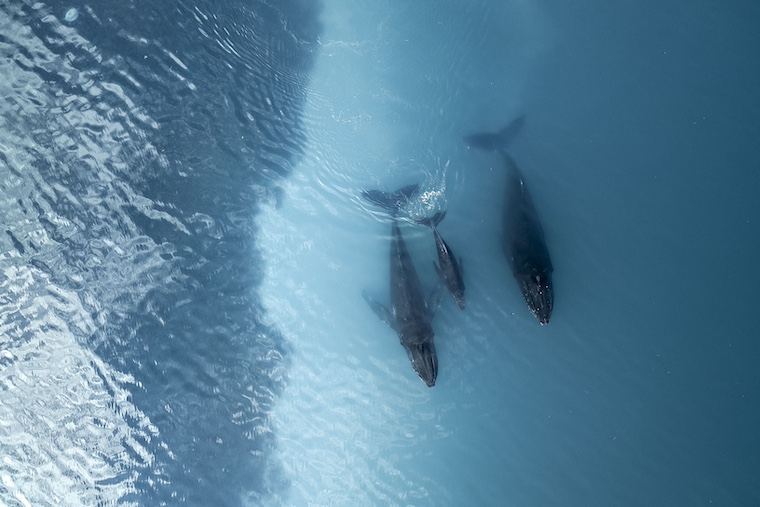
Humpback whales in Shark Bay, Western Australia. Photo Credit: Emilie Ledwidge / Ocean Image Bank
It all depends on where humpbacks live, of course, but many populations have rebounded dramatically thanks to international protections (and U.S. protections under the Endangered Species Act and the Marine Mammal Protection Act). One of the most exciting population recoveries is taking place off the coast of Brazil, where they’d all but disappeared four decades ago. Another unexpected site is the waters off the coast of New York City, where the nonprofit Gotham Whale recently documented 500 humpbacks, up from just 10-30 in the area a decade ago.
There’s a “but” coming, isn’t there?
You know me (and the world) too well. Not all populations have recovered equally. Specific distinct population segments — like the Arabian Sea and Oceania populations — remain endangered. (Newly published research also suggests the Arabian humpbacks may be a unique subspecies with low genetic diversity.)
Even for recovering populations, modern ocean life is a minefield. Humpbacks face constant threats from entanglements in commercial fishing gear and vessel strikes. On top of that, climate change is altering marine food webs, shifting krill distributions, and forcing whales to feed in new areas — where they become even more vulnerable to ship traffic. It’s a nasty circle.
Krill, climate, and humpbacks are intricately linked. A recent study found that a marine heatwave in the northeastern Pacific Ocean from 2013-2016 caused krill and small fish populations to crash — which then caused a decline in humpback populations in Hawaiʻi.
More recently a few starved and emaciated whales have washed ashore in places like Maine and Oregon. Is that a portent of things to come? I’m a bit worried.
So what can people do to help ensure humpbacks keep swimming, feeding, and breaching?
A few key things: If you’re ever out on a boat or taking a whale-watching tour (which I encourage you to do), make sure the operator follows responsible viewing guidelines and keeps a safe distance.
We can also support policy efforts that demand modifications in fisheries gear, such as ropeless fishing technology to eliminate dangerous entanglements like one that mangled a humpback’s jaw this summer. We also need to advocate for reducing boat noise in key migration corridors. A recent study found that engine noise reduced scientists’ ability to record humpback calls by 40-45%. If we can’t hear them, it’s a safe bet to assume they can’t hear themselves.
And, as with other species, supporting broader marine habitat protection and climate action helps safeguard the food and ocean ecosystems humpbacks rely on.
Got it. So what whale are we tackling next month?
That’s the toughest question you ask me each month. There are so many to choose from, including some species that are in the news. I have a few ideas, but anyone reading this can send their own favorites to me at [email protected].
John R. Platt is the editor of The Revelator and an award-winning environmental journalist whose work has appeared in dozens of publications around the world. His “Extinction Countdown” column has run continuously since 2004 and has covered news and science related to more than 1,000 endangered species. He is a member of the Society of Environmental Journalists and the National Association of Science Writers. John lives on the outskirts of Portland, Ore., where he finds himself surrounded by animals and cartoonists.
https://bsky.app/profile/johnrplatt.bsky.social
https://www.threads.net/@johnrplatt
https://linktr.ee/johnrplatt
https://www.instagram.com/johnrplatt
Posted on All-Creatures.org: October 29, 2026
Return to Fishes and Other Sea Animals Articles
Follow us on:


- Home Page
- What's New
- Contact Us
- Action Alerts
- Animal Exploitation
- Animal Issues
- Animal Rights Activism
- Archives
- Art & Photography
- Articles Directory
- Bible
- Bible Commentary Blog
- Books
- Campaigns
- Church & Religion
- Discussions
- Events / Podcasts / Media
- Health
- Hosted Web Sites
- Humor
- Kids' Korner
- Letters
- Links
- Nature Studies
- Newsletter
- Poetry & Stories
- Prayers
- Quotations
- Recipes with Photos
- Recipes Without Photos
- Sermons
- Stop Cruelty in Churches
- Video Library
- The Mary T. and Frank L. Hoffman Family Foundation
- Email: [email protected]
A web site sponsored by The Mary T. and Frank L. Hoffman Family Foundation and all-creatures.org
Copyright © 1998-2026 The Mary T. and Frank L. Hoffman Family Foundation. All rights reserved. May be copied only for personal use or by not-for-profit organizations to promote compassionate and responsible living. All copied and reprinted material must contain proper credits and web site link www.all-creatures.org.
Fair Use Notice: This document, and others on our web site, may contain copyrighted material whose use has not been specifically authorized by the copyright owners. We believe that this not-for-profit, educational use on the Web constitutes a fair use of the copyrighted material (as provided for in section 107 of the US Copyright Law). If you wish to use this copyrighted material for purposes of your own that go beyond fair use, you must obtain permission from the copyright owner.
Thank you for visiting all-creatures.org.
