A Vegan Health Article used with permission from All-Creatures.org
These vegan health articles are presented to assist you in taking a proactive part in your own health.
See All-Creatures.org Health Position and Disclaimer
Matt Reymann addresses non-vegans' perennial protein question and breaks down how much protein a person needs and some of the high-protein, plant-based sources we can draw from.
Yes, it’s Easy to get Enough Vegan Protein – here’s how.
From Matt Reymann, GentleWorld.org
February 2022
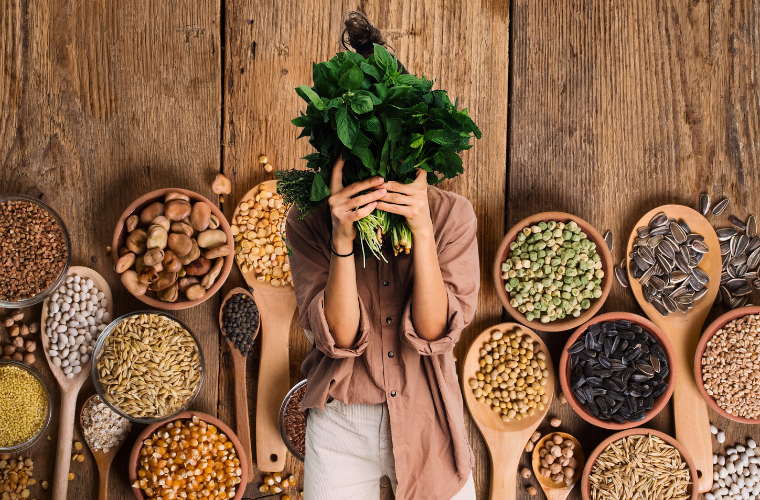
Images from Canva
Is vegan protein hard to find?
The new wave of plant-based athletes suggests that quite the opposite is true. But what about for the rest of us? Is it easy to ensure adequate protein intake on a 100% plant-based diet?
Thankfully, the answer is yes.
“The amounts and proportions of amino acids consumed by vegans are typically more than sufficient to meet and exceed individual daily requirements, provided a reasonable variety of foods are consumed and energy intake needs are being met. The claim that certain plant foods are 'missing' specific amino acids is demonstrably false. All plant foods contain all 20 amino acids, including the 9 indispensable amino acids… The terms 'complete' and 'incomplete' are misleading. In developed countries, plant proteins are mixed, especially in vegetarian diets, and total intake of protein tends to greatly exceed requirement. This results in intakes of all 20 amino acids that are more than sufficient.”
– Dietary Protein and Amino Acids in Vegetarian Diets—A Review
François Mariotti and Christopher D. Gardner
US National Library of Medicine, National Institutes of Health
One of the more common questions vegans still get asked is “where do you get your protein?” Additionally, vegans are asked if we get “enough” protein. A popular belief amongst nonvegans is that protein primarily comes from meat and eggs, or that vegan protein alone won’t be enough for a healthy diet.
Contrary to this belief, there is an abundance of plant foods that make it easy for vegans to get an adequate amount of protein every day.
For context, the DRI (Dietary Reference Intake) for protein is 0.36 grams per pound (0.8 grams per kg) of body weight. This adds up to 56 grams of protein for the average man and 46 grams of protein for the average woman.
With the DRI in mind, consider the following food combinations (sourced from USDA nutrition labels.) A peanut butter sandwich on whole wheat bread has around 15 to 20 grams of protein depending on the brand; a cup of oatmeal with soy milk contains 18 grams of protein; a cup of rice and lentils provides over 20 grams of vegan protein: nearly half the DRI of protein in less than 500 calories!
There’s no shortage of protein-packed meals for vegans to create and choose from, and that’s because there are tons of plant foods that are high in protein. Although protein can be found in nearly all plant-based foods, nuts, legumes, seeds, grains, and some leafy greens typically contain the most per serving. Below is a brief list of high-protein vegan foods:
- Soybeans (29 g per cup)
- Tempeh (16 g per 3 oz)
- Edamame (17 g per cup)
- Lentils (18 g per cup)
- Beans (15 g per cup)
- Nutritional yeast (14 g per oz)
- Nuts and seeds (about 4-9 g per oz)
- Wild rice (7 g per cup)
- Quinoa (8 g per cup)
- Amaranth (9 g per cup)
In addition to these foods, vegans can also find plenty of protein in plant-milks such as soy milk, vegan protein powders like pea and peanut protein powder, and mock meats.
Note: eating a wide variety of high-protein foods will also ensure an adequate intake of essential amino acids.
With this information, it’s easy to understand why protein and amino acid deficiency in vegans is rare, and that the view that protein needs to come from animal products is a misconception. However, it can still be beneficial for a new vegan to track their protein intake using a free nutrition tracker like Cronometer to come to a solid understanding of how easy it is to design desirable meals that meet one’s protein (and other nutritional) goals.
Posted on All-Creatures: August 5, 2026
Return to Vegan Health Articles
Read more at Protein Articles
All-Creatures.org Health Position and Disclaimer
We began this archive as a means of assisting our visitors in answering many of their health and diet questions, and in encouraging them to take a proactive part in their own health. We believe the articles and information contained herein are true, but are not presenting them as advice. We, personally, have found that a whole food vegan diet has helped our own health, and simply wish to share with others the things we have found. Each of us must make our own decisions, for it's our own body. If you have a health problem, see your own physician.
Follow us on:


- Home Page
- What's New
- Contact Us
- Action Alerts
- Animal Exploitation
- Animal Issues
- Animal Rights Activism
- Archives
- Art & Photography
- Articles Directory
- Bible
- Bible Commentary Blog
- Books
- Campaigns
- Church & Religion
- Discussions
- Events / Podcasts / Media
- Health
- Hosted Web Sites
- Humor
- Kids' Korner
- Letters
- Links
- Nature Studies
- Newsletter
- Poetry & Stories
- Prayers
- Quotations
- Recipes with Photos
- Recipes Without Photos
- Sermons
- Stop Cruelty in Churches
- Video Library
- The Mary T. and Frank L. Hoffman Family Foundation
- Email: [email protected]
A web site sponsored by The Mary T. and Frank L. Hoffman Family Foundation and all-creatures.org
Copyright © 1998-2026 The Mary T. and Frank L. Hoffman Family Foundation. All rights reserved. May be copied only for personal use or by not-for-profit organizations to promote compassionate and responsible living. All copied and reprinted material must contain proper credits and web site link www.all-creatures.org.
Fair Use Notice: This document, and others on our web site, may contain copyrighted material whose use has not been specifically authorized by the copyright owners. We believe that this not-for-profit, educational use on the Web constitutes a fair use of the copyrighted material (as provided for in section 107 of the US Copyright Law). If you wish to use this copyrighted material for purposes of your own that go beyond fair use, you must obtain permission from the copyright owner.
Thank you for visiting all-creatures.org.
