Animals in Labs Article used with permission from All-Creatures.org
Last Chance for Animals shares findings from their investigation of Nucro-Technics, a facility that conducts cruel testing on beagles sourced from the notorious Ridglan Farms. Footage from LCA's investigation was included in a recent report that has prompted an investigation of Nucro-Technics by the Canadian Council on Animal Care.
Nucro-Technics Beagle Investigation
From LCA Last Chance for Animals, LCAnimal.org
December 2025
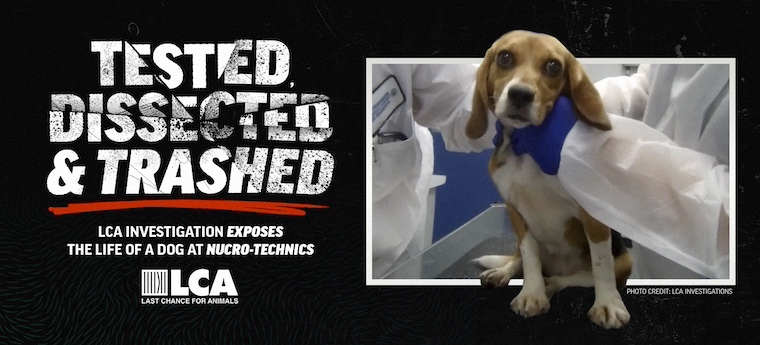
Image from Last Chance for Animals
TESTED, DISSECTED, AND TRASHED:
LCA EXPOSES SUFFERING AT CANADIAN ANIMAL RESEARCH LABORATORY
Released 12/19/2025 - A newly released undercover investigation by LCA exposes the suffering of dogs inside Nucro-Technics, a toxicology animal research laboratory in Scarborough, Ontario, Canada.
On 11/24/2025, the Investigative Journalism Bureau (IJB) in Ontario released a major investigative report, "Surgeries without anasthesia, severed vocal cords: The dog farm supplying an Ontario lab," which included LCA's investigative footage of Nucro-Technics. As a result, Nucro-Technics is under investigation by the Canadian Council on Animal Care (CCAC). Read the IJB article here.
Over the course of six months in 2023, LCA's investigator documented the treatment of beagles used in pharmaceutical drug testing at Nucro-Technics.
WATCH AND SHARE LCA'S UNDERCOVER VIDEO
SUFFERING IS “STANDARD PRACTICE” IN ANIMAL RESEARCH FACILITIES
Nucro-Technics bills itself as the largest contract animal research facility in Canada, operating in a 60,000 square-foot facility with more than 170 employees. Their website describes them as a “contract support organization for the pharmaceutical, biotech, medical device, and marijuana industries.” LCA’s footage shows tests on beagles aged 6 months to 2 years for pharmaceutical drugs. The dogs were repeatedly subjected to tests that included drug injections (subcutaneous and intramuscular), gavage, and oral dosing. At the end of the studies, dogs were documented being killed by using pentobarbital administered into their front paws through an IV line, necropsied, and thrown into garbage cans.
THE INVESTIGATION DOCUMENTED:
- Beagles experiencing severe adverse reactions to test items, including collapsing, vomiting, and skin lumps.
- Beagles struggling and crying during tests.
- A gavage tube accidentally inserted into a dog's lungs rather than the stomach.
- Beagles witnessing procedures on other beagles.
- Beagles housed in solitary cages or pens exhibiting stereotypic pacing behaviour.
- Facility employees and a study sponsor openly admitting they did not know the active ingredient in a drug being tested or what blood levels they were supposed to measure.
- Use of invasive procedures, including jugular blood draws, catheterizations, and EKGs, where dogs struggled so much that their legs were bound together.
- While a dog was being killed, the IV line delivering the pentobarbital fell out of the dog's paw vein, and the dog started thrashing. The technician had to stop the killing and reinsert the IV line.
- Beagles exercise indoors for only 15 minutes a day, Monday to Friday.
- Beagles arriving at Nucro-Technics from Ridglan Farms.
[See original article for photographs from the investigation.]
WHERE DO THE BEAGLES COME FROM?
Nucro-Technics purchased dogs from Ridglan Farms in Mt. Horeb, Wisconsin, the second-largest U.S. breeder of dogs sold to research facilities, which has been in business since 1966. Ridglan is licensed by the United States Department of Agriculture (USDA) as a breeder and research facility. The USDA’s May 2025 inspection report stated Ridglan had 2,502 dogs at its facility (1,927 puppies and 575 adults).
In October 2025, Ridglan agreed to shut down its dog sales and breeding-for-sale operations, stemming from a 2017 DxE investigation documenting the filthy conditions and psychological trauma of dogs. Ridglan will surrender its Wisconsin Department of Agriculture, Trade, and Consumer Protection license by July 1, 2026, in exchange for the state not filing criminal charges regarding the brutal mistreatment of beagles.
Ironically, Ridglan Farms will be allowed to remain in operation and continue breeding dogs for its own research.
CANADA’S BROKEN ANIMAL RESEARCH SYSTEM
The Canadian Council on Animal Care (CCAC) is a non-profit organization that provides national oversight for laboratory animal care across Canada. The CCAC publishes animal care guidelines for all species used in research, including dogs. However, there is no federal government agency in Canada that regulates labs. Although certification with the CCAC is not mandatory, laboratories that are not certified may be ineligible to receive certain funding. Nucro-Technics is certified by the CCAC and holds a Public Health Service (PHS) Approved Animal Welfare Assurance with the U.S.-based National Institute of Health (NIH). Facilities with PHS Assurance can work on research projects funded by the NIH.
In 2024, 9,252 dogs were used in CCAC-Certified institutions; however, this number may be higher, as the data only reflect statistics from certified institutions. The reported number includes 2,578 purpose-bred and 6,674 random-source dogs. The beagles Nucro-Technics purchased from Ridglan are considered purpose-bred.
BE A COMPASSIONATE CONSUMER
What LCA uncovered revealed a disturbing reality, where suffering is routine, and animals’ lives are treated as disposable.
You can help prevent animal suffering by avoiding products tested on animals, including pharmaceuticals, household products, and cosmetics. Look for the Leaping Bunny symbol on products. The Leaping Bunny Program requires that the company, its laboratories, and its ingredient suppliers use no animal testing at any phase of product development.
Posted on All-Creatures.org: January 6, 2026
Return to Animals in Labs
Follow us on:


- Home Page
- What's New
- Contact Us
- Action Alerts
- Animal Exploitation
- Animal Issues
- Animal Rights Activism
- Archives
- Art & Photography
- Articles Directory
- Bible
- Bible Commentary Blog
- Books
- Campaigns
- Church & Religion
- Discussions
- Events / Podcasts / Media
- Health
- Hosted Web Sites
- Humor
- Kids' Korner
- Letters
- Links
- Nature Studies
- Newsletter
- Poetry & Stories
- Prayers
- Quotations
- Recipes with Photos
- Recipes Without Photos
- Sermons
- Stop Cruelty in Churches
- Video Library
- The Mary T. and Frank L. Hoffman Family Foundation
- Email: [email protected]
A web site sponsored by The Mary T. and Frank L. Hoffman Family Foundation and all-creatures.org
Copyright © 1998-2026 The Mary T. and Frank L. Hoffman Family Foundation. All rights reserved. May be copied only for personal use or by not-for-profit organizations to promote compassionate and responsible living. All copied and reprinted material must contain proper credits and web site link www.all-creatures.org.
Fair Use Notice: This document, and others on our web site, may contain copyrighted material whose use has not been specifically authorized by the copyright owners. We believe that this not-for-profit, educational use on the Web constitutes a fair use of the copyrighted material (as provided for in section 107 of the US Copyright Law). If you wish to use this copyrighted material for purposes of your own that go beyond fair use, you must obtain permission from the copyright owner.
Thank you for visiting all-creatures.org.
