A Meat and Dairy Article used with permission from All-Creatures.org
Roland Azar discusses Australia’s upcoming ban on the live export of sheep, a practice broadly condemned for the suffering it inflicts, and the impact this ban will have on the Middle Eastern countries that currently receive these shipments.
Countdown to 2028: Australia’s Ban on Live Sheep Exports and the Middle East’s Dilemma
From Roland Azar, MiddleEastVeganSociety.org
May 2026
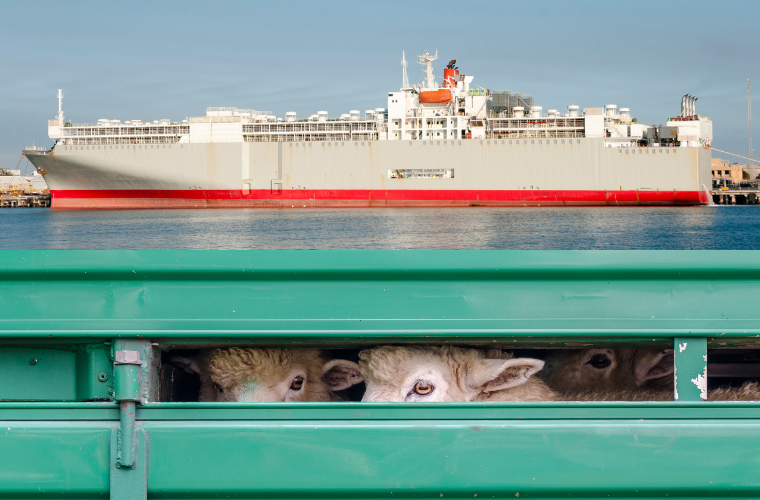
Images from Canva
Australia’s landmark decision to legislate the end of live sheep exports by May 2028 marks one of the most significant animal welfare reforms in modern history. For decades, millions of sheep have been shipped across oceans in overcrowded vessels, enduring extreme heat and high mortality before facing slaughter abroad. The Middle East has been among the largest destinations for these shipments, with countries such as Jordan, Kuwait, Saudi Arabia, the United Arab Emirates, Oman, and Qatar continuing to import live animals. As the countdown to 2028 begins, the question is no longer whether this trade will end in Australia but how Middle Eastern markets will respond to a global shift away from live animal transport.
Cruelty Exposed Across the Region
Sheep endure voyages lasting more than forty days, often in overcrowded conditions with heat stress and high mortality. Upon arrival, slaughter practices in the region frequently involve killing animals while fully conscious, without stunning. In 2025, footage from Jordan revealed Australian sheep gasping and kicking after their throats were cut, even in facilities accredited as “humane.” Similar practices have been documented in Kuwait and Saudi Arabia, where animals are dragged off ships and slaughtered in open markets. Shipments also arrive through Israeli ports such as Haifa and Ashdod, with animals later transported inland, including into Palestinian territories, extending the trade beyond official ports into surrounding markets.
Animal Rights Organizations Speak Out
International organizations have long condemned this trade. PETA’s investigations documented animals collapsing from heat stress and being slaughtered while fully conscious in Middle Eastern ports, including Bahrain, Egypt, Kuwait, and the UAE. Animals Australia has been at the forefront of the campaign, releasing undercover footage and lobbying policymakers to secure Australia’s 2028 ban. Eurogroup for Animals has urged the European Commission to suspend exports after conflicts stranded shipments at sea, exposing the fragility of the trade. Humane Society International has highlighted the global welfare and environmental costs of live transport. Even WOAH, the World Organisation for Animal Health, has launched a regional strategy urging Middle Eastern countries to adopt stronger standards for transport and slaughter.
Countries across the Middle East continue to receive shipments despite growing global condemnation. The persistence of live imports reflects cultural traditions and entrenched demand, but it also places the region under increasing international scrutiny.
Conclusion
Australia’s decision to end live sheep exports by 2028 is not just a national milestone; it is a signal to the Middle East that the world is moving away from practices that cause mass suffering. As shipments continue to arrive in regional ports, the pressure from international organizations and public opinion will only intensify. The dilemma for Middle Eastern countries is clear: either remain tied to a trade that is increasingly condemned or take proactive steps to modernize food systems, invest in plant-based alternatives, and align with global standards of animal welfare. The countdown to 2028 is not only Australia’s; it is a deadline for the region to decide whether it will lead change or resist it.
Posted on All-Creatures.org: May 15, 2026
Return to Meat and Dairy Articles
Follow us on:


- Home Page
- What's New
- Contact Us
- Action Alerts
- Animal Exploitation
- Animal Issues
- Animal Rights Activism
- Archives
- Art & Photography
- Articles Directory
- Bible
- Bible Commentary Blog
- Books
- Campaigns
- Church & Religion
- Discussions
- Events / Podcasts / Media
- Health
- Hosted Web Sites
- Humor
- Kids' Korner
- Letters
- Links
- Nature Studies
- Newsletter
- Poetry & Stories
- Prayers
- Quotations
- Recipes with Photos
- Recipes Without Photos
- Sermons
- Stop Cruelty in Churches
- Video Library
- The Mary T. and Frank L. Hoffman Family Foundation
- Email: [email protected]
A web site sponsored by The Mary T. and Frank L. Hoffman Family Foundation and all-creatures.org
Copyright © 1998-2026 The Mary T. and Frank L. Hoffman Family Foundation. All rights reserved. May be copied only for personal use or by not-for-profit organizations to promote compassionate and responsible living. All copied and reprinted material must contain proper credits and web site link www.all-creatures.org.
Fair Use Notice: This document, and others on our web site, may contain copyrighted material whose use has not been specifically authorized by the copyright owners. We believe that this not-for-profit, educational use on the Web constitutes a fair use of the copyrighted material (as provided for in section 107 of the US Copyright Law). If you wish to use this copyrighted material for purposes of your own that go beyond fair use, you must obtain permission from the copyright owner.
Thank you for visiting all-creatures.org.
