A Meat and Dairy Article used with permission from All-Creatures.org
Virgina Bell discusses the immense scale and severity of suffering that chickens endure at the hands of the meat industry. She also shares responses from bishops to whom she’s written regarding humanity’s treatment of these sensitive creatures and the industry’s environmental impact.
Chicken for Dinner?
From Virginia Bell, Catholic Action for Animals
October 2026
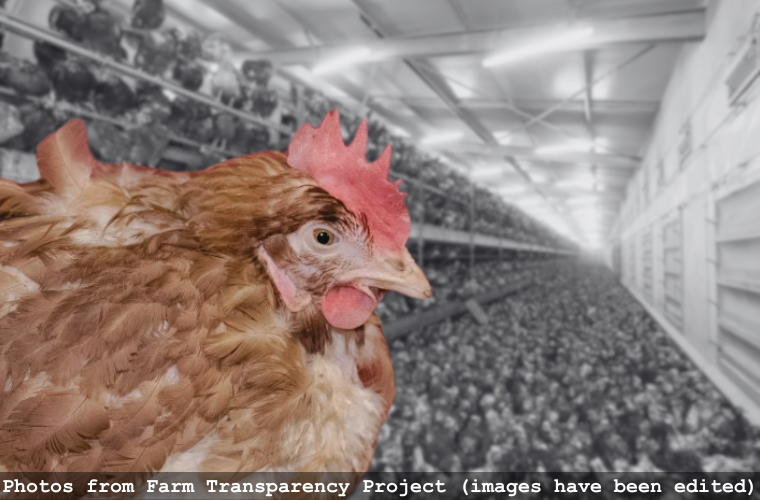
The story of the hen grown for meat calls to heaven for vengeance.
Yet it is just one story of farm animal abuse among many.
Each year in the UK, over 64 million meat chickens die prematurely, before they reach slaughter weight. In 2022, it was 80 million.
At least 1 million chickens die in the UK each year while being transported to slaughterhouses due to overheating, suffocation, poor transport procedures and other issues (Bureau of Investigative Journalism).
In the Summer, livestock suffer and die from the heat, and in Winter from the cold.
For instance, in 2022, 4 million chickens suffocated and baked to death inside their crowded sheds hidden in the UK countryside, and in the lorries taking them to the slaughterhouse (Humane League).
You can imagine how bad the situation is worldwide. In France alone the recent heatwave has killed hundreds of thousands of poultry. Not that numbers have any real meaning when it comes to suffering, because we all suffer individually. It’s the degree of suffering that matters, not the numbers, and I can’t imagine a worse death than being roasted alive.
To increase profit, the meat industry has genetically manipulated animals through selective breeding for centuries, forcing them to grow unnaturally fast and to produce more flesh than their bodies can handle. As a result, every year in the UK millions of chickens die from heart and organ failure because their organs can’t cope with the unnatural growth.
Broiler chickens bred for meat grow so quickly that their legs often collapse under their own weight, and they cannot get up from the ground. So they have to lie in their own waste, which burns them because of the ammonia it contains. The stench of ammonia is so strong that it also burns their lungs.
A single shed can house tens of thousands of birds. The conditions are filthy, windowless, barren, severely overcrowded and hot. Even on a mildly warm day the birds will be uncomfortably hot due to the intensive conditions. The birds are provided with slightly less space than an A4 sheet of paper to live on.
In the UK, over one billion chickens are slaughtered every year – and most of them will die painfully in gas chambers. The carbon dioxide gas used causes severe pain, burning the eyes, nose, mouth and lungs, leaving birds gasping and screaming in fear and panic, thrashing violently to escape the gas chamber.
My MP, in a reply dated 21-7-26, gave the legal requirements concerning housing and the Government recommendations concerning transportation, ending with
“However, the scale of the recent deaths demonstrates that guidance and existing enforcement arrangements are not providing sufficient protection in practice.”
What an understatement!
Defra has assured me, in a reply dated 24-7-26, that “All farm animals are protected by comprehensive and robust animal health and welfare legislation.” Defra mentions the Animal Welfare Act 2006 and the Welfare of Farmed Animals (England) Regulations 2007, legislation so robust that it could not prevent 17,000 broiler chickens, 600 hens and 70 turkeys dying on the way to slaughterhouses because of overheating in just the 3 days 24th – 26th June 2026 (Government figures).
The Government doesn’t care about the suffering of livestock. The Government wants to remove the brakes on industrial chicken farming and the planning constraints which hold back more and more mega chicken factories. The outgoing Environment Secretary Emma Reynolds (Secretary from 5-9-25 to 20-7-26) said she had spoken to other departments to ensure that permission for new chicken factories was easier to obtain.
The new Environment Secretary Angela Eagle, when she was Emma Reynolds’ deputy, sought to drive through the ‘planning reforms’ that the poultry industry is demanding, telling chicken lobbyists, “planning should enable ambition, not stifle it”.
What a farce that these ministers are called ‘Environment’ Secretaries! Chicken factories destroy the environment. They are a driver of deforestation, loss of biodiversity, water pollution and water shortages and are wasteful of the world’s resources – land, water, food and energy.
To grow feed for the chickens, rainforests are cut down and land taken which could be used to feed people directly.
The feed crop is sprayed with poisonous chemicals which kill bees, birds, mammals, fish, amphibians and humans. (Soil Association). The UK chicken factories are killing our rivers.
Nor is chicken healthy. Billion dollar-earning drugs have been pulled from the market because they contain an amount of the ‘probable carcinogen’ NDMA which could be less than that found in a single serving of cooked chicken. So why aren’t they pulling poultry off the shelves as well (NutritionFacts.org)?
No surprise then that last year chicken was linked to 11 different types of digestive or gastrointestinal cancers.
We can see that the government does not care at all about the suffering of chickens or any livestock.
But surely our Church leaders, our bishops, care?
If ‘A robin redbreast in a cage puts all Heaven in a rage’*, how will Heaven feel about our treatment of chickens?
To eat poultry, when eating them causes such suffering, is a mortal sin in my view.
But how do the bishops feel?
I wrote to the 22 bishops of England and Wales, described the conditions in which hens are kept, pointed out the environmental costs and asked why it is that they do not call for Catholics in their diocese to stop eating poultry, given the horrific suffering it causes.
The two replies I’ve received have shocked me with their indifference to the suffering and to the environmental cost involved.
Canon William Agley, General Secretary of the Bishops’ Conference of England & Wales, replied 28-7-26 on behalf of several bishops including Archbishop Richard Moth, to say that they will not be calling for Catholics to refrain from eating poultry.
He opened with, “Pope Francis wrote in Laudato Si’, that our relationship with God depends on us having the right relationship with all of God’s creation”. Surely that would mean that we should not eat animals if we can avoid it, or if our eating them is unnecessary, environmentally harmful, or is causing world hunger?
He continued, “This offers us, as Catholics, a way of interpreting the world around us. The bishops believe that it is up to us as individuals to judge how best to respond to this teaching in our own lives, and to make informed decisions conscious of the impact they may have on other people, other creatures, and the natural world.”
If this is not just equivocation, it means that we can decide on important issues without guidance from the bishops, our spiritual leaders. Some people may make an informed decision that using fossil fuels is ok, or that biodiversity doesn’t really matter. But Laudato Si’ says, paragraph 217 “Living our vocation to be protectors of God’s handiwork is essential to a life of virtue; it is not an optional or a secondary aspect of our Christian experience”.
The other response I received was from Archbishop John Sherrington, 31-7-26. He said, “We have a vocation to care for the whole of God's creation” and quotes the Catechism “It is contrary to human dignity to cause animals to suffer or die needlessly”. Surely that would mean that we should not eat animals if we can avoid it, if it is not necessary?
He went on, “The concerns you raise about animal welfare are distressing”. So why have the bishops done nothing?
He said further, “There is considerable legislation to support the protection of animals which is applicable to farming methods”. Yes, but all useless in practice. Chickens are suffering and dying needlessly in their millions every year. Is he really unaware of that fact? He continued, “It would be important to examine where there are breaches of the law which cause chickens and hens to 'suffer or die needlessly' and to improve the conditions for the farming of hens and chickens”. A quick look into the issue would show that the laws are inadequate, are being totally ignored anyway, and that the Government is determined to allow more and more mega chicken farms. The bishops are either completely unaware of the realities of chicken production, or completely indifferent. Meanwhile, millions of hens are being baked alive every year.
Archbishop Sherrington concluded, “A person may choose not to eat meat or poultry, but this is a personal choice as part of an ongoing journey of ecological consumption”. This presumably means that we can choose to eat chickens that have been horrifically treated in their production, and beef that is a main cause of loss of biodiversity, if that is our personal choice.
He quoted the Catechism “It is likewise unworthy to spend money on them (animals) that should as a priority go to the relief of human misery”. As there will always be human misery, are the bishops saying that we should never give to help animals? That we should ignore the more than eight million other animal species, however desperate their need, however much we have caused their suffering, and just look after our own? How selfish!
It is woolly thinking to say that we shouldn’t be spending money on animals which could relieve humans, yet to ignore the vast amounts of energy, time, food, land, water and other resources that we spend on rearing chickens and other animals which could go, instead, to feeding people directly, and thereby ending global hunger.
I urge Catholics to write to their bishop in disgust at the Church’s attitude to animal suffering, and to set them an example by leaving poultry off their plates.
*Auguries of Innocence by William Blake
Posted on All-Creatures.org: October 12, 2026
Return to Meat and Dairy Articles
Read more at Animals: Tradition—Philosophy—Religion Articles
Follow us on:


- Home Page
- What's New
- Contact Us
- Action Alerts
- Animal Exploitation
- Animal Issues
- Animal Rights Activism
- Archives
- Art & Photography
- Articles Directory
- Bible
- Bible Commentary Blog
- Books
- Campaigns
- Church & Religion
- Discussions
- Events / Podcasts / Media
- Health
- Hosted Web Sites
- Humor
- Kids' Korner
- Letters
- Links
- Nature Studies
- Newsletter
- Poetry & Stories
- Prayers
- Quotations
- Recipes with Photos
- Recipes Without Photos
- Sermons
- Stop Cruelty in Churches
- Video Library
- The Mary T. and Frank L. Hoffman Family Foundation
- Email: [email protected]
A web site sponsored by The Mary T. and Frank L. Hoffman Family Foundation and all-creatures.org
Copyright © 1998-2026 The Mary T. and Frank L. Hoffman Family Foundation. All rights reserved. May be copied only for personal use or by not-for-profit organizations to promote compassionate and responsible living. All copied and reprinted material must contain proper credits and web site link www.all-creatures.org.
Fair Use Notice: This document, and others on our web site, may contain copyrighted material whose use has not been specifically authorized by the copyright owners. We believe that this not-for-profit, educational use on the Web constitutes a fair use of the copyrighted material (as provided for in section 107 of the US Copyright Law). If you wish to use this copyrighted material for purposes of your own that go beyond fair use, you must obtain permission from the copyright owner.
Thank you for visiting all-creatures.org.
