A Sentience Article used with permission from All-Creatures.org
Marc Bekoff discusses the US Federal Animal Welfare Act, which withholds protections for certain species, and the elements at play when people deny the depth and complexity of the minds and experiences of nonhuman animals.
Why Are Rats, Mice, and Birds Excluded from Animalhood?
From Marc Bekoff, Ph.D., PsychologyToday.com
July 2026
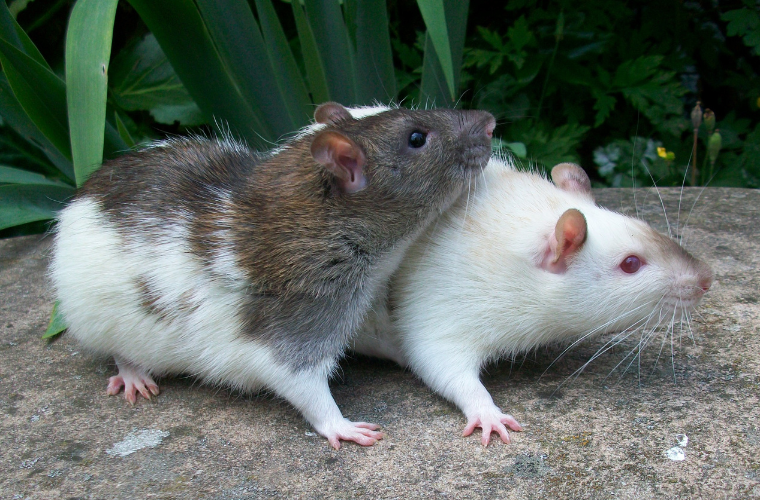
Rats form close friendships. Photo from Canva/Brendan Christopher/Pexels.
KEY POINTS
- Those who ignore ample data about animal minds wrongly criticize the use of anecdotes and anthropomorphism.
- Scientific uncertainty and mistaken claims about human exceptionalism also result in intentional data-denying.
- Data deniers take the easy way out by misrepresenting detailed research that results in mistreatment.
A question that I'm repeatedly asked: "Why is there a lag between learning facts about animal consciousness, sentience, and emotions and using what we know?" Mary, a well-known psychologist who calls herself a cognitive ethologist—someone who studies animal minds—wrote me a nice note asking me to say more, if I could, about the mindset of people who feel comfortable denying scientific facts about animal minds while continuing to do harmful research that has little to no bearing on who the animals really are.
Why animals "lose their minds" and the downsides of data-denying
One of the most egregious and surprising examples of animals losing their minds due to ignoring detailed comparative data on animal cognition and emotions for these clearly sentient and deeply emotional beings can be found in the current updated US Federal Animal Welfare Act, where we read,
"Enacted January 23, 2002, Title X, Subtitle D of the Farm Security and Rural Investment Act, changed the definition of 'animal' in the Animal Welfare Act, specifically excluding birds, rats of the genus Rattus, and mice of the genus Mus, bred for use in research."
I am always incredulous that the Animal Welfare Act does not consider these indisputable animals to be animals. Of course, these rodents are the go-to animals used by the millions in various invasive studies; this use must be defended. Other indisputable animals also are conveniently tossed out of the animal kingdom. People are shocked when I tell them this. We know from detailed scientific research that they have highly evolved cognitive and emotional capacities, they experience empathy, and rats laugh and like to be tickled. We know that tickling laboratory rats is good for science. What more do we need to show that these are sentient beings with rich and deep emotional lives?
Why is data denied?
This question is covered in great detail in two books with numerous references to scientific research.1 Here is a summary of these lengthy discussions; most people do not know why some researchers ignore a wealth of scientific research.1 In addition to the popularity of paradigm science, economic incentives, and laws and regulations that are built on faulty assumptions and misreadings of available data, I highlight four reasons why this occurs.
Scientific uncertainty means that an ever-declining number of skeptics claim that existing data do not prove other animals are richly and deeply emotional, sometimes saying that we don't even know if they are conscious or sentient. While a dwindling number of people still claim we can never know precisely what a nonhuman animal (animal) is truly feeling, most researchers and the vast majority of lay people do not doubt that these and many animals are highly sentient beings.
Anecdotes are all you offer. This claim is false; animal consciousness studies use real, hard data, not fabricated stories. Thus, animals are only acting "as if" they have feelings when they really don't. Nothing could be further from scientific truth.2
Oh, you're just being anthropomorphic by claiming animals are feeling beings. This is one of the most common criticisms by deniers. Anthropomorphism is unavoidable and is extremely useful when used carefully, critically, and biocentrically precisely because humans have no other vocabulary for describing the subjective experiences of nonhuman animals. Anthropomorphism makes animals' worlds accessible to us, but it does not mean animals feel exactly what we feel, or even what other individuals of the same or other species feel. Anthropomorphic language functions as a bridge for understanding rather than a literal scientific claim of identity between human and animal experience. Mindful anthropomorphism works.
Anthropomorphic language also helps us better understand other animals and highlights their individual personalities, and it's not "more anthropomorphic" to say an animal is unhappy than to say they're happy. It's time to accept the benefits of anthropomorphism and use it on behalf of other animals. Naysayers about the usefulness of "being anthropomorphic" and those who ignore what we now know and have known for many decades about animal minds and hearts need to get over it and appreciate the benefits of recognizing it. Eminent researcher Frans de Waal argues that anthropodenial no longer works—the "blindness to the humanlike characteristics of other animals or the animal-like characteristics of ourselves."
This apt quotation is right on the mark:
The mental territory we can claim to be 'uniquely human' is shrinking at an alarming rate. Wasps can distinguish faces, dolphins call one another by name, pigs use tools, zebra finches dream, parrots go on Zoom, and sometimes crayfish get anxious. Chimps, meanwhile, exist in complex cultures, rather like ours, with fashion trends.–Martha Gill3
Anthropocentrism argues for human exceptionalism and refers to false claims that humans are exceptional or superior beings— "better," "more valuable," or "higher" than nonhumans—or smarter, more sentient, and experience deeper emotional lives. Thus, claims about what other animals feel, whether supported by science or not, don't change the fact that they are separate and below and inferior to humans on some purported human-created scale of complexity. Clearly, they are not less than us.4
Follow the science: Animal minds are dynamic, rich, and deep
Studying animal minds and learning what's in them and how they work can range from being fairly easy to being incredibly difficult. There is wide-ranging and ever-growing interest in animal minds, and ample research clearly shows that denying animals the emotional capacities they clearly possess is highly unscientific. Why aren't myriad scientists who know that rats, mice, birds and other animals are indeed minded animals speaking out against this?
Rather than playing a role in animals losing their minds, we should celebrate and respect them for who they are and not worry about whether this means we are "lesser mammals." We're not. Frans de Waal wonders if we're not smart enough to know what's happening in animal minds.
We are not the standard or measure against whom other animals should be measured. We are a highly variable and exceptional species just like countless other animals. Changing our ways and valuing other animals will be better for them and for us, and this is precisely where current science takes us.
References
Zipple, M. N., Hazelwood, C., Webster, M. F., & Benítez, M. E. Animal emotions and consciousness: A preliminary assessment of researchers’ perceptions and biases and prospects for future progress. Royal Society Open Science, 11 (11), 25, 2024.
Zych, A. D., & Gogolla, N. Expressions of emotions across species. Current Opinion in Neurobiology, 68, 57, 2021.
1. Bekoff, Marc. The Emotional Lives of Animals: A Leading Scientist Explores Animal Joy, Sorrow, and Empathy―and Why They Matter, New World Library, second edition, 2024; _____ and Jeff Campbell. Love in Their Hearts: A Celebration of Animal Emotions and a Guide to Compassionate Action. Armin Lear Press, Inc., 2026
See Bekoff, M and Allen, C. Cognitive Ethology: Slayers, Skeptics, and Proponents. In: Anthropomorphism, Anecdotes, and Animals: The Emperor's New Clothes? (Eds) R. W. Mitchell, N. Thompson, and L. Miles. New York, State University of New York Press. 313-334. 1997 for a discussion of different views on animal minds.
2. See "Animal Emotions: Exploring Passionate Natures" for more discussion of the uninformed "as-if" disclaimer.
3. Martha Gill. When dogs recall toys, and horses plan, are animals so different from us? The Guardian. September 7, 2024.
4. Animal Minds and the Foible of Human Exceptionalism; How to Be Animal: The Case Against Human Exceptionalism; "The Arrogant Ape": A Strong Case Against Human Superiority.
About the Author
Marc Bekoff, Ph.D., is professor emeritus of ecology and evolutionary biology at the University of Colorado, Boulder.
Online: marcbekoff.com, X
Article originally published on PsychologyToday.com:
https://www.psychologytoday.com/us/blog/animal-emotions/202607/why-are-rats-mice-and-birds-excluded-from-animalhood
Posted on All-Creatures.org: September 11, 2026
Return to Sentience Articles
Follow us on:


- Home Page
- What's New
- Contact Us
- Action Alerts
- Animal Exploitation
- Animal Issues
- Animal Rights Activism
- Archives
- Art & Photography
- Articles Directory
- Bible
- Bible Commentary Blog
- Books
- Campaigns
- Church & Religion
- Discussions
- Events / Podcasts / Media
- Health
- Hosted Web Sites
- Humor
- Kids' Korner
- Letters
- Links
- Nature Studies
- Newsletter
- Poetry & Stories
- Prayers
- Quotations
- Recipes with Photos
- Recipes Without Photos
- Sermons
- Stop Cruelty in Churches
- Video Library
- The Mary T. and Frank L. Hoffman Family Foundation
- Email: [email protected]
A web site sponsored by The Mary T. and Frank L. Hoffman Family Foundation and all-creatures.org
Copyright © 1998-2026 The Mary T. and Frank L. Hoffman Family Foundation. All rights reserved. May be copied only for personal use or by not-for-profit organizations to promote compassionate and responsible living. All copied and reprinted material must contain proper credits and web site link www.all-creatures.org.
Fair Use Notice: This document, and others on our web site, may contain copyrighted material whose use has not been specifically authorized by the copyright owners. We believe that this not-for-profit, educational use on the Web constitutes a fair use of the copyrighted material (as provided for in section 107 of the US Copyright Law). If you wish to use this copyrighted material for purposes of your own that go beyond fair use, you must obtain permission from the copyright owner.
Thank you for visiting all-creatures.org.
