A Sentience Article used with permission from All-Creatures.org
Marc Bekoff discusses the work of Jane Goodall and Donald Griffin, two renowned researchers with different methods who agreed that nonhuman animals have minds and inner lives similar to our own.
Jane Goodall and Donald Griffin Helped Us Get Over Ourselves
From Marc Bekoff, Ph.D., PsychologyToday.com
November 2026
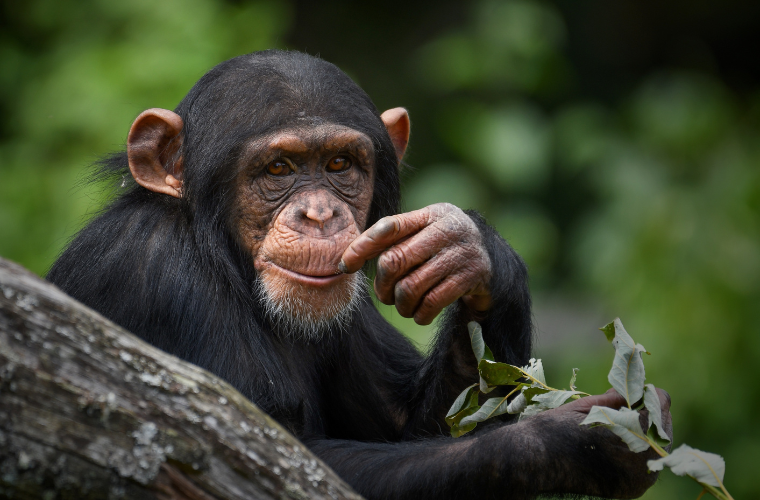
Photo from Canva
Key points
- Goodall and Griffin challenged the idea of a sharp line between humans and other animals.
- Both argued evolutionary continuity makes it unlikely that consciousness and sentience are uniquely human.
- Evidence of animal sentience demands animal protection.
Over the past decade or so, there have been far fewer people wondering if nonhuman animals are in fact conscious, emotional, sentient beings. Ample comparative research clearly shows they are, and the important question at hand is why consciousness and sentience have evolved, not if they have evolved. Why are they crucial adaptations for being able to negotiate complex, challenging, and often ever-changing dynamic social and non-social worlds?
When one pays close attention to what we have learned and continue to learn about the nature of animal minds, it's very clear that it's anti-science data denial to claim that nonhumans aren't highly intelligent, conscious, sentient beings.1 Indeed, several countries have declared that nonhuman animals, including household companions and members of wild species, are sentient beings.
I was most fortunate to work very closely with Jane Goodall and had many wonderful conversations with Donald Griffin, the so-called "Father of Cognitive Ethology", two major contributors to the study of animal minds. Many people have asked me about their long-term contributions to the field, so it's my pleasure to offer a brief review to situate their outstanding, tireless work.2 In essence and for a wide variety of reasons, animals had lost their minds because of rampant data denial, and these two scientists among others helped them rightfully regain what was always there.
Jane Goodall and Donald Griffin: Contrasting Styles, Similar Views
Jane Goodall arrived at Gombe Stream in Tanzania in 1960 with no undergraduate degree. She was sent there by Louis Leakey, and years later earned a PhD in ethology. Her main method of study was patience—slow watching. She was quite the acrobatic fieldworker, often climbing trees, and her team continues to study these fascinating beings 67 years later.
Goodall's contribution to the study of animal minds didn't involve experiments. Rather, she and her colleagues recorded social strategies, long-term relationships, observational learning, and what resembled cultural variation in how groups used tools. Spurred on by Goodall, other researchers also observed that chimpanzees have various traditions that are passed on socially and are not simply inherited patterns of behavior. They also learned that mothers played a major role in shaping their offspring’s behavior and social status.
Goodall's views on the emotional lives of animals were more direct than Griffin's. Without hesitation, she noted that chimpanzees displayed a wide variety of emotions, including happiness, sadness, fear, and despair, and argued that their emotional lives are very similar to ours and that we had to seriously consider this fact when discussing them and us.
One of her most compelling early observations was the rapid change in the behavior of Flint, a young chimpanzee, after the death of his mother Flo. Flint stopped eating, withdrew from the group, and died within weeks. Goodall unhesitatingly described this as grief. She also documented strong mother-infant bonds, reconciliation and consolation after fights, and rituals such as rhythmic “waterfall dances” which she speculated might reflect something like wonder or awe.
Goodall also focused on individual differences among the chimpanzees. She gave her subjects names including David Greybeard, Flo, and Fifi, instead of numbers, which was considered unscientific at the time. She also freely spoke about their unique personalities and temperaments, two practices that were "forbidden" back then. But she insisted that this was perfectly okay and continued to do so for decades. Treating each animal as being highly unique became considered to be real "data" and changed how the public came to understand these and other animals. Her work had a major effect on mine.
Donald Griffin and Goodall sharply contrasted. Griffin conducted highly controlled experiments along with observational data for many different species, including bats, bees, birds, and nonhuman primates, and asked what they suggested about awareness. He focused on animal awareness and used behavioral flexibility as a marker of consciousness, and he took seriously the possibility of consciousness in insects and other invertebrates long before this was mainstream. Behavioral flexibility means an individual is evaluating their situation, considering past experiences, and deciding what to do based on the present moment and imagined future interactions. It is closely aligned with being sentient, which means being aware of and feeling what is happening to them and around them, and changing their behavior. We now know that a large body of scientific evidence stemming from studies of diverse species clearly shows that many animals are conscious sentient beings.
All in all, Griffin concluded that animals were capable of conscious thoughts and subjective experiences. Animal emotions were not a primary concern. On the other hand, Goodall's work on animal minds focused largely on their emotional lives, social relationships, and personalities rather than on more abstract arguments about consciousness.
In short, Griffin made it respectable to ask whether animals think and feel, and Goodall showed, through years of close watching, what a plausible answer might look like for one species.
Coda: Moving Beyond Human Exceptionalism
Both Goodall and Griffin challenged the idea of a sharp line between humans and other animals. Both argued that evolutionary continuity makes it unlikely that mind, emotion, or intelligence are uniquely human.
Griffin didn't write much on what "being conscious" meant about how animals are treated until around 1992, sixteen years after his highly controversial book The Question of Animal Awareness was published. I had some lengthy chats with him about this, and in the foreword to his seminal book Animal Minds: Beyond Cognition to Consciousness, he wrote about Dale Jamieson's and my work.
I was at the meeting where he first talked about The Question of Animal Awareness, his bold and unexpected book, and some people thought he had lost his mind! One comparative psychologist accused him of "muddled thinking" and suggested that cognitive ethologists should "hang up his field glasses, become a cognitive psychologist, and have nothing further to do with talk about consciousness or intention." Goodall’s concern was more explicit and became her public mission. She criticized invasive laboratory research on chimpanzees, advocated for habitat conservation, and founded the Jane Goodall Institute in 1977 and Jane Goodall's Roots & Shoots youth program in 1991.
The abundant scientific database that already exists—a body of evidence that has been available for a long time and just keeps growing—supports the fact that there exist many species of nonhumans who are undeniably sentient; deeply feeling, emotional beings who care about what happens to themselves and others. The fact of sentience needs to be put to use and into practice to protect and respect the lives of the other animals our species interacts with in so many ways.
We must stop pretending that we don’t know this-or-that about animal sentience. While we persist in pondering the obvious, ignoring what we already know and have long known, countless nonhuman victims continue to be abused by humankind, every minute of every day, planet-wide.
References
Why Animal Sentience Must Be Used to Reform Constitutions; It’s Time To Stop Wondering if Animals Are Sentient—They Are; The Emotional Lives of Dogs and Wolves and Why They Matter; The Lives of Sea Turtles and Why They Matter; The Emotional Lives of Animals and Why They Matter; The Fascinating Complex Minds of Bees and Why They Matter; Animal Emotions, Animal Sentience, and Why They Matter; Mindful Anthropomorphism Works, So Let's Stop the Bickering; The State of Animal Consciousness, Sentience, and Emotions; Liv Baker et al. Rethinking Animal Consciousness Research to Prioritize Well-Being, Cambridge Corp, October 28, 2024. Also see: Granting Rights to Animals Doesn't Undermine Human Rights; Jane Goodall's Core Values Reject Human Exceptionalism.
1) Griffin’s critics, among them Marian Dawkins and other behavioral scientists, argued that his program lacked clear, falsifiable tests, and that behavioral flexibility can be explained without invoking consciousness. Dawkins still believes we don't really know if nonhumans are conscious, and that the link between behavioral flexibility is inadequate, a minority view for sure. She does not claim that animals don't feel. We can still be concerned about their welfare without invoking consciousness. For more on this topic, see her latest book (2025), Who is Conscious?: A Guide to the Minds of Animals.
2) I was thrilled when Carolyn Ristau published an in-depth three-volume work about the life of this most amazing man, a summary of which can be found in an essay titled "Précis of: 'Birds, Bats and Minds: Tales of a Revolutionary Scientist, Donald R. Griffin'" in the journal Animal Sentience. (All three volumes can be downloaded for free here.) In 1992, Dale Jamieson and I summarized Griffin's seminal work in an essay called "On Aims and Methods of Cognitive Ethology," in which we wove his work into the general field of ethology and the rise of cognitive ethology. Griffin also challenged skeptics who offered glib accounts of animal minds to bear the burden of proof, and to offer testable hypotheses rather than time-worn dogma. He awakened us to animal cognition and the complex nature of animal minds.
About the Author
Marc Bekoff, Ph.D., is professor emeritus of ecology and evolutionary biology at the University of Colorado, Boulder.
Online: marcbekoff.com, X
Article originally published on PsychologyToday.com:
https://www.psychologytoday.com/us/blog/animal-emotions/202611/jane-goodall-and-donald-griffin-helped-us-get-over-ourselves
Posted on All-Creatures.org: November 24, 2026
Return to Sentience Articles
Follow us on:


- Home Page
- What's New
- Contact Us
- Action Alerts
- Animal Exploitation
- Animal Issues
- Animal Rights Activism
- Archives
- Art & Photography
- Articles Directory
- Bible
- Bible Commentary Blog
- Books
- Campaigns
- Church & Religion
- Discussions
- Events / Podcasts / Media
- Health
- Hosted Web Sites
- Humor
- Kids' Korner
- Letters
- Links
- Nature Studies
- Newsletter
- Poetry & Stories
- Prayers
- Quotations
- Recipes with Photos
- Recipes Without Photos
- Sermons
- Stop Cruelty in Churches
- Video Library
- The Mary T. and Frank L. Hoffman Family Foundation
- Email: [email protected]
A web site sponsored by The Mary T. and Frank L. Hoffman Family Foundation and all-creatures.org
Copyright © 1998-2026 The Mary T. and Frank L. Hoffman Family Foundation. All rights reserved. May be copied only for personal use or by not-for-profit organizations to promote compassionate and responsible living. All copied and reprinted material must contain proper credits and web site link www.all-creatures.org.
Fair Use Notice: This document, and others on our web site, may contain copyrighted material whose use has not been specifically authorized by the copyright owners. We believe that this not-for-profit, educational use on the Web constitutes a fair use of the copyrighted material (as provided for in section 107 of the US Copyright Law). If you wish to use this copyrighted material for purposes of your own that go beyond fair use, you must obtain permission from the copyright owner.
Thank you for visiting all-creatures.org.
