Animals: Tradition - Philosophy - Religion Article used with permission from All-Creatures.org
Jon Hochschartner applies an insightful perennialist perspective to the scriptural and ideological inconsistencies in Jesus’ relationship to non-human animals in the Bible.
Animals and Jesus
From Jon Hochschartner, Slaughter-Free America, slaughterfreeamerica.substack.com
May 2026
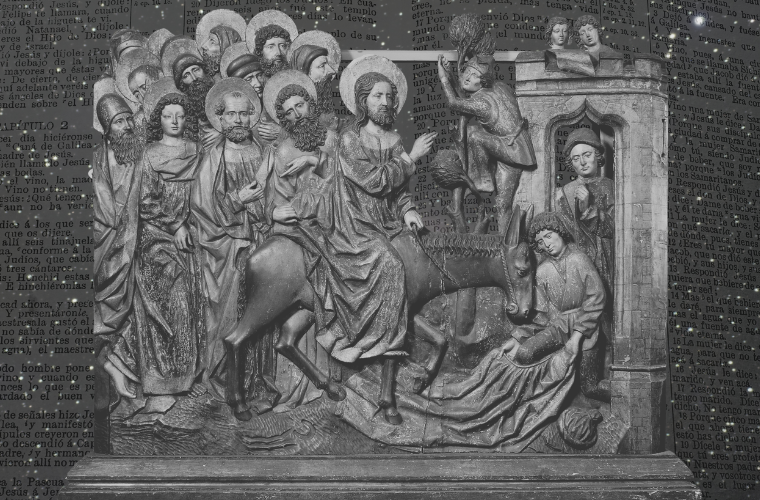
Images from Canva and The Met
Recently, I’ve read a fair amount of theology, as part of an effort to construct a more animal-friendly Christianity for myself. An interesting distinction that comes up time and time again is that between the Jesus of history and the Christ of faith. The former, of course, is the first-century Jewish preacher, of whom little can verifiably be said. The latter is the same figure as depicted in the New Testament. Unfortunately, neither understanding is particularly beneficial for animals. What’s needed, in my view, is what might be called a Jesus of perennialism.
Again, scholars can agree on very little when it comes to the Jesus of history. The consensus appears to be he was an apocalyptic prophet who was crucified approximately 2,000 years ago. Beyond these facts just about everything is debated. The only researchers I’ve come across who argue Jesus was vegetarian are animal activists, which leads me to believe some motivated reasoning is at play. While scholars can make general inferences, absent significant new archeological evidence, the Jesus of history seems largely unknowable.
Similarly, the Christ of faith is portrayed as exploiting animals in a variety of ways, such as eating and riding them. Further, there’s the inconvenient fact this figure is not portrayed uniformly across the New Testament. It’s not just a matter of certain events in his life happening at different points or not happening at all in different gospels, it’s that Jesus’ role in the universe and his relationship to God is understood dissimilarly in the various accounts of his life. Like the Jesus of history, the Christ of faith provides unsteady ground on which to base a worldview.
Instead, I think Christian animal activists should embrace a perennialist reading of Jesus. For those who don’t know, perennialism is the belief all great religions are describing a single, universal truth, and differences between the faiths can be ascribed to cultural filters through which this truth is perceived. While perennialists should do their best to be even handed, they should forthrightly acknowledge that trying to separate which religious teachings represent universal truth and which represent culturally-specific ephemera involves personal judgment.
In short, Christian animal activists should argue Jesus’ teachings in favor of mercy and peacemaking fall into the former category, and, comprehensively applied, forbid the exploitation of animals. On the other hand, they should argue his seeming endorsement of violence against nonhumans falls into the latter category. One could make a perennialist Christian case for animal liberation based on a variety of passages, including the Beatitudes, which, I believe, are as good and timeless a statement of spiritual truth as there is.
That said, one of my favorite ways of making the case is through a panentheistic understanding of God, the divine, or whatever one might call an analogous concept. If you’re unfamiliar with the term, panentheism is the view that God is present, to some degree, everywhere and in everything, undergirding and extending beyond the universe. This idea is generally associated with Indian religions, but can be found in Abrahamic faiths, like Christianity, as well. For instance, in his Epistle to the Colossians, Saint Paul writes, “Christ is all, and is in all.”
Likewise, in chapter 25 of the Gospel of Matthew, Jesus says the Son of Man will judge everyone based on how they treat the most vulnerable: “The King will say to those on his right, ‘Come, you who are blessed by my Father; take your inheritance, the kingdom prepared for you since the creation of the world. For I was hungry and you gave me something to eat, I was thirsty and you gave me something to drink, I was a stranger and you invited me in, I needed clothes and you clothed me, I was sick and you looked after me, I was in prison and you came to visit me.’”
This passage raises all sorts of questions for those primarily concerned with the Jesus of history or the Christ of faith. Did Jesus actually say these words? Did Jesus believe he was the Son of Man, or was he describing a separate figure? Christian animal activists might wonder to what degree, if at all, Jesus included nonhumans amongst the vulnerable. For perennialists, these questions are of academic interest, but, in terms of our own theological beliefs, they’re not particularly important. We’re interested in universal truth, wherever that might be found.
Panentheism, which recognizes animals as bearers of a divine spark like humans, is part of that truth. Whatever the Jesus of history or the Christ of faith might have thought, we can confidently say God is present in the fish caught in a net, the chicken in a factory farm, the mouse in a laboratory, the mink in a fur farm, or the elephant in a zoo, and we will be judged, in some manner, based on our treatment of them. Our divine purpose is to move closer to God, which necessarily implies loving others, especially the most vulnerable, such as animals.
Posted on All-Creatures.org: May 21, 2026
Return to Animals: Tradition—Philosophy—Religion Articles
Follow us on:


- Home Page
- What's New
- Contact Us
- Action Alerts
- Animal Exploitation
- Animal Issues
- Animal Rights Activism
- Archives
- Art & Photography
- Articles Directory
- Bible
- Bible Commentary Blog
- Books
- Campaigns
- Church & Religion
- Discussions
- Events / Podcasts / Media
- Health
- Hosted Web Sites
- Humor
- Kids' Korner
- Letters
- Links
- Nature Studies
- Newsletter
- Poetry & Stories
- Prayers
- Quotations
- Recipes with Photos
- Recipes Without Photos
- Sermons
- Stop Cruelty in Churches
- Video Library
- The Mary T. and Frank L. Hoffman Family Foundation
- Email: [email protected]
A web site sponsored by The Mary T. and Frank L. Hoffman Family Foundation and all-creatures.org
Copyright © 1998-2026 The Mary T. and Frank L. Hoffman Family Foundation. All rights reserved. May be copied only for personal use or by not-for-profit organizations to promote compassionate and responsible living. All copied and reprinted material must contain proper credits and web site link www.all-creatures.org.
Fair Use Notice: This document, and others on our web site, may contain copyrighted material whose use has not been specifically authorized by the copyright owners. We believe that this not-for-profit, educational use on the Web constitutes a fair use of the copyrighted material (as provided for in section 107 of the US Copyright Law). If you wish to use this copyrighted material for purposes of your own that go beyond fair use, you must obtain permission from the copyright owner.
Thank you for visiting all-creatures.org.
