A Wildlife Article used with permission from All-Creatures.org
Although the first wild condor egg in the Pacific Northwest in more than 100 years likely did not hatch, Nika Bartoo-Smith reports that this was not unexpected and that there is still much hope for these condors and others like them in the region.
Nesting Condor’s First Egg Likely Failed
From Nika Bartoo-Smith, Underscore Native News + ICT, Underscore Native News
April 2026
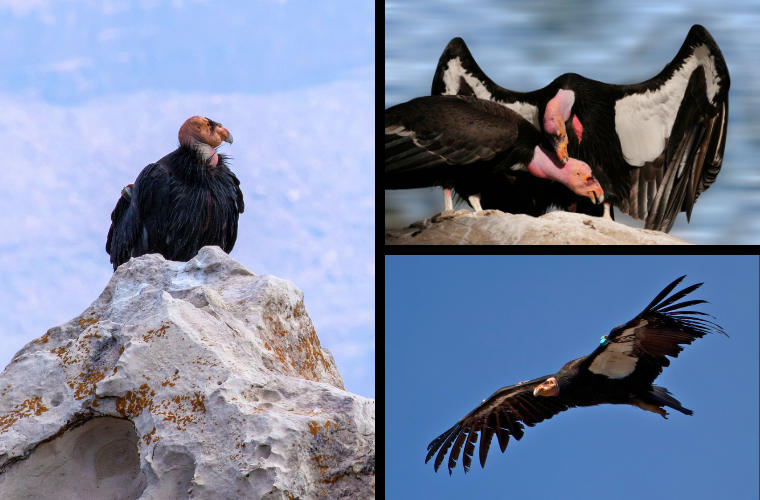
Photos from Canva
In February, two condors from the Northern California Condor Restoration Program were believed to have laid an egg, after establishing the first wild condor nest in the region for over a century.
The egg appears to have been unsuccessful, based on the birds’ behavior and flight patterns, according to a news release from the Yurok Tribe.
“Even if the egg failed, this is still a major milestone in the condor restoration effort,” Tiana Williams-Claussen, a citizen of the Yurok Tribe and the Yurok Wildlife Department director, told UNN + ICT.
Biologists with the Northern California Restoration Program, run by the Yurok Tribe and Redwood National and State Parks, believe the egg failed because the nesting condors have spent significant time away from the nest site together. If the egg had hatched, the chick would need lots of parental care to survive, according to the tribe.
Though this egg appears to have been unsuccessful, that can be common with the first egg for new condor parents. There are a number of things that could have gone wrong including an infertile egg or inadequate incubation chilling the egg or hatching failure, according to the release.
Because the nesting area is in a remote location, biologists will continue to observe the parents’ behavior for several weeks to confirm that the egg did not hatch.
The prospective parents, A0, or Ney-gem’ ‘Ne-chween-kah in Yurok, which translates to “she carries our prayers,” and A1, or Hlow Hoo-let in Yurok, which translates to “at least I (or we) fly!,” could attempt to reproduce again as soon as this spring.
“A0 and A1 have figured out how to find an ideal nesting location, and whether they reproduce this season or next, we expect to see our first condor chick in the very near future,” Williams-Claussen told UNN + ICT. “Over the next few short years, several of our condors are going to reach breeding age and they will have the benefit of mentors in A0 and A1, which will make a big positive difference. I am extremely excited about what the future holds for our condor flock.”
Underscore Native News is a nonprofit newsroom committed to Indigenous-centered reporting in the Pacific Northwest. We are supported by foundations and donor contributions. Follow us on Facebook, Instagram, TikTok, YouTube and Bluesky.
This story is co-published by Underscore Native News and ICT, a news partnership that covers Indigenous communities in the Pacific Northwest.
This article first appeared on Underscore Native News and is republished here under a Creative Commons Attribution-NoDerivatives 4.0 International License.
Posted on All-Creatures.org: April 22, 2026
Return to Wildlife Articles
Follow us on:


- Home Page
- What's New
- Contact Us
- Action Alerts
- Animal Exploitation
- Animal Issues
- Animal Rights Activism
- Archives
- Art & Photography
- Articles Directory
- Bible
- Bible Commentary Blog
- Books
- Campaigns
- Church & Religion
- Discussions
- Events / Podcasts / Media
- Health
- Hosted Web Sites
- Humor
- Kids' Korner
- Letters
- Links
- Nature Studies
- Newsletter
- Poetry & Stories
- Prayers
- Quotations
- Recipes with Photos
- Recipes Without Photos
- Sermons
- Stop Cruelty in Churches
- Video Library
- The Mary T. and Frank L. Hoffman Family Foundation
- Email: [email protected]
A web site sponsored by The Mary T. and Frank L. Hoffman Family Foundation and all-creatures.org
Copyright © 1998-2026 The Mary T. and Frank L. Hoffman Family Foundation. All rights reserved. May be copied only for personal use or by not-for-profit organizations to promote compassionate and responsible living. All copied and reprinted material must contain proper credits and web site link www.all-creatures.org.
Fair Use Notice: This document, and others on our web site, may contain copyrighted material whose use has not been specifically authorized by the copyright owners. We believe that this not-for-profit, educational use on the Web constitutes a fair use of the copyrighted material (as provided for in section 107 of the US Copyright Law). If you wish to use this copyrighted material for purposes of your own that go beyond fair use, you must obtain permission from the copyright owner.
Thank you for visiting all-creatures.org.
