When Friends Ask:
Where Do You Get Your Protein?
By
John McDougall, MD
www.drmcdougall.com
Printable PDF
 If you don�t know where you get your
protein while following a plant-food-based diet, you�re in good company.
The Nutrition Committee of the American Heart Association, scientists
from the Human Nutrition Research Center and Medical School at Tufts
University, and registered dietitians, research nutritionists and
physicians of Northwestern University, and the Harvard School of Public
Health are just a few examples of �experts� you look to for advice who
have the protein story wrong.1-4 Consequences of their
shortfall are as grave as a lifetime of sickness and obesity, and
premature death, for innocent people. These professionals must be held
accountable.
If you don�t know where you get your
protein while following a plant-food-based diet, you�re in good company.
The Nutrition Committee of the American Heart Association, scientists
from the Human Nutrition Research Center and Medical School at Tufts
University, and registered dietitians, research nutritionists and
physicians of Northwestern University, and the Harvard School of Public
Health are just a few examples of �experts� you look to for advice who
have the protein story wrong.1-4 Consequences of their
shortfall are as grave as a lifetime of sickness and obesity, and
premature death, for innocent people. These professionals must be held
accountable.
|
Wrong Statements
from the Experts 1-4 |
|
Although plant proteins form a
large part of the human diet, most are deficient in 1
or more essential amino acids and are therefore
regarded as incomplete proteins. (American Heart Association)
Plant protein sources, although
good for certain essential amino acids, do not always offer all
nine essential amino acids in a single given food. For example,
legumes lack methionine, while grains lack lysine. (Tufts Human
Nutrition Research Center)
Single plant protein foods
usually are lower in protein quality than most animal proteins
because they lack significant amounts of various essential amino
acids. (Tufts University Medical School)
Other protein sources lack one
or more amino acids that the body can't make from scratch or
create by modifying another amino acid. Called incomplete
proteins, these usually come from fruits, vegetables, grains,
and nuts. (Harvard School of Public Health)
Plant sources of protein
(grains, legumes, nuts, and seeds) generally do not contain
sufficient amounts of one or more of the essential amino acids.
Thus protein synthesis can occur only to the extent that the
limiting amino acids are available. (Feinberg School of
Medicine, Northwestern University) |
Ignorance Sickens and Kills People
Don�t think it matters little if our
public policy makers and educators remain ignorant about our nutritional
needs. Misinformation leads to disastrous outcomes. People have serious
health problems like heart disease, type-2 diabetes, multiple sclerosis,
and inflammatory arthritis that can be easily resolved by a diet based
solely on plant foods. However, advice to make this dietary change may
be withheld from you or a family member because of the erroneous fear
that such a diet will result in a greater catastrophe, like a
nutritional collapse from protein deficiency.
Consider this scenario: Your loving
husband of 35 years has a massive heart attack. He recovers and both of
you pledge you will do anything�even eat cardboard�in order to avoid a
repeat experience. On your first follow-up visit you tell your doctor
that your family is going to follow a low-fat, vegan diet (all plant
foods) from here on out. Your doctor says, �You can�t do that; you will
become protein deficient�plant foods are missing essential amino
acids�you must eat meat and other high quality animal foods.� Even
though you vigorously explain meat, dairy, and eggs are the reasons you
almost lost your husband, your doctor insists that you would be foolish
to embark on such a course and defends that position with the writings
of the Nutrition Committee of the American Heart Association.
The Nutrition Committee of the American
Heart Association Has It Wrong
In an October 2001 research paper
published in the Heart Association�s journal, Circulation, the
Healthcare Professionals from the Nutrition Committee of the Council on
Nutrition, Physical Activity, and Metabolism wrote, �Although plant
proteins form a large part of the human diet, most are
deficient in 1 or more essential amino acids and are
therefore regarded as incomplete proteins.�1 My letter to the
editor correcting this often quoted, but incorrect information, about
the adequacy of amino acids found in plants was published in the June
2002 issue of Circulation.5 Another letter from me in
the November 2002 issue of Circulation demanded a correction.6
But, the head of the nutrition committee, Barbara Howard, PhD, would not
admit she was wrong and used research from the world�s leading expert on
protein, Professor Joe Millward, to defend her position.6
Joe Millward, PhD, Professor of Human
Nutrition, University of Surrey (England), reviewed the published
letters of disagreement between the American Heart Association (AHA) and
myself, and wrote the following to me on July 10, 2003, �I thought I had
made my position quite clear in my published papers. In an article I
wrote for Encyclopedia of Nutrition (Millward DJ. 1998 Protein
requirements. Encyclopedia of Nutrition. Academic Press pp 1661-1668) I
said �Contrary to general opinion, the distinction between dietary
protein sources in terms of the nutritional superiority of animal over
plant proteins is much more difficult to demonstrate and less relevant
in human nutrition.� This is quite distinct from the AHA position which
in my view is wrong.�7
I informed the American Heart
Association about Dr. Millward�s position, but so far they have chosen
to remain silent�and annually, 1.25 million people in the USA alone
suffer with heart attacks�an often fatal condition entirely preventable
by following a low-fat diet based solely on plant foods�all of which
contain all of the essential amino acids in ideal amounts for humans.
Plants--the Original Sources of Protein
and Amino Acids
Proteins are made from chains of 20
different amino acids that connect together in varying sequences�similar
to how all the words in a dictionary are made from the same 26 letters.
Plants (and microorganisms) can synthesize all of the individual amino
acids that are used to build proteins, but animals cannot. There are 8
amino acids that people cannot make and thus, these must be obtained
from our diets�they are referred to as �essential.�
After we eat our foods, stomach acids
and intestinal enzymes digest the proteins into individual amino acids.
These components are then absorbed through the intestinal walls into the
bloodstream. After entering the body�s cells, these amino acids are
reassembled into proteins. Proteins function as structural materials
which build the scaffoldings that maintain cell shapes, enzymes which
catalyze biochemical reactions, and hormones which signal messages
between cells�to name only a few of their vital roles.
Since plants are made up of structurally
sound cells with enzymes and hormones, they are by nature rich sources
of proteins. In fact, so rich are plants that they can meet the protein
needs of the earth�s largest animals: elephants, hippopotamuses,
giraffes, and cows. You would be correct to deduce that the protein
needs of relatively small humans can easily be met by plants.
People Require Very Little Protein
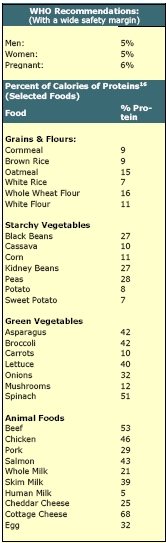 The World Health Organization (WHO)
recommends that men and women obtain 5% of their calories as protein.
This would mean 38 grams of protein for a man burning 3000 calories a
day and 29 grams for a woman using 2300 calories a day. This quantity of
protein is impossible to avoid when daily calorie needs are met by
unrefined starches and vegetables. For example, rice alone would provide
71 grams of highly useable protein and white potatoes would provide 64
grams of protein.8
The World Health Organization (WHO)
recommends that men and women obtain 5% of their calories as protein.
This would mean 38 grams of protein for a man burning 3000 calories a
day and 29 grams for a woman using 2300 calories a day. This quantity of
protein is impossible to avoid when daily calorie needs are met by
unrefined starches and vegetables. For example, rice alone would provide
71 grams of highly useable protein and white potatoes would provide 64
grams of protein.8
Our greatest time of growth�thus, the
time of our greatest need for protein�is during our first 2 years of
life�we double in size. At this vigorous developmental stage our ideal
food is human milk, which is 5% protein. Compare this need to food
choices that should be made as adults�when we are not growing. Rice is
8% protein, corn 11%, oatmeal 15%, and beans 27%.8 Thus
protein deficiency is impossible when calorie needs are met by eating
unprocessed starches and vegetables.
The healthy active
lives of hundreds of millions of people laboring in Asia, Africa, and
Central and South America on diets with less than half the amount of
protein eaten by Americans and Europeans prove that the popular
understanding of our protein needs is seriously flawed.
Faulty Observations Lead to High
Protein Recommendations
People commonly believe: the more
protein consumed the better. This faulty thinking dates back to the late
1800s, and was established without any real scientific research. An
assumption was made that people who could afford to do so would
instinctively select a diet containing the right amount of protein.
After observing the diets of laborers, soldiers, and workers in Western
Europe and the USA, recommendations of 100 and 189 grams of protein a
day were established.9 People�s innate ability to select a
proper diet is disproved by the present day popularity of burger joints,
donut shops, and pizza parlors.
Further confusion about our protein
needs came from studies of the nutritional needs of animals. For
example, Mendel and Osborne in 1913 reported rats grew better on animal,
than on vegetable, sources of protein. A direct consequence of their
studies resulted in meat, eggs, and dairy foods being classified as
superior, or "Class A" protein sources and vegetable proteins
designated as inferior, or "Class B" proteins.9 Seems
no one considered that rats are not people. One obvious difference in
their nutritional needs is rat milk is 11 times more concentrated in
protein than is human breast milk. The extra protein supports this
animal�s rapid growth to adult size in 5 months; while humans take 17
years to fully mature.
The recent popularity of high protein
diets has further popularized the fallacy that �more protein is good for
you.� True, high protein diets, like Atkins, will make you sick enough
to lose your appetite and temporarily lose weight, but this fact should
not be extrapolated to mean high protein is healthy�in fact, the
opposite is true.
The Truth Has Been Known for More than a
Century
In 1903, the head of Yale�s department
of biochemistry, Professor Russell Henry Chittenden, reported profound
health benefits gained by cutting popular recommendations for protein
held at his time by half to two-thirds (from 150 grams to 50 grams
daily). His research included detailed dietary histories and laboratory
studies of his subjects.9
In the 1940s, William Rose performed
experiments on people which found daily minimum protein needs to be
about 20 grams a day. Further research on men found single plant foods
consumed in an amount sufficient to meet daily needs easily met these
human requirements for all 8 essential amino acids.9 (A more
detailed discussion of the history of protein recommendations is found
in my December 2003 newsletter article: A Brief History of Protein:
Passion, Social Bigotry, and Enlightenment.)
The results of Dr.
Rose's studies are summarized in the following chart, under "minimum
requirements". From the chart, it is clear that vegetable foods contain
more than enough of all the amino acids essential for humans.10

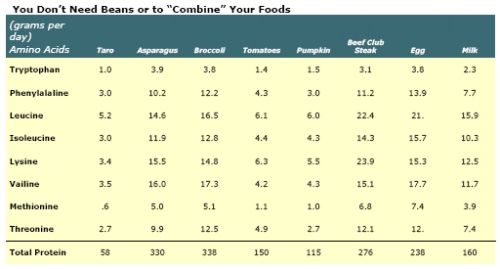
You Don�t Need Beans or to �Combine�
Your Foods
Many investigators have measured the
capacity of plant foods to satisfy protein needs. Their findings show
that children and adults thrive on diets based on single or combined
starches, and grow healthy and strong.10 Furthermore, no
improvement has been found from mixing plant foods or supplementing them
with amino acid mixtures to make the combined amino acid pattern look
more like that of flesh, milk, or eggs. In fact, supplementing a food
with an amino acid in order to conform to a contrived reference standard
can create amino acid imbalances. For example, young children fed diets
based on wheat or corn and supplemented with the amino acids tryptophan
and methionine in order to conform to the standard requirements set by
the Food and Agriculture Organization of the United Nations (FAO)
developed negative responses in terms of nitrogen balance (the body's
utilization of protein).10
People who are worried about getting
sufficient protein will sometimes ask me if they can still follow the
McDougall Diet if they do not like beans. From the chart above, you will
notice that any single starch or vegetable will provide in excess of our
needs for total protein and essential amino acids�thus there is no
reason to rely on beans or make any efforts to food combine different
plant foods to improve on Nature�s own marvelous creations.
Potatoes Alone Suffice
Many populations, for example people in
rural Poland and Russia at the turn of the 19th century, have
lived in very good health doing extremely hard work with the white
potato serving as their primary source of nutrition. One landmark
experiment carried out in 1925 on two healthy adults, a man 25 years old
and a woman 28 years old had them live on a diet primarily of white
potatoes for 6 months. (A few additional items of little nutritional
value except for empty calories�pure fats, a few fruits, coffee, and
tea�were added to their diet.)11 The report stated, �They did
not tire of the uniform potato diet and there was no craving for
change.� Even though they were both physically active (especially the
man) they were described as, ��in good health on a diet in which the
nitrogen (protein) was practically solely derived from the potato.�
The potato is such a great source of
nutrition that it can supply all of the essential protein and amino
acids for young children in times of food shortage. Eleven Peruvian
children, ages 8 months to 35 months, recovering from malnutrition, were
fed diets where all of the protein and 75% of the calories came from
potatoes. (Soybean-cottonseed oils and pure simple sugars, neither of
which contains protein, vitamins, or minerals, provided some of the
extra calories.)12 Researchers found that this simple potato
diet provided all the protein and essential amino acids to meet the
needs of growing and small children.
Excess Protein Causes Diseases of
Over-nutrition
Unlike fat, protein cannot be stored.
When it is consumed in excess of our needs, protein is broken down
mostly by the liver, and partly by the kidneys and muscles. Consumption
in excess of our needs overworks the liver and kidneys, and can cause
accumulation of toxic protein byproducts.
Proteins are made of amino acids, and
are, therefore, acidic by nature. Animal proteins are abundant in
sulfur-containing amino acids which break down into very powerful
sulfuric acid. These kinds of amino acids are abundant in hard cheese,
red meat, poultry, seafood, and eggs, and their acids must be
neutralized by buffers found in the bones. The bones dissolve to release
the buffering materials; eventually resulting in a condition of weakened
bones, known as osteoporosis. Released bone materials often settle and
coalesce in the kidney system, causing kidney stones. Fruits and
vegetables are largely alkaline, preserving bone health and preventing
kidney stones.13 (A more detailed discussion of the health
consequences from excess protein is found in my January 2004 newsletter
article: Protein Overload.)
Diseases of over-nutrition are directly
connected to planet health, too. Recommendations to eat animal foods for
protein have resulted in an environmental catastrophe. Livestock
produces 18% of the greenhouse gases; these food-animals occupy 26
percent of the ice-free surface of the Earth and 33 percent of the total
arable land is used to produce their food. One telling tragedy is they
account for the deforestation of 70 percent of Amazon rainforests, which
act as the �lungs of the Earth.�14 (A more detailed
discussion of the environmental damage from livestock is found in my
December 2006 newsletter article: An Inconvenient Truth: We Are Eating
Our Planet To Death.)
Protein Deficiency Is Really Food
Deficiency
How many cases of the so-called �protein
deficiency state,� kwashiorkor, have you seen? I have never seen a case,
even though I have known thousands of people on a plant-food based diet.
How about those starving children in Africa? The picture one often sees
of stick-thin children with swollen bellies in famine areas of Asia or
Africa is actually one of starvation and is more accurately described as
�calorie deficiency.�10 When these children come under
medical supervision, they are nourished back to health with their local
diets of corn, wheat, rice, and/or beans. Children recovering from
starvation grow up to l8 times faster than usual and require a higher
protein content to provide for their catch-up in development�and plant
foods easily provide this extra amount of protein.10 Even
very-low protein starchy root crops, such as cassava root, are
sufficient enough in nutrients, including protein, to keep people
healthy.15
Starving People Die of Fat, Not Protein,
Deficiency
In 1981, 10 Irish prisoners from the
Republican Army (IRA) went on a hunger strike. Nine out of 10 of these
men died between 57 and 73 days (mean of 61.6 days) of starvation after
losing about 40% of their body weights (the remaining striker died of
complications of a gunshot wound).16,17 This experience gave
doctors a chance to observe first hand the metabolic changes that occur
during starvation. Protein stores were generally protected during
starvation, with most of the energy to stay alive being derived from the
men�s fat stores. It was estimated that the hunger strikers had lost up
to 94% of their body-fat levels, but only 19% of their body-protein
levels at the time of death.16 They died when they ran out of
fat. Since fat is more critical than protein, people should be asking,
�Where do you get your fat (on any diet)?
Since Nature designed her plant foods
complete, with abundant amounts of fat, protein, carbohydrates, vitamins
and minerals, �Where you get a specific nutrient?� is almost never a
relevant question, as long as there is enough to eat. So, why have
scientists, dietitians, medical doctors, diet-book authors, and the lay
public become fixated on a non-existent problem? Protein is synonymous
with eating meat, poultry, fish, dairy, and eggs�the foods traditionally
consumed by the wealthier people in a society�thus, protein-eating means
higher social status. High-protein foods are also high-profit foods.
Therefore, propagating the protein myth is motivated by egos and
money�and the usual consequences of pain and suffering follow closely
behind these two human frailties.
References:
1)
St Jeor S, Howard B, Prewitt E. Dietary protein and weight reduction: a
statement for healthcare professionals from the Nutrition Committee of
the Council on Nutrition, Physical Activity, and Metabolism of the
American Heart Association. Circulation. 2001; 104: 1869�1874.
2) Tufts University: http://www.thedoctorwillseeyounow.com/articles/nutrition/protein_2/
http://www.quackwatch.org/03HealthPromotion/vegetarian.html
3) Harvard School of Public Health:
http://www.hsph.harvard.edu/nutritionsource/protein.html
4) Northwestern University: http://www.feinberg.northwestern.edu/nutrition/factsheets/protein.html
5)
McDougall J. Plant foods have a complete amino acid composition.
Circulation. 2002 Jun 25;105(25):e197; author reply e197.
6)
McDougall J. Misinformation on plant proteins. Circulation. 2002 Nov
12;106(20):e148; author reply e148.
7) Personal Communication with John
McDougall, MD on July 10, 2003.
8) J Pennington. Bowes & Church�s Food
Values of Portions Commonly Used. 17th Ed. Lippincott.
Philadelphia- New York. 1998.
9)
The December 2003 McDougall Newsletter: A Brief History of Protein:
Passion, Social Bigotry, and Enlightenment.
10) McDougall J. The McDougall Plan. New
Win Publ. 1983; pages 95-109.
11) Kon S. XXXV. The value of whole
potato in human nutrition. Biochemical J. 1928; 22:258-260
12) Lopez de Romana G. Fasting and
postprandial plasma free amino acids of infants and children consuming
exclusively potato protein. J Nutr. 1981 Oct;111(10):1766-71.
13)
The January 2004 McDougall Newsletter: Protein Overload.
14)
The December 2006 McDougall Newsletter: An Inconvenient Truth: We Are
Eating Our Planet To Death.
15) Millward DJ. The nutritional value
of plant-based diets in relation to human amino acid and protein
requirements. Proc Nutr Soc. 1999 May;58(2):249-60.
16) Leiter LA, Marliss EB. Survival
during fasting may depend on fat as well as protein stores. JAMA
1982;248:2306
17)
Zimmerman MD, Appadurai K, Scott JG, Jellett LB, Garlick FH.
Survival. Ann Intern Med. 1997 Sep 1;127(5):405-9.