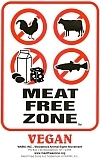
Meat Free Zone
Articles - Health & Nutrition
|
Meat Free Zone |
|
Home Woodstock Animal Rights Movement
A Store For Life
P. O. Box 746 |
Preventing and Reversing Osteoporosis Osteoporosis can lead to serious and sometimes disabling fractures, particularly in the vertebrae and hip. The condition is more common among women than men, and more prevalent among Caucasians than other racial groups. According to the National Health and Nutrition Examination Survey III, conducted between 1988 and 1991, the age-adjusted prevalence of osteoporosis in women aged 50 years and older was 21 percent in U.S. whites, compared to 16 percent for Mexican Americans and 10 percent for African Americans.1 Similarly, a 1988 Texas study showed that hip fracture rates (a sign of osteoporosis) were much lower among African American (55 per 100,000) and Mexican American women (67 per 100,000) than white women (139 per 100,000).2 While patients tend to assume that boosting their calcium intake will ensure strong bones, research clearly shows that calcium intake is only part of the issue and that simply increasing calcium intake is an inadequate strategy. No less important is reducing calcium losses. The loss of bone mineral probably results from a combination of genetics and dietary and lifestyle factors, particularly the intake of animal protein, salt, and possibly caffeine, along with tobacco use, physical inactivity, and lack of sun exposure. Animal protein tends to leach calcium from the bones, leading to its excretion in the urine. Animal proteins are high in sulfur-containing amino acids, especially cystine and methionine. Sulfur is converted to sulfate, which tends to acidify the blood. During the process of neutralizing this acid, bone dissolves into the bloodstream and filters through the kidneys into the urine. Meats and eggs contain two to five times more of these sulfur-containing amino acids than are found in plant foods.3 International comparisons show a strong positive relationship between animal protein intake and fracture rates. Such comparisons generally do not take other lifestyle factors, such as exercise, into account. Nonetheless, their findings are supported by clinical studies showing that high protein intakes aggravate calcium losses. A 1994 report in the American Journal of Clinical Nutrition showed that when animal proteins were eliminated from the diet, calcium losses were cut in half.4 Patients can easily get adequate protein from grains, beans, vegetables, and fruits. Sodium also encourages calcium to pass through the kidneys. While patients tend to associate sodium with high blood pressure, its effect on calcium is equally important. People who reduce their sodium intake to 1-2 grams per day cut their calcium requirement by an average of 160 milligrams per day. It helps to encourage your patients to avoid salty snacks and canned foods with added sodium, and to minimize salt use in the kitchen and at the table.5 Caffeine�s diuretic effect causes the loss of both water and calcium, and appears to be significant at consumption levels equivalent to two or more cups of coffee per day.6 Smoking is also a contributor to calcium loss. A study of identical twins showed that long-term smokers had a 44 percent higher risk of fracture compared to their non-smoking twins.7 Active people keep calcium in their bones, while sedentary people tend to lose calcium. Physical activity may be part of the reason why people in the nonindustrialized world have fewer fractures. Simple weight-bearing exercises can be recommended for patients at virtually any age. Vitamin D is also important, as it controls how efficiently the body absorbs and retains calcium. In a 1997 study of 389 subjects who were given either a combination of 700 IU of cholecalciferol and 500 milligrams of calcium citrate malate or a placebo each day, 11 people in the treated group had fractures over a three-year period, compared to 26 in the placebo group.8 A few minutes of sunlight on the skin each day normally produces all the vitamin D the body needs. However, people who get little or no sun exposure, who live in areas with less direct sunlight, who have darker skin, or who are older, may need a vitamin D supplement. The Recommended Dietary Allowance for healthy adults is 200 IU (5 micrograms) per day. The Role of Calcium Getting enough calcium in the diet has been emphasized in the popular press. However, calcium intake alone does not protect against osteoporosis and fractures, nor do low calcium intakes predict fracture risk. A 1992 review of fracture rates in many different countries showed that populations with the lowest calcium intakes had far fewer fractures than those with much higher intakes. For example, South African blacks had a very low average daily calcium intake�only 196 milligrams�yet their a fracture incidence was only 6.8 per 100,000 person-years, far below that of either black or white Americans, whose incidence rates were 60.4 and 118.3 per 100,000 person-years, respectively.9 A possible explanation for this apparent contradiction is that countries with high calcium intakes also tend to have high protein intakes. Since dairy cattle are slaughtered for meat when their milk consumption is no longer cost-efficient, dairy-producing countries also have a constant supply of animal protein. The meat consumption that is common in these countries probably contributes to their high rates of osteoporosis. The Harvard Nurses� Health Study of 77,761 women, aged 34 to 59 followed for 12 years, found that those who drank three or more glasses of milk per day had no reduction in the risk of hip or arm fractures compared to those who drank little or no milk, even after adjustment for weight, menopausal status, smoking, and alcohol use. In fact, the fracture rates were slightly, but significantly, higher for those who consumed this much milk, compared to those who drank little or no milk.10 Healthful Calcium Sources While an exclusive focus on calcium intake is inappropriate, the body does need calcium. The optimal calcium intake is not known. The World Health Organization recommends 400-500 milligrams of calcium per day for adults. American standards are higher, at 800 milligrams per day or even more, partly because the meat, salt, tobacco, and physical inactivity of American life leads to rapid calcium loss. The most healthful calcium sources are green leafy vegetables and legumes, which your patients can remember as �greens and beans.� They have several advantages that dairy products lack. They contain antioxidants, complex carbohydrate, fiber, and iron, and have little fat and no cholesterol. The calcium absorption from vegetables is as good or better than that of milk. Calcium absorption from milk is approximately 32 percent. Figures for broccoli, Brussels sprouts, mustard greens, turnip greens, and kale range between 40-64 percent.11,12 A noteworthy exception is spinach, which contains a large amount of calcium, but in a form that is poorly absorbed. Beans (e.g., pinto beans, black-eyed peas, and navy beans) and bean products, such as tofu, are rich in calcium. For patients looking for a very concentrated calcium source, calcium-fortified orange juice contains 270 milligrams of calcium per cup, usually in the form of calcium citrate, which has a much higher absorption fraction than cow�s milk. Calcium-fortified soy and rice milks are also widely available.
The Role of Hormones As menopause approaches, bone loss accelerates. Doctors have attributed this loss of bone calcium to the drop in estrogens and/or progesterone. The use of prescription hormone �replacement,� using a combination of estrogens and progesterone derivatives, slows, but does not usually arrest bone loss, and their benefits diminish with time. The most commonly prescribed estrogen, Premarin, is made from pregnant mares� urine, from whence comes its name. Other brands are synthetic or plant-derived. Estrogens have numerous side effects, the most worrisome of which is an increase in breast cancer risk. The Harvard Nurses� Health Study found that women taking estrogens have 30-80 percent more breast cancer, compared to other women.13 Adding progesterone derivatives does not offset this increased risk. A non-prescription hormone preparation, called natural progesterone, may be a safer and more effective alternative. It is an exact copy of human progesterone that is derived from wild yams or soybeans and is administered as a transdermal cream or oral preparation. The cream is preferable as it bypasses liver detoxification. In a three-year study of post-menopausal women treated with natural progesterone, bone density increased by about 15 percent, which is more than enough to have a major effect on fracture risk.14 It apparently acts by stimulating osteoblasts to lay down healthy new bone. Osteoporosis in Men Osteoporosis is less common in men than in women, and is often due to other health conditions, including the following:15
In many of the remaining cases, the causes are excessive calcium losses and inadequate vitamin D. The first part of the solution is to avoid animal protein, excess salt and caffeine, and tobacco, and to stay physically active. Second, vitamin D supplements are helpful, as noted above. References |
|||||||||||||||||||||||||||||||||||||||||||||||||||||||||||||||||||||||||||||||||||||||||||||||||||
Your
comments are welcome

The Meat Free Zone (MFZ) campaign is intended to make the MeatFreeZone logo as recognizable a symbol as the "Smoke Free Zone". The idea was originally conceived when The WARM Store in Woodstock, NY, was in operation throughout the '90's (Woodstock Animal Rights Movement). The store was truly a meat free zone as it was the first cruelty-free, Vegan, socially conscious animal rights store in the United States. Now that the Vegan and Vegetarian movements have been growing so rapidly, more and more people are showing concern about the food in their diet and their overall health and nutrition. Many people are giving up eating fish, chicken, beef, pork (pigs ), dairy (milk, cheese, yogurt, ice cream) and eggs. Headlines of Mad Cow disease, E-coli and salmonella are in the news with greater frequency. Vegan and vegetarian recipe cookbooks are standard now in all bookstores and many restaurants have added Vegan and Vegetarian options to their menus. We hope you will help us with the Meat Free Zone campaign by putting the signs up in your homes and workplaces and by spreading them to all the vegetarian and vegan restaurants that you know and frequent. And someday we will have true "meat free zones" in establishments that serve meat. (d-2)
|
This site is hosted and maintained by: |