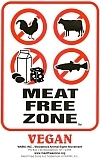
Meat Free Zone
Articles - Health & Nutrition
|
Meat Free Zone |
|
Home Woodstock Animal Rights Movement
A Store For Life
P. O. Box 746 |
Diet and Prostate Cancer Scientific evidence clearly shows that diet has an important influence on prostate cancer risk. Frequent consumption of meat and dairy products is linked to increased risk, due, at least in part, to the amount and type of fat they contain. Animal products also lack the protective nutrients found in vegetables and fruits.1-3 The disease is rarer among populations consuming more rice, soybean products, and green or yellow vegetables, and among vegetarians.4-8 Seventh-day Adventist men, about half of whom are vegetarians, have only one-third the prostate cancer risk of other men, and data suggest that the earlier a vegetarian diet is adopted, the lower the risk.7,8 Dietary factors may influence not only prostate cancer incidence, but also how quickly it changes from a small growth causing no clinical problems to an advancing, spreading tumor. The prevalence of latent cancers (small growths causing no symptoms) varies somewhat from one country to another, the lowest rates being in Singapore (13 percent) and Hong Kong (15 percent), and the highest in Sweden (31 percent).9 The prevalence of advancing cancer, however, varies much more widely. While a man in Sweden is twice as likely as a man in Hong Kong to have latent cancerous cells in his prostate, he is more than eight times more likely to die of prostate cancer.9 Such studies suggest that environmental factors, particularly diet, may play an important role in the progression of the disease. Plant-based diets are not only rich in protective nutrients, especially carotenoids such as lycopene, the natural red color in tomatoes. They are also very low in fat. Reduced fat intake helps avert testosterone excesses. Men consuming high-fat diets typically have elevated levels of testosterone in their blood.10-13 This elevation does not confer any health benefits (it does not make them more "manly"). Rather, it can overstimulate the cells of the prostate, increasing cancer risk. IGF-I and Prostate Cancer An additional cancer risk relates to a protein in the bloodstream called insulin-like growth factor-I (IGF-I). Although a certain amount of IGF-I in the blood is normal, high levels are linked to increased cancer risk.14-17 IGF-I plays a role in cell growth among other functions, and test-tube experiments show that IGF-I encourages cancer cell growth.18,19 Diet has a strong influence on IGF-I. In general, excess intake of calories or proteins increases the amount of IGF-I in the blood, and the inclusion of dairy products in the diet merits particular attention. According to a review published by the World Cancer Research Fund and the American Institute for Cancer Research, at least 11 human population studies have linked dairy product consumption and prostate cancer.20 People increasing the amount of dairy products in their diets are typically found to have higher levels of IGF-I in their blood. Following a study of 12-year-old girls in Sheffield, England, which found that increasing daily milk consumption increased serum IGF-I concentration, a study of adult men and women showed that adding three daily eight-ounce servings of nonfat or 1 percent milk for 12 weeks was associated with a 10 percent increase in serum IGF-I concentration.21,22 Conversely, plant-based diets may reduce serum IGF-I levels.23 The most important message is that while consumption of meat and dairy products appears to increase cancer risk, diets rich in vegetables and fruits cut risk, giving men more control over their health than they might otherwise have had. References |
Your
comments are welcome

The Meat Free Zone (MFZ) campaign is intended to make the MeatFreeZone logo as recognizable a symbol as the "Smoke Free Zone". The idea was originally conceived when The WARM Store in Woodstock, NY, was in operation throughout the '90's (Woodstock Animal Rights Movement). The store was truly a meat free zone as it was the first cruelty-free, Vegan, socially conscious animal rights store in the United States. Now that the Vegan and Vegetarian movements have been growing so rapidly, more and more people are showing concern about the food in their diet and their overall health and nutrition. Many people are giving up eating fish, chicken, beef, pork (pigs ), dairy (milk, cheese, yogurt, ice cream) and eggs. Headlines of Mad Cow disease, E-coli and salmonella are in the news with greater frequency. Vegan and vegetarian recipe cookbooks are standard now in all bookstores and many restaurants have added Vegan and Vegetarian options to their menus. We hope you will help us with the Meat Free Zone campaign by putting the signs up in your homes and workplaces and by spreading them to all the vegetarian and vegan restaurants that you know and frequent. And someday we will have true "meat free zones" in establishments that serve meat. (d-3)
|
This site is hosted and maintained by: |