The goal of every doctor should be to help make his or
her patients drug-free by teaching them to become healthy. Unfortunately,
most doctors know only drug-therapy for patients’ problems and the result
is fat and sick people carrying around bags full of prescriptions – and
they are not one speck healthier or happier. (And you wonder why so many
doctors complain about the practice of medicine these days. How would you
feel if all of your projects ended in failure?)
To make matters worse, well-intentioned doctors are
making their prescription decisions based upon fraudulent and incomplete
information paid for by pharmaceutical companies – blind to the suffering
of their customers; these businesses manipulate the research studies in
order to boost sales. You should not be surprised by this, after all,
pharmaceutical companies are in the business of profiting from your
sickness and, as a result of their efforts, they are considered among the
most successful of all businesses worldwide.
Drug companies spend billions of dollars and employ
thousands of people to try to demonstrate the slightest benefits from
their products. From the beginning, the “investigations” used to sell
their products are designed so that the results will turn out favorable –
why not? They are paying for the project. And if the results do not turn
out as expected, then these companies bury any research findings that
weigh negatively upon their products.1 The US government turns a blind eye
to these shenanigans. According to top researchers, we can no longer rely
upon the Food and Drug Administration (FDA) for protection from useless
and dangerous drugs, since this organization acts essentially as a tool
for the pharmaceutical industries.2
All this dishonesty is very profitable; $154.4 billion
dollars was spent by consumers in one year (2001) on medications that in
many cases do more harm than good – and prescription drug spending rises
15% to 18% per year.3 All the while, hopeful patients are lulled into
believing they will be saved by these miracle potions. If the truth were
to be known, more of these same ill people would take matters into their
own hands and save themselves with a healthy diet, some exercise, and
clean habits, rather than waiting to be saved by “technological
breakthroughs.” When was the last miracle drug invented? Penicillin
discovered in 1928 by Alexander Fleming? Viagra discovered in 1991 by
Nicholas Terrett? Most new drugs released to the marketplace are simply
copies of older drugs with minor variations to allow a new patent.
Most Drugs on the Market Are Useless and Harmful
People running the drug companies are aware of the
fraudulent nature of their business. According to Allen Roses, Vice
President of GlaxoSmithKline, one of the world’s leading pharmaceutical
companies, “Vast majority of drugs only work in 30 or 50% of people.”4
When he says “work,” I assume he is giving credit for even the slightest
positive change, and not talking about resolving the patients’ illnesses –
because essentially 100% of the drugs used to treat chronic diseases fail
to cure the patient. Yet, the language used by pharmaceutical companies to
promote their products might cause you to think otherwise. They refer to
their drugs in ways that suggest their inventions commonly cure chronic
diseases, by calling their products, “antihypertensive” and “antidiabetic”
– as if these chemicals would eradicate hypertension (high blood pressure)
and diabetes – maybe something like antibiotics kill bacteria and cure
infections. The truth is, no doctor has ever seen a patient cured of high
blood pressure or diabetes with either class of medication, no matter how
much they might wish it to be otherwise. By and large, drugs do little, if
anything, to improve the well-being and/or longevity of people suffering
with chronic diseases, but are undeniably a direct source of death,
disability and suffering.
Approximately 2 to 7 % of all hospital admissions are
caused by medications prescribed to patients, and approximately 70% of
these incidences are judged as preventable.5,6 Approximately 28% of all
emergency department visits are a result of taking prescription drugs.7
The drugs most commonly implicated are: NSAIDs, antiplatelets, seizure
medications, antidiabetic drugs, antihypertensives (diuretics and
beta-blockers), inhaled corticosteroids, and cardiac drugs.
FDA Official Warns Us about Five Medications
On Thursday, November 19, 2004, David Graham, associate
science director of the Office of Drug Safety, told a US Senate hearing
that FDA agency officials "ostracized" him and subjected him to "veiled
threats" when he tried to have his study cleared for publication on the
hazards of Vioxx.8 Based on the results of Merck's own clinical trials,
Graham said “between 88,000 and 139,000 Americans had probably had heart
attacks or strokes as a result of taking Vioxx, and that 30 to 40 percent
had probably died.” He described the FDA as incapable of stopping
dangerous drugs from coming to and staying on the market and that the
FDA's role in reviewing and approving new drugs sometimes conflicted with
its duty to address safety issues.
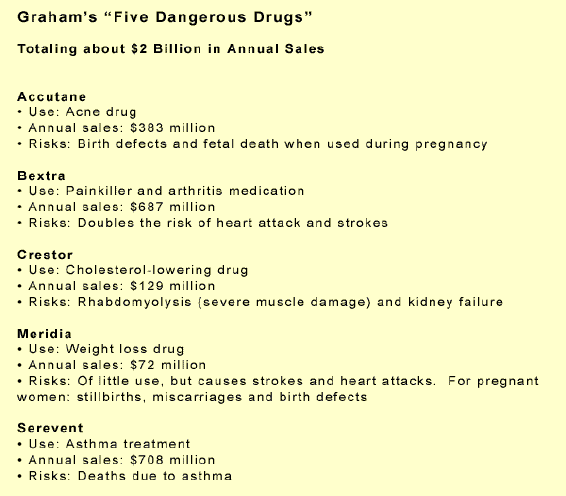
He told the Senate that five other widely used drugs
should be either withdrawn or sharply restricted because they have
dangerous side effects.
McDougall’s “Five Dangerous Categories of Drugs”
Totaling more than $30 Billion in Annual Sales
Note: All five of the following medications increase the
risk of dying from heart disease and many of my patients have taken all
five at the same time in the past.
As a board-certified internist for more than 30 years,
taking care of mostly adults with chronic diseases, I realize that
medications can be useful, and occasionally lifesaving. My decisions that
lead to prescribing are based on the scientific research published in the
medical journals. As I explained above, this information has been so
severely compromised by the pharmaceutical companies that I look upon any
research that appears favorable to high-profit drugs with skepticism.
However, when research repeatedly criticizes any of the
“billion-dollar-medications,” then I know the condemning evidence must be
overwhelming. Based on what I have learned, there are five categories of
medication I never prescribe. (If you are taking any of these medications,
I encourage you to talk to your doctor about stopping them and/or
substituting with a safer choice.)
n Sulfonylureas for Type-2 Diabetics:
Sulfonylureas are used for type-2 diabetes because they
lower the blood sugar level by stimulating insulin secretion by the
pancreas. Insulin is a hormone which lowers the blood sugar level.
Why I will not prescribe them:
Since 1972 the Physicians’ Desk Reference (PDR) has
warned that these drugs will increase your risk of dying from heart
disease by 2 ½ times over taking no medication at all. The mechanisms for
causing this harm are well-known.9 In a recent study, these “antidiabetic
agents” have been shown to more than double the risk of heart attacks and
almost triple the risk of early death in patients after an angioplasty.10
They cause an average weight gain of 8 to 20 pounds when the drugs are
started. 11 Most importantly, they do not make patients live longer or
healthier.
Examples of Commonly Prescribed Medications: Amaryl,
DiaBeta, Diabinese, Glucotrol, Glucovance, and Metaglip.
n Calcium Channel Blockers for Hypertension:
Calcium channel blockers are also called “calcium
antagonists” and “calcium blockers.” They may decrease the heart's pumping
strength and relax blood vessels, and are commonly used to treat high
blood pressure, angina (chest pain), and some arrhythmias (abnormal heart
rhythms).
Why I will not prescribe them:
They increase the risk of dying from heart disease,
cancer (and especially breast cancer), and suicide.12-16 They can cause
excessive bleeding.17 Simpler, safer, and cheaper medications, such as
diuretics and beta blockers are available.18,19 Like other blood
pressure-lowering medications, they have done very little, if anything, to
reduce the risk of heart attacks, and far too little to reduce the risk of
strokes.
Examples of Commonly Prescribed Medications: Adalat,
Cardene, Cardizem, Covera-HS, DynaCirc, Isoptin, Nimotop, Norvasc, Plendil,
Procardia, Sular, Tiazac, Verelan.
n Medroxyprogesterone for Menopause:
Medroxyprogesterone is a progestin, which means it acts
like the female hormone progesterone, but it is synthetic, and therefore,
able to be patented. Most commonly this hormone is used in the treatment
of menopausal symptoms.
Why I will not prescribe them:
These medications increase the risk of heart attacks,
stroke, breast cancer, pulmonary emboli, and blood clots.20 Natural
progesterone works as well without an increased risk of heart attacks,
strokes or breast cancer.
Examples of Commonly Prescribed Medications: Amen,
Cycrin, Premphase, Prempro, Provera.
n Cox-2 Inhibitors for Arthritis Pain:
COX-2 inhibitors are newly developed drugs for
inflammation and pain, such as are found with arthritis. They selectively
block the COX-2 enzyme, thus reducing the production of small hormones,
called prostaglandins. Because they selectively block the COX-2 enzyme and
not the COX-1 enzyme, these drugs are uniquely different from traditional
NSAIDs (like Motrin and Advil), which block both kinds of enzymes. By not
blocking Cox-1, damage to the esophagus and stomach is reduced.
Why I will not prescribe them:
Cox-2 inhibitor NSAIDs have been shown to increase the
chances of having a heart attack by 2 to 5 times.21 They are no more
effective at relieving pain than aspirin or regular NSAIDs (like Motrin or
Advil). The manufacturer of Celebrex remains steadfast that its medication
is innocent of this deadly side effect.
Examples of Commonly Prescribed Medications: Celebrex,
Betrax, and Vioxx. Vioxx was recently withdrawn from the market.
n Angiotensin Receptor Blockers for Hypertension or
Heart Disease:
Angiotensin is a hormone found in the body that causes
blood vessels to constrict, resulting in high blood pressure and extra
work on the heart. Angiotensin Receptor Blockers (ARBs), also called
Angiotensin II Receptor Antagonists, prevent angiotensin from binding to
its receptor in the walls of the blood vessels. This results in a lower
blood pressure. These medications are often prescribed because they are
less likely to cause a chronic cough than medications called angiotensin
converting enzyme inhibitors, which also work on the “angiotensin system”
to control high blood pressure.
Why I will not prescribe them:
Careful evaluation of the current evidence shows that
angiotensin receptor blockers (unlike angiotensin converting enzyme
inhibitors) increase the rates of myocardial infarction (heart attacks)
despite their beneficial effects on reducing blood pressure.22
Examples of Commonly Prescribed Medications: Cozaar,
Benicar, Diovan, Avapro, Micardis, Teveten, Hyzaar, and Atacand.

Drugs I Occasionally Prescribe
I am a real medical doctor with a prescription pad and
my obligation to each of my patients is to provide them the best that
medical science has to offer. In actual practice, for every new drug I
prescribe, I stop, on average, ten medications. The three reasons I take
people off their medications are:
1) They never needed them in the first place. The
medication is doing nothing for the benefit of the patient. For example,
many people have been prescribed blood pressure medications for blood
pressure readings too low to show any real benefits (below 160/100 mm Hg),
and thus, there is no indication to treat them based on the research.23
2) The medication is doing more harm than good. For
example, most diabetic pills for type-2 diabetics.
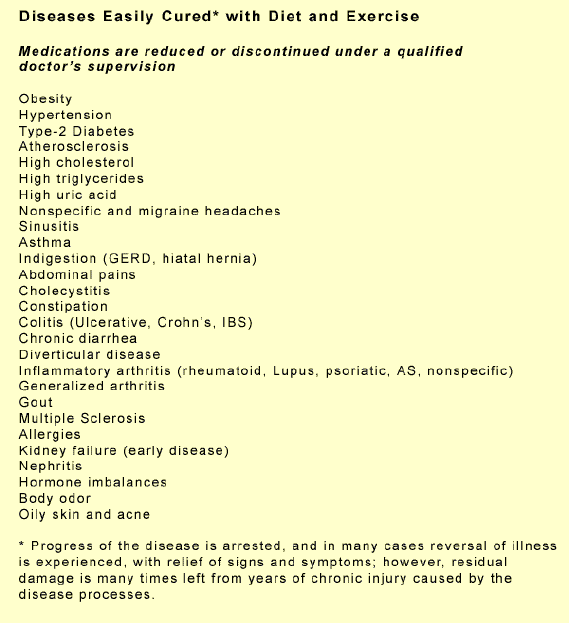
3) After a change in diet, some additional exercise, and
cleaner habits, the indication for the medication has been eliminated.
(See the extensive list of “easily treated diseases” below.)
Cholesterol-Lowering Medications:
I use “statins” often because they are well-tolerated,
and somewhat effective. I prefer Pravachol (pravastatin) because of its
safety record – it is not known to cause muscle damage. Plus, there is
good evidence that this medication is much more effective at preventing
heart attacks than the other statins.24 These benefits may be due to the
physical properties of this medication which prevent it from entering the
cells – its action is all outside of the body’s cells. I do, however,
prescribe most of the other statins, like Lipitor, Mevacor, Zocor, etc. –
usually because this is the one the patient’s insurance company pays for.
I also use niacin (usually as an extended release form,
like Niaspan); often along with agents that bind cholesterol in the
intestine and cause it to leave the body. These are called cholestyramine
(Questran) and colestipol (Colestid). (See my February 2003 newsletter
article: “Niacin - A Time Honored Treatment for Cholesterol and
Triglycerides.”)
My goal is to use sufficient medication to lower the
cholesterol below 150 mg/dl (and the LDL-cholesterol below 80 mg/dl).
Learn more about this treatment from my June 2003 newsletter article,
“Cleaning Out Your Arteries.”
Prevention of a Second Heart Attack:
One baby aspirin (81 mg) daily offers more benefits than
risks in people with a history of serious heart disease (bypass surgery,
angioplasty, or heart attack).25 Those without this history of heart
disease may suffer far more harm (bleeding) than benefit from taking
aspirin. More than 81 mg of aspirin is less effective and has more side
effects. I also use baby aspirin for people with a high risk for stroke.
Blood Pressure Lowering Medications:
I use beta blockers and/or diuretics, because they are
as effective as any other kind of medication used to lower blood
pressure.18,19 Mostly importantly, the slight reduction in the risk of
strokes achieved by lowering blood pressure is as good with these simple
drugs as that seen with the newer, more expensive, medications. Diuretics
and beta-blockers cost pennies to buy (as opposed to dollars for one dose
for the others) and because they have been used for more than 40 years,
their side effects are very well-known. I use sufficient medication to
keep the diastolic BP between 85 and 100 mmHg. BP lowered below 85 mmHg
with medication increases the risk of heart attacks and strokes. (See my
July 2004 newsletter article: “Over-treat Your Blood Pressure and You
Could Die Sooner.”)
Blood sugar-lowering medications:
For type-1 diabetics I use only insulin.
For type-2 diabetics I use enough insulin to keep them
from losing too much weight and to control symptoms of frequent urination
and excessive thirst. With some reluctance I will use Glucophage. The
evidence on the results of treating blood sugars for type-2 diabetics with
medications shows much harm and little good is done. The risk of dying
from heart disease appears to be increased and there is no convincing
evidence that blindness and kidney disease are reduced. Furthermore, most
treatments cause the patient to gain weight, which may aggravate their
diabetes. (See my February 2004 newsletter article: “Type-2 Diabetes – the
Expected Adaptation to Overnutrition.”)
Pain Medications:
I like aspirin and Tylenol. However, inexpensive
over-the-counter NSAIDs, like Motrin and Advil, are also fine for
occasional use. For severe pain, narcotics are useful, but addicting, over
the long term.
Relief of indigestion (Gastritis)
Wafer antacids (like Tums) or liquids. Use of simple,
over-the-counter antacid pills, like Tagamet or Zantac – used only as
needed, not daily. Changing to a healthy diet and raising the head of the
bed are of the most help. (See my February and March 2002 lead newsletter
articles.)
Colds and Flu:
Pains and fever: aspirin (not for children) and Tylenol.
Cough: Syrups with dextromethorphan (DM).
Nasal congestion: Nasalcrom spray, Afrin nasal spray,
and Sudafed tablets.
(See my October 2003 newsletter article: “Surviving the
Cold Season.”)
Chronic allergies and asthma:
Inhaled steroids and bronchodilators. Raising the head
of the bed and a diet change are very helpful. (See my February 2002
newsletter article: “My Stomach's on Fire and I Can't Put It Out.”)
Menopausal Symptoms and for reversal of bone loss:
Estradiol and/or natural progesterone mixed in creams
and applied to the skin. My goals are relief of symptoms and stabilization
of the bones. (See the “McDougall Program for Women” book.)
Infections:
Topical and systemic antibiotics along with proper wound
care.
There are many other medications I am called upon to
prescribe or renew, but these represent very special indications and apply
to very few of my patients.
References:
1) Antes G, Chalmers I. Under-reporting of clinical trials is
unethical. Lancet. 2003 Mar 22;361(9362):978-9.
2) Psaty B, Furberg C, Ray W, Weiss N, MD, Potential for Conflict of
Interest in the Evaluation of Suspected Adverse Drug Reactions. Use of
Cerivastatin and Risk of Rhabdomyolysis JAMA. 2004;292. :(DOI
10.1001/jama.292.21.2622).
3) NIHCM Foundation. Another Year of Escalating Costs. Revised
5-6-2002: http://www.nihcm.org/spending2001.pdf
4) Dyer O. City reacts negatively as GlaxoSmithKline announces plans
for new drugs. BMJ 2003;327:1366.
5) Roughead EE, Gilbert AL, Primrose JG, Sansom LN. Drug-related
hospital admissions: a review of Australian studies published 1988-1996.
Med J Aust. 1998 Apr 20;168(8):405-8.
6) Howard RL, Avery AJ, Howard PD, Partridge M. Investigation into the
reasons for preventable drug related admissions to a medical admissions
unit: observational study.
Qual Saf Health Care. 2003 Aug;12(4):280-5.
7) Patel P, Zed PJ. Drug-related visits to the emergency department:
how big is the problem? Pharmacotherapy. 2002 Jul;22(7):915-23.
8) Kaufman M. 5 widely used drugs called unsafe FDA officer says
conflicts of interest compromise agency.
http://www.sfgate.com/cgi-bin/article.cgi?file=/chronicle/archive/2004/11/19/MNGSB9UAM41.DTL
9) Engler RL, Yellon DM. Sulfonylurea KATP blockade in type II diabetes
and preconditioning in cardiovascular disease. Time for reconsideration.
Circulation. 1996 Nov 1;94(9):2297-301.
10) Garratt KN, Brady PA, Hassinger NL, Grill DE, Terzic A, Holmes DR
Jr. Sulfonylurea drugs increase early mortality in patients with diabetes
mellitus after direct angioplasty for acute myocardial infarction. J Am
Coll Cardiol. 1999 Jan;33(1):119-24.
11) Fonseca V. Effect of thiazolidinediones on body weight in patients
with diabetes mellitus. Am J Med. 2003 Dec 8;115 Suppl 8A:42S-48S.
12) Psaty BM, Heckbert SR, Koepsell TD, Siscovick DS, Raghunathan TE,
Weiss NS, Rosendaal FR, Lemaitre RN, Smith NL, Wahl PW, et al. The risk of
myocardial infarction associated with antihypertensive drug therapies.
JAMA. 1995 Aug 23-30;274(8):620-5.
13) Beiderbeck-Noll AB, Sturkenboom MC, van der Linden PD, Herings RM,
Hofman A, Coebergh JW, Leufkens HG, Stricker BH. Verapamil is associated
with an increased risk of cancer in the elderly: the Rotterdam study. Eur
J Cancer. 2003 Jan;39(1):98-105.
14) Fitzpatrick AL, Daling JR, Furberg CD, Kronmal RA, Weissfeld JL.
Use of calcium channel blockers and breast carcinoma risk in
postmenopausal women. Cancer. 1997 Oct 15;80(8):1438-47.
15) Pahor M, Guralnik JM, Ferrucci L, Corti MC, Salive ME, Cerhan JR,
Wallace RB, Havlik RJ. Calcium-channel blockade and incidence of cancer in
aged populations. Lancet. 1996 Aug 24;348(9026):493-7.
16) Lindberg G, Bingefors K, Ranstam J, Rastam L, Melander A. Use of
calcium channel blockers and risk of suicide: ecological findings
confirmed in population based cohort study. BMJ. 1998 Mar
7;316(7133):741-5.
17) Pahor M, Guralnik JM, Furberg CD, Carbonin P, Havlik R. Risk of
gastrointestinal haemorrhage with calcium antagonists in hypertensive
persons over 67 years old. Lancet. 1996 Apr 20;347(9008):1061-5.
18) Carlberg B, Samuelsson O, Lindholm LH. Atenolol in hypertension: is
it a wise choice? Lancet. 2004 Nov 6;364(9446):1684-9.
19) Major outcomes in high-risk hypertensive patients randomized to
angiotensin-converting enzyme inhibitor or calcium channel blocker vs
diuretic: The Antihypertensive and Lipid-Lowering Treatment to Prevent
Heart Attack Trial (ALLHAT). JAMA. 2002 Dec 18;288(23):2981-97.
20) Warren MP. A comparative review of the risks and benefits of
hormone replacement therapy regimens. Am J Obstet Gynecol. 2004
Apr;190(4):1141-67.
21) Topol EJ, Falk GW. A coxib a day won't keep the doctor away.
Lancet. 2004 Aug 21;364(9435):639-40.
22) Verma S, Strauss M. Angiotensin receptor blockers and myocardial
infarction. These drugs may increase myocardial infarction – and patients
may need to be told. BMJ 2004 Nov 27;329:1248-9.
23) Williams B, Poulter NR, Brown MJ, Davis M, McInnes GT, Potter JF,
Sever PS, Thom SM; BHS guidelines working party, for the British
Hypertension Society. British Hypertension Society guidelines for
hypertension management 2004 (BHS-IV): summary. BMJ. 2004 Mar
13;328(7440):634-40.
24) Ichihara K, Satoh K. Disparity between angiographic regression and
clinical event rates with hydrophobic statins. Lancet. 2002 Jun
22;359(9324):2195-8.
25) Lip GY, Felmeden DC. Antiplatelet agents and anticoagulants for
hypertension. Cochrane Database Syst Rev. 2004;(3):CD003186
Fair Use Notice: This document may contain copyrighted material whose
use has not been specifically authorized by the copyright owners.
We believe that this not-for-profit, educational
use on the Web constitutes a fair use of the copyrighted material (as
provided for in section 107 of the US Copyright Law). If you wish to use
this copyrighted material for purposes of your own that go beyond fair
use, you must obtain permission from the copyright owner.