 Art and Photo Presentations from All-Creatures.org
Art by Barry Kent MacKay
In this section are copies of original works of art. All of them are dedicated to helping us live according to unconditional love and compassion, which is the foundation of our peaceful means of bringing true and lasting peace to all of God's creatures, whether they are human beings or other animals.
Andean Condor (Vultur gryphus)
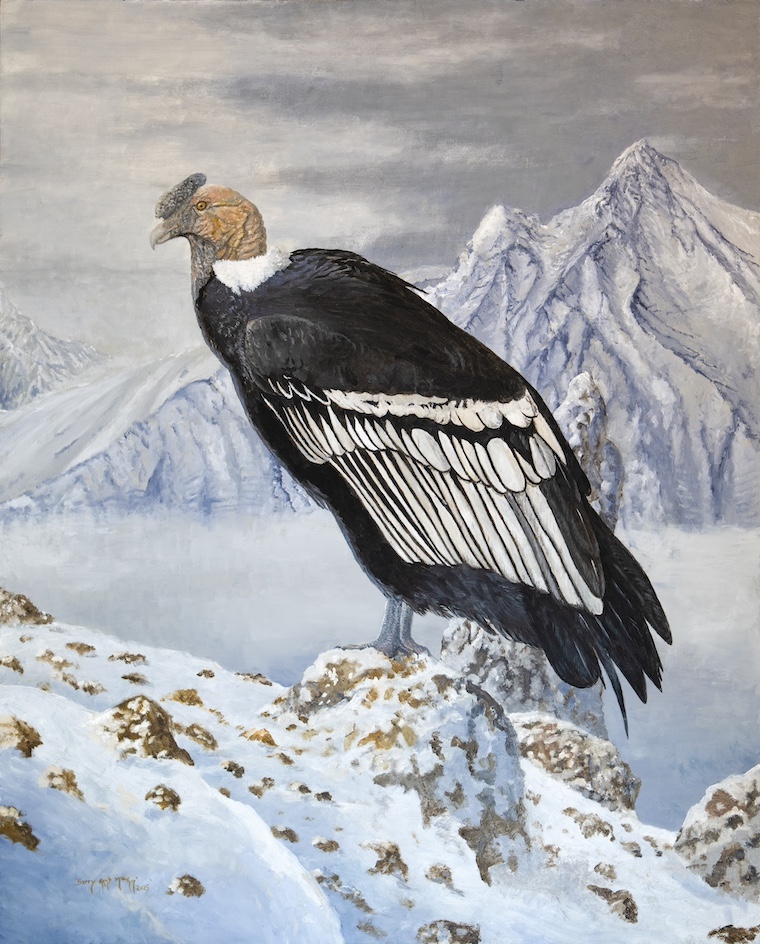
(Artwork - 259)
Andean Condor (Vultur gryphus)
This oil painting is of the probably the largest flying bird in the modern world, the Andean Condor (Vultur gryphus), with a maximum wingspan of about 3.3 meters (10 feet, 10 inches), and weighing in at 15 kg (33 lbs). The Snowy Albatross has a wingspan of up to a 3.7 meters (12 feet, 2 inches) but is much lighter in weight. Around 37 million years ago there was an extraordinary reptile we now call Quetzalcoatlus northropi that is estimated from fossil remains to have had a wingspan of 10 to 11 meters (33 to 36 feet). If we are going to consider the prehistoric animals, the bird with the widest wingspread was Pelagornis sandersi, with a wingspan estimated to have been 6 to 7 meters (20 to 24 feet). It was a seabird from the Oligocene, about 25 to 28 million years ago, whose fossils were found in South Carolina, in 2014. Its lineage died out but we know their beaks has tooth-like projections, like a modern merganser’s beak, writ large, rather spike-like, and like most modern birds, they had hollow bones. They had long, slender wings and would have soared, like albatrosses, over the ocean. Of course, there may be yet more such surprises to be found in the fossil record. Note to paleontologists: keep digging!
The Andean Condor is well-named as virtually their entire range is in, or within view of, the Andes mountains, down the west coast of South America, or their northern extension, north and east as far as Venezuela, where they are very rare. Altitudinally, the birds have been found from literally sea level to as high as 6,500 meters (21,300 feet) above sea level. Being, as I am, used to equating vultures with temperate and tropical climes, it sort of goes against my expectation that these species occur in snowy environs. But they are master gliders and from high, snow-covered peaks they can glide to the sun-baked shorelines of at least the equatorial coastline, far below, perhaps to dine on a washed-up whale or sealion.
Carrion is indeed their main diet, and as is true of other birds with similar feeding habits, they have too often died from secondary poisoning from the lead bullets in carcasses of animals shot by hunters. That, and habitat loss, plus some persecution, have all led to a reduction in the numbers and range of the species and resulted as it being listed as vulnerable by the International Union for Conservation of Nature. However, the species is also well regarded and protected and is the national symbol of Colombia, Ecuador, Peru, Chile, and Bolivia.
The painting is in oils and is 30 by 24½ inches on compressed hardboard.
 Previous
Return to Art by Barry Kent MacKay - Page 5
Copyright © Barry Kent MacKay
Barry describes himself as a Canadian artist/writer/naturalist.
See his website: www.barrykentmackay.com
For purchasing of original art, prints and other products GO HERE.
Return to Art by Barry Kent MacKay
Return to Art By Various Artists
Return to Art and Photo Journals and Galleries
Posted on All-Creatures: December 8, 2025
Follow us on:


- Home Page
- What's New
- Contact Us
- Action Alerts
- Animal Exploitation
- Animal Issues
- Animal Rights Activism
- Archives
- Art & Photography
- Articles Directory
- Bible
- Bible Commentary Blog
- Books
- Campaigns
- Church & Religion
- Discussions
- Events / Podcasts / Media
- Health
- Hosted Web Sites
- Humor
- Kids' Korner
- Letters
- Links
- Nature Studies
- Newsletter
- Poetry & Stories
- Prayers
- Quotations
- Recipes with Photos
- Recipes Without Photos
- Sermons
- Stop Cruelty in Churches
- Video Library
- The Mary T. and Frank L. Hoffman Family Foundation
- Email: [email protected]
A web site sponsored by The Mary T. and Frank L. Hoffman Family Foundation and all-creatures.org
Copyright © 1998-2026 The Mary T. and Frank L. Hoffman Family Foundation. All rights reserved. May be copied only for personal use or by not-for-profit organizations to promote compassionate and responsible living. All copied and reprinted material must contain proper credits and web site link www.all-creatures.org.
Fair Use Notice: This document, and others on our web site, may contain copyrighted material whose use has not been specifically authorized by the copyright owners. We believe that this not-for-profit, educational use on the Web constitutes a fair use of the copyrighted material (as provided for in section 107 of the US Copyright Law). If you wish to use this copyrighted material for purposes of your own that go beyond fair use, you must obtain permission from the copyright owner.
Thank you for visiting all-creatures.org.
