 Art and Photo Presentations from All-Creatures.org
Art by Barry Kent MacKay
In this section are copies of original works of art. All of them are dedicated to helping us live according to unconditional love and compassion, which is the foundation of our peaceful means of bringing true and lasting peace to all of God's creatures, whether they are human beings or other animals.
Przewalski's Horse (Equus przewalskii)
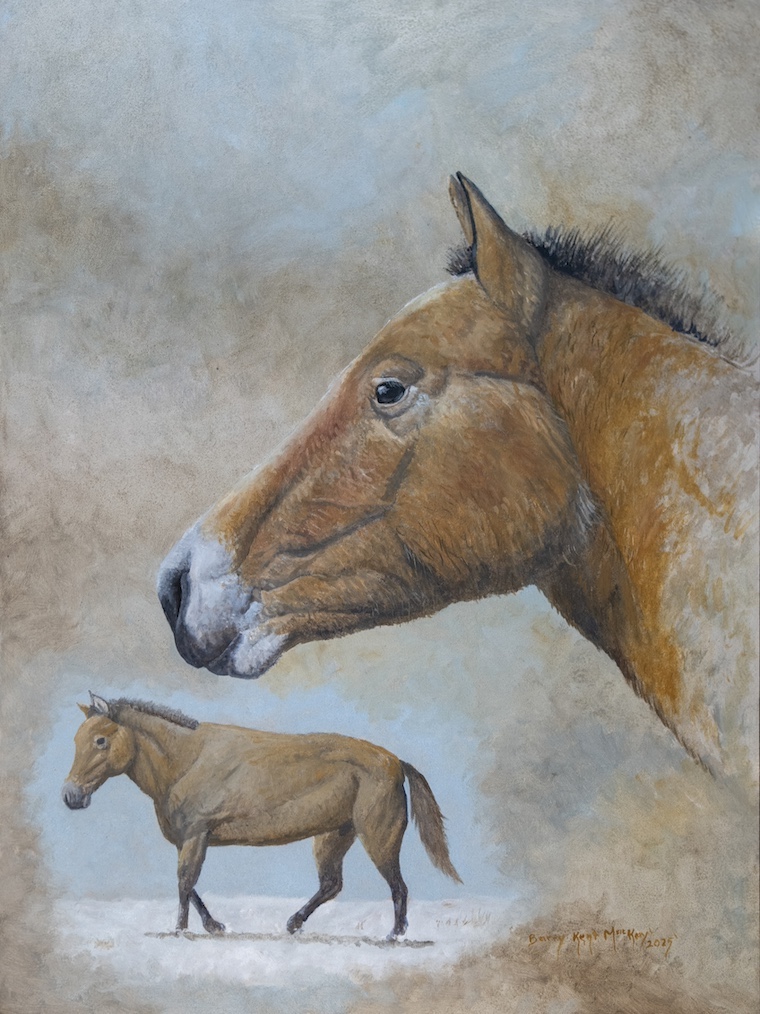
(Artwork - 260)
Przewalski's Horse (Equus przewalskii)
This is more study than painting, and of a “bucket list” species I have long wanted to portray, however simplistically, and this is certainly not my most creative painting. As a child I learned that Przewalski’s Horse (Equus przewalskii) was the last truly wild horse. Przewalski’s has 33 chromosome pairs, compared to 32 for the domestic horse, with which they have common ancestry dating back at least about 38,000 years, and possibly much longer ago than that. It is true that dating back centuries individual Przewalski’s Horses have been tamed, while domestic horses have turned wild (as we see in free-roaming mustangs in western Canada and the U.S., and Sable Island ponies off the coast of Nova Scotia, or the “brumby” horses in Australia) when set free on the landscape and allowed to survive.
Horses evolved in North America, moving to the eastern hemisphere across the Bering Land Bridge, which existed during the ice age when sea levels were low and what is now Alaska was connected to what is now Siberia. In the eastern hemisphere those early horses diverged into zebras and asses, but the wild ancestor of the domestic horse went extinct. That happened in North America as recently as 8 to 10 thousand years ago, at a time well after first humans reached the continent and when many other larger animals also went extinct.
Controversy continues over how much human hunting had to do with these numerous “Pleistocene extinctions”, and how much could be attributed to an inability of the native horses and other species to adapt to habitat changes caused by the retreat of ice age climate. Certainly, when domestic horses were brought to North America the ones that escaped captivity quickly adapted to living free and wild, as if re-filling an ecological niche only relatively recently vacated by the extinctions of native horses and other large herbivores. And instead of just hunting them, the people who were already here learned to tame and ride them, often with incredible skill. The domestic horse’s own wild ancestor, Equus ferus, was exterminated in Eurasia around the same time as the North American ones. But in Eurasia, before going extinct in the wild the species was taken into captivity and domesticated into many different breeds, all now considered to be a new, anthropogenically created subspecies, E. f. caballus, or even a new species, E. caballus.
When formally made known to science in 1881, Przewalski’s Horse was seriously endangered, and confined to rugged high plains, deserts and mountains of Central Asia. Like another Asian quadruped, Père David's Deer (Elaphurus davidianus), the species became extinct in the wild, but still existing in captivity. From its discovery by scientists to the present conservationists have worked to save the species through international captive breeding projects that started with just a dozen horses, and had to focus intently on avoiding the risk of inbreeding. The release of the progeny of such programmes back into the wild is well underway as described in this interesting video https://www.google.com/search?q=extinct+horses+reput+into+desert+in+china&ie=UTF-8&oe=UTF-8&hl=en-ca&client=safari#fpstate=ive&vld=cid:0c38fd57,vid:fmIOKwjz1lY,st:0/
There is now full protection of wild herds being re-established in areas they once inhabited, including the Chernobyl exclusion zone where people are not allowed to visit, all the while seeking to not domesticate them.
It does seem that some 5,000 years ago both the Przewalski’s Horse and the Wild Horse were used for more than food in Eurasia, leading to speculation, as yet unresolved to the satisfaction of all, that the “wild” Przewalski’s Horses derive from the same animal as the domestic species, a point that I find to be moot. Przewalski’s is distinct and was so back when all horses were wild.
My painting is in oils on compressed hardboard and is 24 by 18 inches.
 Previous
Return to Art by Barry Kent MacKay - Page 5
Copyright © Barry Kent MacKay
Barry describes himself as a Canadian artist/writer/naturalist.
See his website: www.barrykentmackay.com
For purchasing of original art, prints and other products GO HERE.
Return to Art by Barry Kent MacKay
Return to Art By Various Artists
Return to Art and Photo Journals and Galleries
Posted on All-Creatures: January 5, 2026
Follow us on:


- Home Page
- What's New
- Contact Us
- Action Alerts
- Animal Exploitation
- Animal Issues
- Animal Rights Activism
- Archives
- Art & Photography
- Articles Directory
- Bible
- Bible Commentary Blog
- Books
- Campaigns
- Church & Religion
- Discussions
- Events / Podcasts / Media
- Health
- Hosted Web Sites
- Humor
- Kids' Korner
- Letters
- Links
- Nature Studies
- Newsletter
- Poetry & Stories
- Prayers
- Quotations
- Recipes with Photos
- Recipes Without Photos
- Sermons
- Stop Cruelty in Churches
- Video Library
- The Mary T. and Frank L. Hoffman Family Foundation
- Email: [email protected]
A web site sponsored by The Mary T. and Frank L. Hoffman Family Foundation and all-creatures.org
Copyright © 1998-2026 The Mary T. and Frank L. Hoffman Family Foundation. All rights reserved. May be copied only for personal use or by not-for-profit organizations to promote compassionate and responsible living. All copied and reprinted material must contain proper credits and web site link www.all-creatures.org.
Fair Use Notice: This document, and others on our web site, may contain copyrighted material whose use has not been specifically authorized by the copyright owners. We believe that this not-for-profit, educational use on the Web constitutes a fair use of the copyrighted material (as provided for in section 107 of the US Copyright Law). If you wish to use this copyrighted material for purposes of your own that go beyond fair use, you must obtain permission from the copyright owner.
Thank you for visiting all-creatures.org.
