 Art and Photo Presentations from All-Creatures.org
Art by Barry Kent MacKay
In this section are copies of original works of art. All of them are dedicated to helping us live according to unconditional love and compassion, which is the foundation of our peaceful means of bringing true and lasting peace to all of God's creatures, whether they are human beings or other animals.
Common Grackle (Quiscalus quiscula)
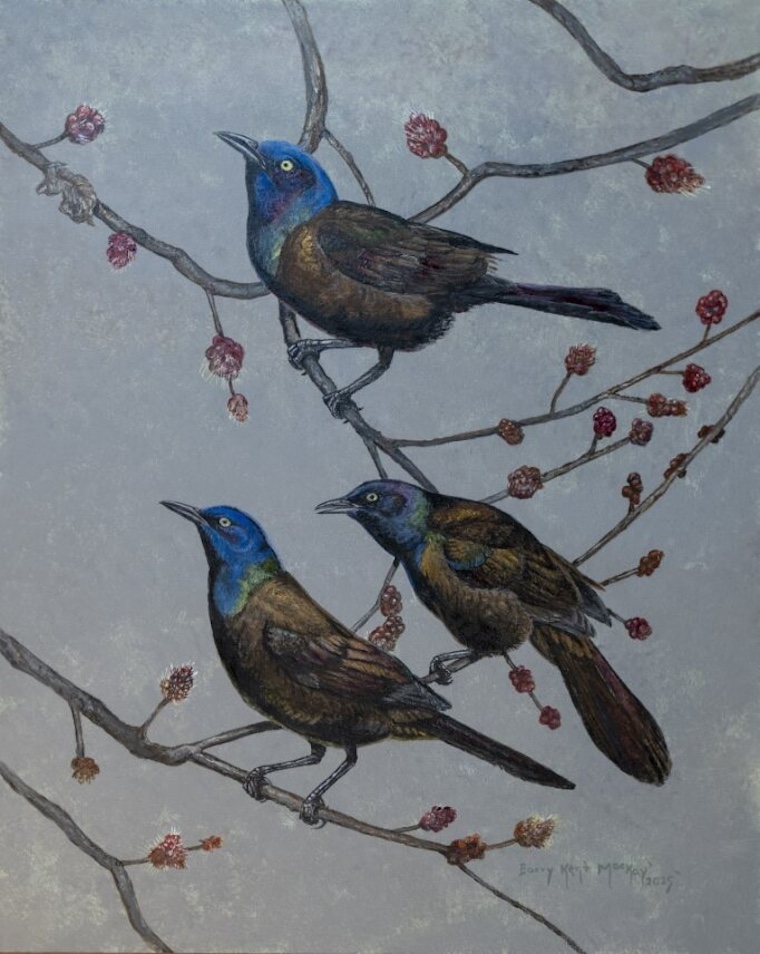
(Artwork - 261)
Common Grackle (Quiscalus quiscula)
This painting shows a trio of Common Grackles (Quiscalus quiscula), two males, and a female, quite similar in plumage, between them. This is the northern subspecies (Q. q. versicolor) which, in my youth, was called the Bronzed Grackle as it is quite distinctive from southern birds, which lack the bronze body, and were, at the time, called Purple Grackles, now “lumped” with the northern, bronze-colored birds (Q. q. stonei), with the nominate race, found in the southeastern U.S. In addition to my acrylic painting, I have attached two photos of museum specimens showing dorsal and ventral views of a typical “Bronzed” Grackle, top, a very typical “Purple” Grackle, bottom, and an intermediate between the two, in the middle. The middle one is from New Jersey, thus a little north of where we can expect to see typical “Purple” Grackles, and a little south of where we will see typical “Bronzed” Grackles. The fact that there is not a clean genetic break between these three distinct forms is why they are now classified as a single species.
The species is a North American endemic, ranging from the far north of Alberta across the continent southward, east of the Rockies and desert country, south to the very north-eastern tip of Mexico, and east to the Atlantic coast. They are “short-distance migrants” so that northern birds leave the colder, higher latitudes and fly south, where all subspecies can be seen in the same area. They are among the later birds to leave my area, in southern Ontario, in the fall, and I always eagerly look for them each spring, about the time the Silver Maple (Acer saccharinum) is in bloom, as I tried to show in my painting, but the tiny flowers are complex in structure and I didn’t do a very good job.
Grackles belong to the family Icteridae, which includes such diverse birds as New World orioles of the genus, Icterus, meadowlarks, Bobolinks (Dolichonyx oryzivorus), oropendolas of the genus Oriolus, and quite a few blackbirds, none of which should be confused with several species of thrush of the genus Turdus that are called blackbirds and live in the eastern hemisphere. Bird names can be confusing. The males average about an ounce (28 grams) heavier than the females, but at times the two sexes can be difficult to tell apart.
Grackles tend to be gregarious, even to placing nests in the same general region, a form of colonial nesting, and in Ontario nesting can go from early April through to July. The nests are cups of interwoven vegetation reinforced with mud, often hidden in cedars or other dense vegetation, or in recesses in buildings. They normally lay 3 to seven eggs, light blue to light olive, with scattered dark markings. Incubation takes about two weeks, and both parents feed their brood, who grow quickly and leave the nest in about 12 to 20 days.
Common Grackles are omnivorous, eating both plant and animal life, including acorns, hard seeds, invertebrates, small vertebrates, sprouting grains, and left-over food wastes, which they may even await at fast-food outlets. They are frequent visitors at bird feeders where they out-compete (and, rarely, may even prey upon) smaller avian visitors to the feeder. In late summer to fall they join flocks that typically include other Icterid species, and Common Starlings (Sturnus vulgaris). My painting is approximately life size, in acrylics on compressed hardboard.
Addendum
Part of my affection for this species stems from having raised several rescued orphaned grackles, plus one who we called Gracula, from nestlinghood to adult hood when I was a kid. My mom did an early version of what is now called wildlife rehab, me helping, and we were still learning the ropes. Gracula became “imprinted”, too tame to safely be released, but his often comical, complex behavior contributed to my overall appreciation of the species.
To give you an idea of the general attitude toward grackles, while the collective name of flock of starlings is a murmur, for swans, a wedge, and for sandpipers, a fling – for grackles it is a plague. They have loudly discordant voices and an “in your face” approach to their interactions with people, bold and strutting, flashing radiantly in sunlight, uncouthly bullying all the smaller birds at the feeder, while contemplating the world through yellow eyes almost always described as “baleful”, which my online thesaurus says is synonymous with threatening, menacing, malevolent, sinister, or malignant. Much worse, they can do crop damage, pulling up newly sprouted crops, attacking corn-on-the-cob-on-the-stalk and performing similar crimes against humanity. And to top it all off, they are black, which, as any crow, starling, or cormorant – or all too many of our own species – can explain, is not a path to appreciation among by our own kind.
I find it hard to “blame” any species, human included, for doing what it cannot help but do. Grackles are “intelligent” as the term is popularly defined, but not to the point of developing a moral template comparable to what humans have not only developed, but codified – said codification so often being so totally ignored. So I am inclined to focus on what, to me, are subjective values, the greatest being the miracle of a three billion year evolution that put such a creature among our midst. I tend, like most people, to focus on the rare and unique and one unique character of grackles among songbirds is the ability of males to hold their tail in a “keel” shape, with the center lower than the highly held outer edges. It’s a characteristic of a larger close relative of the Common Grackle that has led to the common name, “Boat-tailed Grackle”. The yellow eye, really the iris, is not unknown among songbirds, but is very rare among Canadian songbird species. And that goes for the level of iridescence, that shattering of the visual spectrum into the bright blues and blue-greens of the head, and the rich bronzes and purplish-bronzes of the body plumage. Once I took a birder freshly arrived from tropical South America to a nearby birding location, Thickson’s Woods, in May, with the view of thrilling him with a variety of beautifully coloured warblers, tanagers, orioles, grosbeaks and other species, along with thrushes and ovenbirds and so on, but he could not tear himself away from some birds up in a tree beside the road that borders the woods. “They’re just so beautiful,” he said. “I wish we had them in Brazil!” He was looking at a group of grackles, in full sunlight, and he was right – they were beautiful.
One interesting feature of these birds is a specially evolved horny structure on the roof of the mouth, which protrudes downward, like a keel, and is exactly where the beak can exert maximum pressure on anything held there (as my fingers can attest from my bird-banding days). The adductor muscles of the jaw are enlarged compared to other Icterids thus allowing the birds to even crack open acorns. They have the ability to store extra food, indicating a well-developed memory. While not as well known or studied in grackles as in jays and nutcrackers, whose ability to remember exceeds what humans can do, it is still very well developed, and it seems that the birds use visual cues for orientation in facilitating retrieval of previously stored food. In common with other Icterids, but unlike other most other songbirds, grackles can hold food in one foot and manipulate it. They can clean out the interior of acorns, for example, leaving only the hard shell, and cap, behind.
The Common Grackle has a wondrous breeding display, with beak thrust upward, breast downward, tail up, wings partly spread and a characteristic, trance-like stare, all meant to impress the ladies. The species is monogamous, usually, but a little extra-marital activity is not unknown. Still, the male assists the female in raising their brood.
This is a species with the ability to orient with the earth’s magnetic field as it varies, being a dynamic force that may assist birds in their movements, even though many of them in the southern part of their range are non-migratory.
When I was young this species was far more common than now, and even though hated and persecuted by farmers they held their own, for a while. But now there are fewer of them and data from Christmas bird counts indicate a 61% decrease from a benchmark of 190 million birds down to 73 million. The IUCN now classifies the species as “near threatened”. While conservationists name the usual reasons, the one that I think most decisive is the marked decline in insects. Grackles devour large numbers of the larger insects, adults and larvae, and the dramatic decline in insects as a result of excessive use of pesticides by agricultural and gardening interests has dramatically reduced an essential food source for these and numerous other wildlife species, or that is my theory based on evidence I’ve encountered to date.
 Previous
Return to Art by Barry Kent MacKay - Page 5
Copyright © Barry Kent MacKay
Barry describes himself as a Canadian artist/writer/naturalist.
See his website: www.barrykentmackay.com
For purchasing of original art, prints and other products GO HERE.
Return to Art by Barry Kent MacKay
Return to Art By Various Artists
Return to Art and Photo Journals and Galleries
Posted on All-Creatures: March 1, 2026
Follow us on:


- Home Page
- What's New
- Contact Us
- Action Alerts
- Animal Exploitation
- Animal Issues
- Animal Rights Activism
- Archives
- Art & Photography
- Articles Directory
- Bible
- Bible Commentary Blog
- Books
- Campaigns
- Church & Religion
- Discussions
- Events / Podcasts / Media
- Health
- Hosted Web Sites
- Humor
- Kids' Korner
- Letters
- Links
- Nature Studies
- Newsletter
- Poetry & Stories
- Prayers
- Quotations
- Recipes with Photos
- Recipes Without Photos
- Sermons
- Stop Cruelty in Churches
- Video Library
- The Mary T. and Frank L. Hoffman Family Foundation
- Email: [email protected]
A web site sponsored by The Mary T. and Frank L. Hoffman Family Foundation and all-creatures.org
Copyright © 1998-2026 The Mary T. and Frank L. Hoffman Family Foundation. All rights reserved. May be copied only for personal use or by not-for-profit organizations to promote compassionate and responsible living. All copied and reprinted material must contain proper credits and web site link www.all-creatures.org.
Fair Use Notice: This document, and others on our web site, may contain copyrighted material whose use has not been specifically authorized by the copyright owners. We believe that this not-for-profit, educational use on the Web constitutes a fair use of the copyrighted material (as provided for in section 107 of the US Copyright Law). If you wish to use this copyrighted material for purposes of your own that go beyond fair use, you must obtain permission from the copyright owner.
Thank you for visiting all-creatures.org.
