 Art and Photo Presentations from All-Creatures.org
Art by Barry Kent MacKay
In this section are copies of original works of art. All of them are dedicated to helping us live according to unconditional love and compassion, which is the foundation of our peaceful means of bringing true and lasting peace to all of God's creatures, whether they are human beings or other animals.
Carolina Wren (Thryothorus ludovicianus)
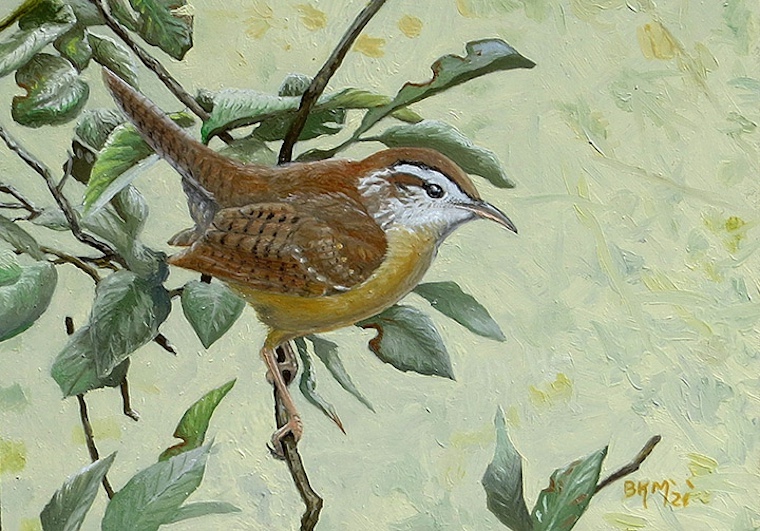
(Artwork - 262)
Carolina Wren (Thryothorus ludovicianus)
To understand why I very nearly did not share a photograph of this little painting with you, please see the accompanying essay. It is not a long read.
The Carolina Wren is the largest wren through much of its range, which encompasses most of the eastern United States, extends north into southern Ontario and the St. Lawrence Valley of Quebec, and reaches south through parts of Mexico into Central America. About ten subspecies have been named, and I have portrayed the nominate form, the one occupying most of the eastern United States and southern Canada.
Although once grouped with several similar species, the Carolina Wren is now generally considered distinct enough genetically to stand alone in its genus, though it remains closely related to the somewhat smaller and darker Bewick’s Wren (Thryomanes bewickii).
The species was first formally described in 1790 by the English physician and naturalist John Latham (1740–1837), who, so far as I know, never saw a living Carolina Wren. Working from preserved specimens sent from around the world, he described many birds new to science, including such Australian species as the Emu and the Superb Lyrebird. The type specimen of the Carolina Wren came from near New Orleans, Louisiana. According to Wikipedia, the scientific name ludovicianus derives from the post-classical Latin Ludovicus, ultimately referring to Louisiana. The common name “Carolina” referred broadly in the eighteenth century to the southern region of what is now the United States.
Since then, the species has expanded its range considerably northward. Unlike many small insect-eating birds, Carolina Wrens are largely non-migratory and frequently visit bird feeders, particularly where suet, peanut butter, or vegetable shortening is offered. As a result, they are among the few predominantly insectivorous birds regularly encountered during Canadian winters, appearing alongside chickadees, nuthatches, and juncos even when snow covers the ground.
The Carolina Wren is the official state bird of South Carolina, which commemorated the species on its state quarter, alongside the palmetto tree and yellow jessamine. The reverse side bears the familiar portrait of George Washington, who, given his interest in natural history, would almost certainly have known this lively little bird.
Carolina Wrens weigh about 20 grams (roughly 0.7 ounces), making them among the largest wrens in eastern North America, though larger species occur in the tropics and subtropics. They possess a loud, rich, multi-note song that carries surprisingly well for such a small bird.
Pairs are generally monogamous and may remain together for many years. They maintain territories throughout the year, vigorously excluding other Carolina Wrens while generally avoiding people. The species thrives in a variety of wooded habitats and seems particularly fond of old farmsteads, weathered barns, sheds, and similar structures.
Their nests are domed constructions of grasses, twigs, mosses, and assorted found materials. They may be built in tree cavities, bird boxes, old shoes, rural mailboxes, sheds, and almost any sheltered nook or cranny that appeals to the birds.
A typical clutch contains three to six eggs, occasionally seven. The female performs the incubation, which lasts about two weeks, while the male assists in feeding the young. Nestlings are fed almost entirely on small invertebrates and leave the nest after roughly another two weeks. In the southern parts of their range, Carolina Wrens may raise multiple broods in a single year. The painting is in oils on a 7 X 9 inch pre-gessoed panel.
I hope you enjoy it.
Barry
Essay: Why I Almost Didn't Show You This Carolina Wren
This little Carolina Wren painting almost never made it here.
Not because there was anything wrong with the bird, or because I dislike the painting, but because I wasn't sure what to make of it. It sat around for about five years before I finally decided that, while it was certainly not the painting I had hoped to create, it was nevertheless interesting enough to share.
To explain why, I have to go back a very long way.
I cannot explain why, from as early as I can remember, I became fascinated by paintings of birds. Other children liked cartoons, trains, or cowboys. So did I, but more than that, I liked bird illustrations. Not just birds themselves—though I loved those too—but paintings of birds. I would stare at reproductions in books and magazines for hours, and an illustrated bird book was always what I asked for as a birthday or Christmas gift. I cherished those National Geographic magazines with paintings of exotic birds by Walter A. Weber. I still do.
The artists who captivated me included Allan Brooks, T. M. Shortt, D. M. Reid-Henry, Louis Agassiz Fuertes, Don Eckelberry, and many others. Most worked primarily in watercolour or gouache rather than oils. Their paintings were often intended to illustrate books and journals, and because they were illustrating birds, accuracy mattered. Every feather seemed to count. It took me a long time to realize that every feather wasn't painted—it just looked that way.
Part of the reason these artists used water-based paints was practical. Watercolours dried quickly, allowed extraordinary precision, and were well suited to publishing deadlines. Looking back, I suspect that if modern acrylics had existed in their present form, many of these artists might have used them as well.
Yet I was also drawn to another group of artists: Sir Peter Scott, Keith Shackleton, Bruno Liljefors, Carl Rungius, and others who worked largely in oils. Their paintings possessed a strength and boldness that seemed different from illustration. They were often less concerned with delineating every feather—or, in Rungius's case, every hair, since he specialized in large mammals—and more interested in atmosphere, movement, light, and place. Yet their birds and other animals remained convincing because they understood them so thoroughly. Animal, environment, and atmosphere were all part of the same image.
As I grew older, I realized that I admired both approaches.
Then, about three decades ago, I had the opportunity to spend time in galleries in Europe and North America studying some of the Old Masters. What fascinated me was not necessarily the subjects they chose, but their techniques. Artists such as Willem Kalf could create astonishing effects of texture, light, and depth with oil paint. The paintings themselves were often of objects that held little personal interest for me—silverware, crystal, fruit, expensive foods—but the craftsmanship was mesmerizing.
Gradually all these influences blended together in my mind: the great bird illustrators, the wildlife painters, and the Old Masters.
I still work much as I always have. I surround myself with photographs—preferably my own—along with sketches, museum specimens when available, and the work of artists whose judgement I trust. I do not want to trace photographs or simply copy them. What interests me is drawing, designing, interpreting, and occasionally inventing aspects of a composition while remaining faithful to the bird itself.
And that brings me back to this little Carolina Wren.
When I painted it, I was experimenting with oils and trying to achieve some of the delicacy I had always associated with the best bird illustration while retaining some of the strengths that oils can offer. After I finished, I photographed it under angled light, which emphasized every ridge and texture in the paint surface. At the time, I wasn't entirely satisfied with the result.
Five years later, I see it differently.
It is not a great painting. It may not even be a particularly good one. Artists such as D. M. Reid-Henry or Robert Verity Clem could undoubtedly have done better work on a bad day. But it is still a painting. It is still interesting. It still says something about what I was trying to accomplish.
Most importantly, it reminds me that I am still pursuing the same goal I have pursued since before kindergarten: to create the perfect bird painting.
I have never done it.
I have never matched the artists whose work I most admire, whether Allan Brooks, T. M. Shortt, Peter Scott, Bruno Liljefors, Rembrandt, or any number of others across a rather broad spectrum of realism, schools, and styles.
But after all these years, it remains tremendous fun to try.
 Previous
Return to Art by Barry Kent MacKay - Page 5
Copyright © Barry Kent MacKay
Barry describes himself as a Canadian artist/writer/naturalist.
See his website: www.barrykentmackay.com
For purchasing of original art, prints and other products GO HERE.
Return to Art by Barry Kent MacKay
Return to Art By Various Artists
Return to Art and Photo Journals and Galleries
Posted on All-Creatures: June 8, 2026
Follow us on:


- Home Page
- What's New
- Contact Us
- Action Alerts
- Animal Exploitation
- Animal Issues
- Animal Rights Activism
- Archives
- Art & Photography
- Articles Directory
- Bible
- Bible Commentary Blog
- Books
- Campaigns
- Church & Religion
- Discussions
- Events / Podcasts / Media
- Health
- Hosted Web Sites
- Humor
- Kids' Korner
- Letters
- Links
- Nature Studies
- Newsletter
- Poetry & Stories
- Prayers
- Quotations
- Recipes with Photos
- Recipes Without Photos
- Sermons
- Stop Cruelty in Churches
- Video Library
- The Mary T. and Frank L. Hoffman Family Foundation
- Email: [email protected]
A web site sponsored by The Mary T. and Frank L. Hoffman Family Foundation and all-creatures.org
Copyright © 1998-2026 The Mary T. and Frank L. Hoffman Family Foundation. All rights reserved. May be copied only for personal use or by not-for-profit organizations to promote compassionate and responsible living. All copied and reprinted material must contain proper credits and web site link www.all-creatures.org.
Fair Use Notice: This document, and others on our web site, may contain copyrighted material whose use has not been specifically authorized by the copyright owners. We believe that this not-for-profit, educational use on the Web constitutes a fair use of the copyrighted material (as provided for in section 107 of the US Copyright Law). If you wish to use this copyrighted material for purposes of your own that go beyond fair use, you must obtain permission from the copyright owner.
Thank you for visiting all-creatures.org.
