Articles Reflecting a Vegan Lifestyle used with permission from All-Creatures.org
Despite all the violence and suffering in the world, Christine Rose reflects on the profound joy still available to us when we live by our values and take time to appreciate the wonder and beauty of nature.
Joy in the Anthropocene
From Christine Rose, MaySafelyGraze.org.nz
March 2026
Images from Canva
A trip to Tiritiri Matangi in Auckland’s beautiful Hauraki Gulf led Christine Rose to reflect on how, amidst war and conflict, and the trials of the Anthropocene – we can live principled, healing lives and find joy!
The winds of war blew and so did a cold, strong southwesterly the few days we stayed at Tiritiri Matangi at the beginning of March. But I found joy.
It’s easier to imagine the end of the world than the end of capitalism. But as the saying goes, we have to be the change we want to see in the world. And it’s possible to find joy in the Anthropocene. In fact, with the world in chaos, it’s essential to sow and harvest peace in our own lives, and to remake our happiness.
That’s why I’m doing a ‘Marie Kondo’ in my life. I’m stripping out those things that don’t spark joy, and that aren’t in service of Life. But not just things, experiences and actions too.
Sociologists like Richard Twine research people like me who are sometimes considered killjoys within the prevailing culture, for what we won’t do. I won’t fly, won’t eat animal products, try not to drive much, won’t buy brand new. But in the process of being a killjoy, we remake joy anew.
While human biomass and animals suffering in factory farms outweigh all wild animals, while the climate crisis inflicts pain, suffering and insecurity, while children are bombed carrying their school bags, and others starve, time at Tiri can remind us of the good in the world.
I jumped off rocks into the sea, and snorkeled in shallow water. Tāmure – snapper came up kanohi ki te kanohi. The meeting of minds in the water was made even better because those fish are now safe in a new Hauraki Gulf Marine Protected Area.
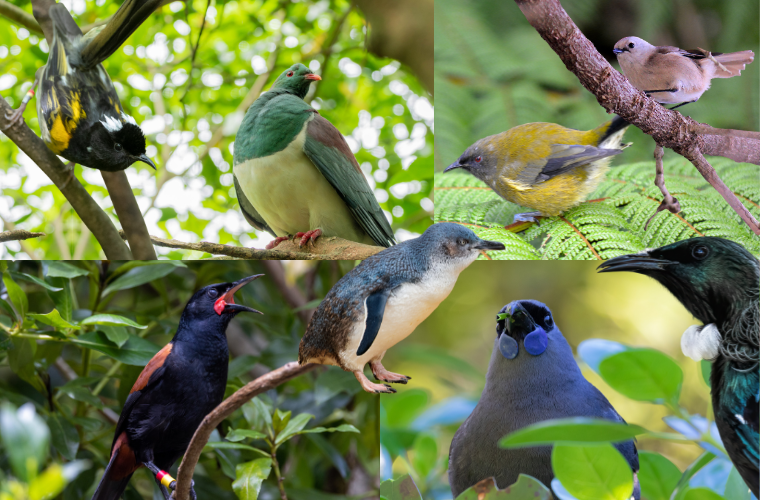
We were sheltered from wind and sun under the canopies of forest planted by the visionary Supporters of Tiritiri Matangi. Volunteers guided tours, weeded paths, fundraised for conservation. A panoply of native birds saved from extinction dropped early autumn seeds on us, pōpokatea – whiteheads, tieke – saddlebacks, and kokako. We saw a kereru nest – a loose platform of sticks, perched in a tree. We saw a little blue penguin ‘feather explosion’ at the entrance to its roost, the downy feathers a sign of the season’s moult.
The island’s current 94 kokako chorused the morning with their haunting calls, and little spotted kiwi and tuatara graced the tracks. Hihi – stitchbirds, korimako – bellbirds, and tui were more resonant than any church bell. Especially around the feeding stations where volunteers feed 8700 litres of sugar water every year- supporting the hihi recovery, which otherwise only survived at Hauturu.
At night a powerful electrical storm to the east channeled energy in huge lightning bolts that arced from the sky to the sea. We, sheltered from the wind, were awed viewers of heavenly theatre. We witnessed the lunar eclipse that turned the moon apricot while meteors shot overhead and ruru swooped across the valley.
We ate delicious and nutritious home cooked vegan meals.
We lived the mantra from Desiderata – ‘…with all its drudgery and broken dreams, it is still a beautiful world. Strive to be happy’.
At Tiri, we found joy.
Christine Rose is a former Councillor for the Rodney District Council and the Auckland Regional Council, and was lead climate and agriculture campaigner for Greenpeace. A long time campaigner for the oceans, forests, and creatures of our planet, 25 years ago she founded, and has since run, the Māui and Hector’s Dolphin Defenders organization. Christine is a potter and painter, and says ‘I use art and politics to shape a better world.’
Posted on All-Creatures: March 10, 2025
Return to Articles Reflecting a Vegan Lifestyle
Read more at Wildlife Articles
Follow us on:


- Home Page
- What's New
- Contact Us
- Action Alerts
- Animal Exploitation
- Animal Issues
- Animal Rights Activism
- Archives
- Art & Photography
- Articles Directory
- Bible
- Bible Commentary Blog
- Books
- Campaigns
- Church & Religion
- Discussions
- Events / Podcasts / Media
- Health
- Hosted Web Sites
- Humor
- Kids' Korner
- Letters
- Links
- Nature Studies
- Newsletter
- Poetry & Stories
- Prayers
- Quotations
- Recipes with Photos
- Recipes Without Photos
- Sermons
- Stop Cruelty in Churches
- Video Library
- The Mary T. and Frank L. Hoffman Family Foundation
- Email: [email protected]
A web site sponsored by The Mary T. and Frank L. Hoffman Family Foundation and all-creatures.org
Copyright © 1998-2026 The Mary T. and Frank L. Hoffman Family Foundation. All rights reserved. May be copied only for personal use or by not-for-profit organizations to promote compassionate and responsible living. All copied and reprinted material must contain proper credits and web site link www.all-creatures.org.
Fair Use Notice: This document, and others on our web site, may contain copyrighted material whose use has not been specifically authorized by the copyright owners. We believe that this not-for-profit, educational use on the Web constitutes a fair use of the copyrighted material (as provided for in section 107 of the US Copyright Law). If you wish to use this copyrighted material for purposes of your own that go beyond fair use, you must obtain permission from the copyright owner.
Thank you for visiting all-creatures.org.
