Articles Reflecting a Vegan Lifestyle used with permission from All-Creatures.org
Cherie Hans reflects on the importance of extending our compassion to non-vegans and using our own choices and behavior to model ethical living for those around us without forcing an issue they are not ready to confront.
The Inclusive Vegan: Choosing Compassion Over Criticism
From Cherie Hans, MVLCE, Main Street Vegan Academy, MainStreetVegan.com
September 2026
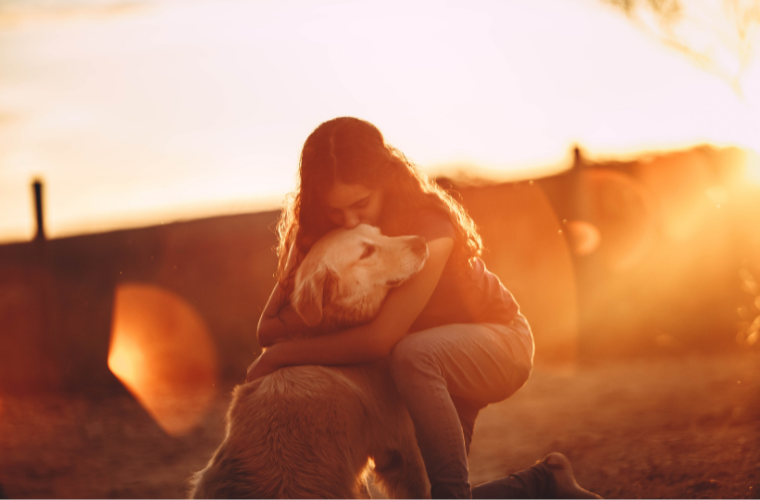
Photo from Canva
Originally printed in the Main Street Vegan blog, MainStreetVegan.com.
Why would vegans want to alienate anyone who loves animals? We shouldn’t, but sometimes we do.
At a recent Main Street Vegan Academy (MSVA) reunion, 35 people attended the weekend’s events. At the luncheon, the lovely lady across from me said she was vegetarian. She was apologetic for being “only” a vegetarian, but I made sure she felt welcome and included and that she didn’t have to explain to us why she wasn’t vegan.
I will admit that for a split second, I was surprised to see a non-vegan at our event. In order to take the certification course, you have to be vegan, but I remembered that Victoria Moran (the organizer of our reunion and founder of the MSVA) invited my omnivore husband to join us for dinner on Friday night, since it was our wedding anniversary.
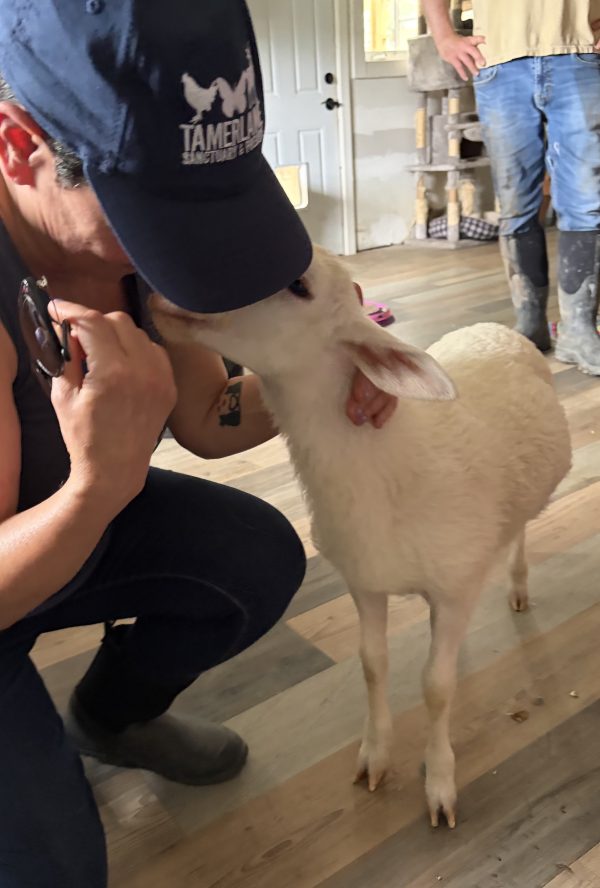
Shauna, a lamb at Tamerlaine Sanctuary, with Cherie. Photo credit: Tamerlaine Sanctuary & Preserve
I also recalled that the founders of the Tamerlaine Sanctuary & Preserve in Montague, New Jersey, where we visit as often as we can, do not shun non-vegans. As Gabrielle Stubbert (co-founder) reminded me, “We, too, ate meat for years. Who are we to judge anybody else?” I agree.
Gabrielle told me, “We’re a vegan sanctuary, and while we don’t expect everyone to become vegan overnight, we do ask people to eat less meat, just like all of those things we do to reduce our footprint, like recycling and conserving energy. Animal agriculture is one of the top drivers of environmental harm. Eating less meat is the best thing you can do for the planet, your health, and, most of all, the animals. If you’re trying to get the world to go vegan, judging people and making them feel defensive about their choices is surely not going to help our cause. Meet people where they are and show them compassion. None of us were born vegan. We were meat eaters ourselves. If you want people to eat less meat, or become vegan, stick really good vegan food in their mouths.”
I asked fellow MSVA grads and vegans how they feel about animal lovers who still eat meat.
Nivi Jaswal-Wirtjes, MBA, NBC-HWC, MVLCE, and Founder & President of The Virsa Foundation & JIVINITI Research Program, “If I’m being completely truthful, my immediate emotional response is often annoyance—sometimes even anger. I struggle with the contradiction when someone describes themselves as a huge animal lover while continuing to eat animals. Almost immediately, I feel the weight of needing to be a good role model. I remind myself that if I want people to move toward greater compassion, I need to lead by example rather than judgement.”
Another MSVA grad told me, “I could not be friends with someone who actively hunts, brags about the carnivore diet, or puts down the vegan lifestyle.” I agree and cannot discuss hunting with anybody. I agree that someone who is bragging about eating meat or disrespecting my vegan choices is not a friend. Even so, we do not live in a vegan world, and I don’t live in a vegan household. I am used to seeing meat in front of me, but I don’t like the look or the smell of it at all. I do not say anything, but I think it.
A vegan told me she does not eat out with omnivores. I respect her choice; however, if I waited for a vegan companion to dine with, I’d never eat out. I do eat at vegan establishments alone most of the time, but some friends, family, and my husband are willing to support me by joining me occasionally, and I am grateful. By the same token, I must eat at regular restaurants with them, too. I don’t eat out with anyone who doesn’t make sure there are vegan options, so I agree with my fellow MSVA grad.
I used to view eating alone as a stigma or worried I looked lonely. At 60, I no longer care. I listen to an audiobook and always chat with the staff—several of whom, even at vegan Manhattan restaurants, are not vegan themselves.
I did stop actively following a few people on social media who hunt. One dead carcass with a bloody pic was enough.
One of my nieces, Amy, lives with her pig, Ollie, who has his own room in her house. She still eats meat. There is no need to discuss it because we have mutual respect for one another. It is none of my business. My niece belongs to a pig rescue team and once left Thanksgiving dinner to save a pig. Actions speak volumes. Before meeting me 13 years ago, she viewed vegans as “obnoxious and judgy” especially in her rescue groups.
Nobody wants to listen to a know-it-all on any subject.
What I found shocking, speaking to Amy, was that many people have asked her if she will eat Ollie after he dies. What?! Amy told me she would do whatever it takes to protect Ollie. Who am I—or any of us—to question her love and loyalty?
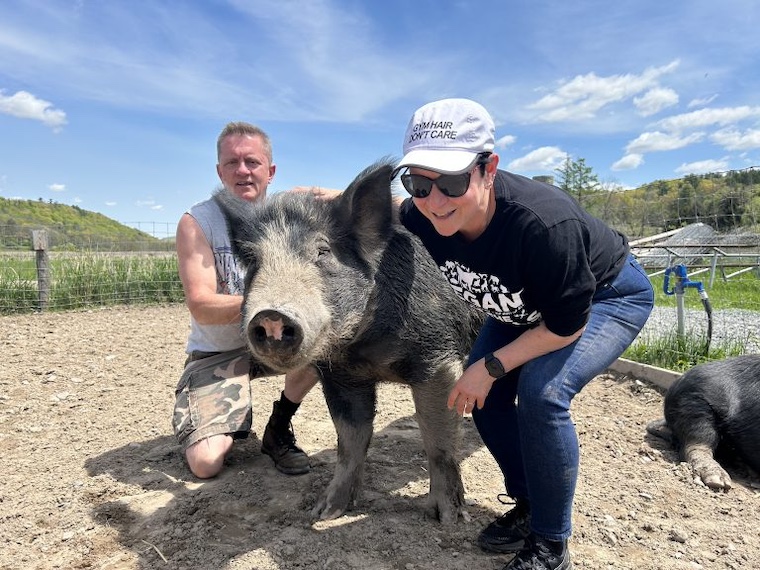
Tamerlaine resident, Roman, enjoys a visit from Cherie and husband, Al. Photo credit: Tamerlaine Sanctuary & Preserve
I have been asked how I can be with my omnivore husband. The one who sobs when we lose a cat (we have had ten rescued cats in our 13 years together), but not when a human relative he loved dies. The man who loves our cats as much as I do and will spare no expense to save one of them at the vet. He rescued a baby squirrel out of a drainpipe, took him home, bottle-fed him, and when Rocky, the squirrel, was old enough, brought him to a sanctuary to live safely outside.
We vegans always hope that someone will connect that pigs, goats, chickens and cows are just like cats, dogs, or a rescued baby squirrel. They’re affectionate, smart, and have feelings, too. It is not our place to force this issue.
At my mother-in-law’s recent 90th birthday celebration, both of my sisters-in-law ordered a vegan meal for me in advance. For my 60th birthday, my family and friends ate at a vegan restaurant and enjoyed it. This is a loving example of mutual respect.
Vegans often do what they do for three reasons: for the animals, the environment, and for their health. I do it for all three, but my strongest motivator is the animals. As a child (when I had no voice for what I had to eat), I did not like the idea of an animal being slaughtered to be on my plate. I was told that it’s normal and expected. It wasn’t for me.
As soon as I moved out, I became a vegetarian—35 years ago. Twenty years ago, after learning the truth about factory farming, I became a vegan. I have no regrets and sleep well at night knowing I’m living my values. But I also believe in respecting others. I don’t force my views on anyone. I trust my life to carry the message.
By Cherie Hans, trained and certified as a vegan lifestyle coach and educator by Main Street Vegan Academy, www.MainStreetVegan.com
Cherie Hans, shown here with Felipe, a resident of Tamerlaine Sanctuary, holds certifications from Dr. McDougall’s Starch Solution and Dr. Campbell’s Plant-Based Nutrition programs, and is a Main Street Vegan Academy Master Vegan Lifestyle Coach and Educator. She holds a Master of Science in Bilingual Education from St. John’s University, New York, and a Bachelor of Arts from the City University of NY: Queens College in English and Spanish, and currently teaches adults in English as a Second Language. She is from Queens, New York, but now resides in New Jersey with her husband and many rescued cats.
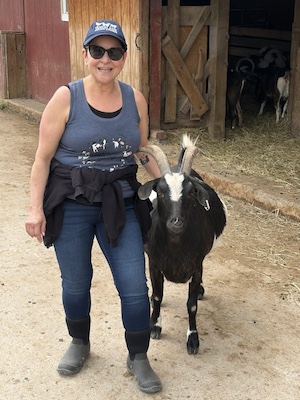
Photo credit: Tamerlaine Sanctuary & Preserve
Posted on All-Creatures: October 2, 2026
Return to Articles Reflecting a Vegan Lifestyle
Follow us on:


- Home Page
- What's New
- Contact Us
- Action Alerts
- Animal Exploitation
- Animal Issues
- Animal Rights Activism
- Archives
- Art & Photography
- Articles Directory
- Bible
- Bible Commentary Blog
- Books
- Campaigns
- Church & Religion
- Discussions
- Events / Podcasts / Media
- Health
- Hosted Web Sites
- Humor
- Kids' Korner
- Letters
- Links
- Nature Studies
- Newsletter
- Poetry & Stories
- Prayers
- Quotations
- Recipes with Photos
- Recipes Without Photos
- Sermons
- Stop Cruelty in Churches
- Video Library
- The Mary T. and Frank L. Hoffman Family Foundation
- Email: [email protected]
A web site sponsored by The Mary T. and Frank L. Hoffman Family Foundation and all-creatures.org
Copyright © 1998-2026 The Mary T. and Frank L. Hoffman Family Foundation. All rights reserved. May be copied only for personal use or by not-for-profit organizations to promote compassionate and responsible living. All copied and reprinted material must contain proper credits and web site link www.all-creatures.org.
Fair Use Notice: This document, and others on our web site, may contain copyrighted material whose use has not been specifically authorized by the copyright owners. We believe that this not-for-profit, educational use on the Web constitutes a fair use of the copyrighted material (as provided for in section 107 of the US Copyright Law). If you wish to use this copyrighted material for purposes of your own that go beyond fair use, you must obtain permission from the copyright owner.
Thank you for visiting all-creatures.org.
