An Animal Rights/Vegan Activists' Strategies Article used with permission from All-Creatures.org
In honor of Guardian Month in May, Fleur Dawes of In Defense of Animals shares the winners of this year’s Guardian Award and discusses the importance of the language we use when we speak about non-human animals and our relationship to them.
Change the World for Animals With Words This Guardian Month
From Fleur Dawes, IDA In Defense of Animals, idausa.org
May 2026
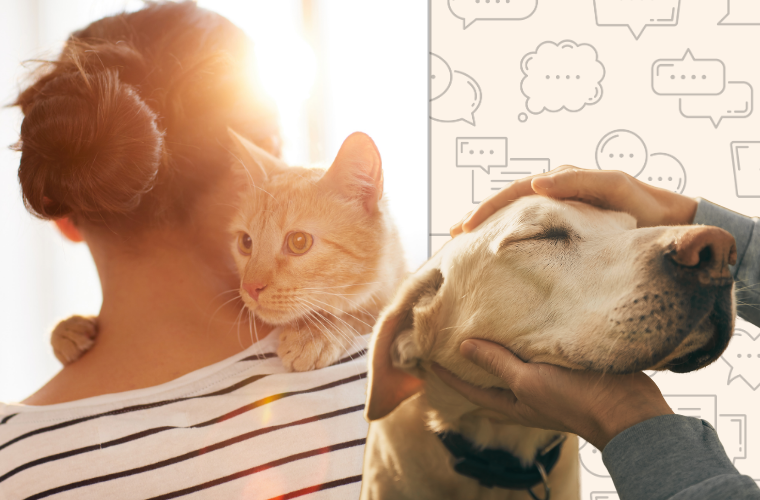
Images from Canva
Millions of us share our homes and lives with animal companions and advocate for them and those who live in the wild, but there is still a lot of communication online and off that doesn’t fully or fairly represent them or their interests. Find out what you can do this May for Guardian Month to make the world better for animals.
Our Guardian campaign, which was created by our late founder, Dr. Elliot Katz, is dedicated to promoting language that reflects the fact that the nonhuman animals we share this Earth with are not simply inanimate objects who have no interests of their own, but sentient beings who deserve our understanding, respect, and protection.
This year, we gave our Guardian Award to two deserving individuals: Jane Velez-Mitchell, award-winning journalist, author, and founder and managing editor of UnChainedTV, a global network dedicated to animal rights and plant-based living, and Dr. Marc Abraham OBE, an award-winning veterinary surgeon, author, broadcaster, animal welfare campaigner, and star of the new film Dog$piracy.
They are among many who advocate for animals through storytelling, where the language we use around animals matters. Unfortunately, detrimental language spans all over, from media and advertising to academia and government.
Animals are referred to like objects when we call them it, that, or which, and reduced to commodities and not individuals with complex inner lives and relationships when we normalize saying things like fur is a renewable resource, or refer to animals as pests or call wolves vicious predators.
In her blog Discarding euphemisms: the fate of animals deserves truthful words, Dr. Gosia Bryja writes that using words like “‘crop’, ‘harvest’, ‘stock’, ‘cull’, ‘yield’, and ‘surplus’ strip us of compassion towards non-human animals … These words are blindfolds put over our eyes or drips of alcohol seeping into our bloodstream; they are meant to numb our senses and make us do, justify, and accept what we know is cruel, horrific, and heart-wrenching.”
Things could change a lot if we talked and wrote about animals as if they were someone, not something, whose lives mattered to them. Equally harmful is the concept of ownership. Using the outdated term owner instead of more respectful terms, such as guardian or pet parent, perpetuates a harmful mindset that diminishes animals' rights.
We hope to encourage more and more people to be mindful of the impact of their words, and use them to make the world a safer and more compassionate place where animals are better understood, respected, and protected.
How You Can Help
Sign and share the guardian pledge to acknowledge that animals are our fellow beings, and deserve to be considered as individuals with their own interests, and that we are not their owners or masters, but their guardians.
Sign and share our alert urging major news outlets to change their internal style guides for more accurate coverage of animals.
Join our Fireside Chat on Thursday, May 28, 2026, to learn more about how we can change the world for animals with language. Register on Zoom.
Posted on All-Creatures.org: May 8, 2026
Return to Animal Rights/Vegan Activist Strategies
Read more at Companion Animal Care
Follow us on:


- Home Page
- What's New
- Contact Us
- Action Alerts
- Animal Exploitation
- Animal Issues
- Animal Rights Activism
- Archives
- Art & Photography
- Articles Directory
- Bible
- Bible Commentary Blog
- Books
- Campaigns
- Church & Religion
- Discussions
- Events / Podcasts / Media
- Health
- Hosted Web Sites
- Humor
- Kids' Korner
- Letters
- Links
- Nature Studies
- Newsletter
- Poetry & Stories
- Prayers
- Quotations
- Recipes with Photos
- Recipes Without Photos
- Sermons
- Stop Cruelty in Churches
- Video Library
- The Mary T. and Frank L. Hoffman Family Foundation
- Email: [email protected]
A web site sponsored by The Mary T. and Frank L. Hoffman Family Foundation and all-creatures.org
Copyright © 1998-2026 The Mary T. and Frank L. Hoffman Family Foundation. All rights reserved. May be copied only for personal use or by not-for-profit organizations to promote compassionate and responsible living. All copied and reprinted material must contain proper credits and web site link www.all-creatures.org.
Fair Use Notice: This document, and others on our web site, may contain copyrighted material whose use has not been specifically authorized by the copyright owners. We believe that this not-for-profit, educational use on the Web constitutes a fair use of the copyrighted material (as provided for in section 107 of the US Copyright Law). If you wish to use this copyrighted material for purposes of your own that go beyond fair use, you must obtain permission from the copyright owner.
Thank you for visiting all-creatures.org.
