An Animal Rights/Vegan Activists' Strategies Article used with permission from All-Creatures.org
The National Link Coalition discusses The Second Greatest Show on Earth by Darcy Ingram, a new biography of Henry Bergh. Bergh was the founder of the ASPCA and cofounder of the New York Society for the Prevention of Cruelty to Children, although the biography focuses more on Bergh’s personality as a showman. The National Link Coalition also elucidates the involvement of Bergh and the ASPCA in child welfare work at the time.
Henry Bergh and The Second Greatest Show on Earth
From March 2026 LINK-Letter, The National Link Coalition
March 2026
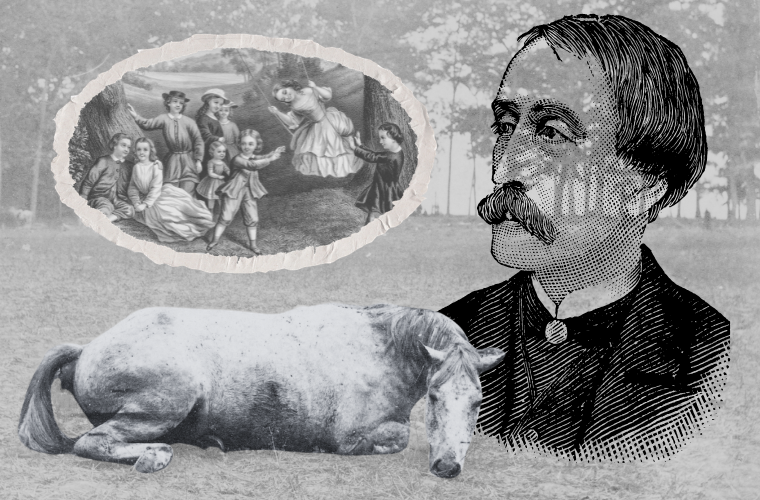
Images from Canva and The Met (horse and children)
New Biography Sheds Little Light on Early Child/Animal Abuse History
The prevailing narrative underlying The Link between child abuse and animal cruelty is that Henry Bergh – a wealthy scion of a New York shipbuilding family stationed as an American diplomat in Russia during the Civil War – saw a man beat a horse. During his return from St. Petersburg he visited the Royal Society for the Prevention of Cruelty to Animals in London, decided we needed a counterpart in the U.S., and formed the ASPCA in 1866.
Eight years later, the story goes, the case of an abused girl, “Little Mary Ellen” Wilson, captured his interest, and Bergh rescued her. She became the first ward of the state, Bergh went on to form the Society for the Prevention of Cruelty to Children, and many humane organizations began protecting children as well as animals.
The reality, however, is more complex (See following section), and while the most recent biography of Bergh sheds little light on his work in child protection, it presents an illuminating look into the personality of a man described as a mover, a shaker, and most importantly an actor – a showman whose need for celebrity status and media attention was matched only by his contemporary P.T. Barnum.
In The Second Greatest Show on Earth, historian Darcy Ingram repeatedly describes Bergh as a frustrated writer, poet and playwright whose patrician upbringing and life of leisurely gentility conflicted with a need to find a more meaningful purpose of contributing to the greater good. He found that purpose only late in life by transforming the St. Petersburg incident into his ascendancy at the ASPCA during an era of unprecedented social movements.
Ingram describes in depth how Bergh’s staged, shrewd and calculated performances of direct action harnessed the power of the news media to his maximum advantage – “theatrically-infused tactics” that generated constant publicity through “spectacle, novelty, drama, and controversy”. These captured the imagination of audiences in New York and beyond.
Ingram portrays Bergh not as a left-leaning political radical or even someone with a special dedication to the cause but rather as an authoritarian who saw animal protection as a way to maintain the social order and fulfill the artistic, intellectual and theatrical ambitions that had long eluded him – “a means of self-actualization and thus a vehicle for an identity he had long cultivated but failed to find a stage.”
While references to children are notably limited, Ingram makes several references to The Link, describing an ethos of the age that cruelty or an absence of mercy toward animals was a sure path to cruelty directed at fellow humans.
However, Ingram makes only four fleeting references to Bergh’s work vis-à-vis child protection and his posthumous reputation as a founder of the child welfare movement – a reputation sometimes built on fictionalized accounts. Given the book’s second focus – the evolution of the modern animal welfare and rights movements – this omission is perhaps not surprising.
But it leaves many questions unanswered. “Two centuries after his birth, Bergh continues to await his biographer,” Ingram concludes, even after citing dozens of biographies and hundreds of contemporary references. So perhaps one of those biographies awaiting publication will shed more light on the intersection of child and animal welfare in Bergh’s world. What is clear is that his founding of the SPCC was an individual act and not part of the ASPCA – although later organizations did take up the dual Link-based causes. Was his intervention another outcome of his unfulfilled need for performance?
-- Ingram, D. (2025). The Second Greatest Show on Earth: Henry Bergh, The Protection of Animals, and the Evolution of the Modern Social Movement. McGill-Queen’s University Press.
What Is the Real Story Behind “Little Mary Ellen”?
The definitive account was written by Bernard Unti. According to Unti, child abuse and neglect only began to attract public notice in the post-Civil War years, but law enforcement and charitable responses were minimal. Within a year of the ASPCA’s founding in 1866, New York news media began calling for a similar establishment to protect children. Bergh declined to intervene on the grounds that child maltreatment was outside the ASPCA’s domain – and was criticized accordingly.
In June 1871, Bergh and ASPCA attorney Elbridge T. Gerry interceded in the case of Emily Thompson, an exploited and abused child. The girl’s guardian was found guilty of assault, Bergh and Gerry secured a writ of habeus corpus and the child was removed to her grandmother’s home in New Jersey. Their legal ploy remains unknown, but news media praised Bergh as a “determined and fearless man” who proved parental brutality of a child is no more acceptable than cruelty to a horse.
In 1874, missionary Etta Wheeler related to Bergh the case of Mary Ellen who was beaten and imprisoned in her home. When the Children’s Aid Society declined to intervene, Bergh sent an ASPCA inspector, posing as a census worker, into the home to confirm the sensational details which captured public attention.
Bergh, acting as a private citizen, petitioned the court for Mary Ellen’s removal. Gerry secured a writ of habeus corpus which permitted ASPCA officers to take her into custody. In court, she related how Mary Connolly, to whom she had been indentured, had whipped her and cut her with scissors.
Mary Connolly denied the accusations, but she was indicted, arrested, convicted of felonious assault, and sentenced to one year in prison. Mary Ellen was eventually placed in Wheeler’s care.
The intervention “had fateful consequences for the course of the humane movement, “Unti wrote, as it demonstrated how abused children were “falling through the cracks” of a patchwork system of child welfare.
Gerry, Bergh and Quaker Merchant John D. Wright incorporated the New York Society for the Prevention of Cruelty to Children. Wright and then Gerry served as Presidents while Bergh served on the Board of Managers until his death in 1888. A nationwide proliferation of child protection agencies followed, courts became increasingly instrumental in determining appropriate child-rearing standards, and many cities organized dual-purpose humane societies addressing relief and prevention of suffering of children and animals – a larger, Link-based movement.
-- Unti, Bernard, "The Quality of Mercy: Organized Animal Protection in the United States 1866-1930" (2002). Animal Abuse, Animal Welfare, and Animal Protection. Paper 40. http://animalstudiesrepository.org/acwp_awap/40
Posted on All-Creatures.org: March 25, 2026
Return to Animal Rights/Vegan Activist Strategies
Follow us on:


- Home Page
- What's New
- Contact Us
- Action Alerts
- Animal Exploitation
- Animal Issues
- Animal Rights Activism
- Archives
- Art & Photography
- Articles Directory
- Bible
- Bible Commentary Blog
- Books
- Campaigns
- Church & Religion
- Discussions
- Events / Podcasts / Media
- Health
- Hosted Web Sites
- Humor
- Kids' Korner
- Letters
- Links
- Nature Studies
- Newsletter
- Poetry & Stories
- Prayers
- Quotations
- Recipes with Photos
- Recipes Without Photos
- Sermons
- Stop Cruelty in Churches
- Video Library
- The Mary T. and Frank L. Hoffman Family Foundation
- Email: [email protected]
A web site sponsored by The Mary T. and Frank L. Hoffman Family Foundation and all-creatures.org
Copyright © 1998-2026 The Mary T. and Frank L. Hoffman Family Foundation. All rights reserved. May be copied only for personal use or by not-for-profit organizations to promote compassionate and responsible living. All copied and reprinted material must contain proper credits and web site link www.all-creatures.org.
Fair Use Notice: This document, and others on our web site, may contain copyrighted material whose use has not been specifically authorized by the copyright owners. We believe that this not-for-profit, educational use on the Web constitutes a fair use of the copyrighted material (as provided for in section 107 of the US Copyright Law). If you wish to use this copyrighted material for purposes of your own that go beyond fair use, you must obtain permission from the copyright owner.
Thank you for visiting all-creatures.org.
